Here is a question that separates intermediate players from advanced ones. Your opponent could have a flush draw or a set on the turn. Which one is more likely? Most players shrug and say it feels about even. The advanced player, however, does some quick mental arithmetic and answers with confidence, because they understand poker combinations.
Combinations, or combos for short, are the hidden math that tells you how many ways your opponent can hold a specific hand. They sound intimidating, like something reserved for math majors and solver wizards, but they are genuinely simple once they click. And once they do, you stop guessing at ranges and start counting them.
This guide breaks down poker combinations from the ground up. We will cover what combos are, how to count them quickly, and most importantly, how to use them to read hands with a precision that feels almost like cheating. By the end, you will look at the board differently, because you will see not just what your opponent might have, but exactly how likely each possibility is.
What Are Poker Combinations?
Let us define the concept cleanly before we start counting anything.
A poker combination is a single specific way to hold a particular hand using two exact cards. Take pocket aces as an example. You might think of it as just “aces,” one hand, but mathematically there are six different ways to be dealt them. You could have the ace of spades and hearts, spades and diamonds, spades and clubs, hearts and diamonds, hearts and clubs, or diamonds and clubs. Each of those pairings counts as one combo, and together they make six combos of aces.
This matters enormously, because when you read your opponent’s range, you are not really asking “could they have aces?” You are asking “out of all the hands they could hold right now, how many of those hands are aces?” The answer is a count of combinations, and that count tells you the actual probability of each holding rather than a vague feeling.
Consequently, combinations transform range reading from an art into something closer to a science. Instead of saying “they probably have a strong hand,” you start saying “they have twelve combos of value hands and only four combos of bluffs, so I am getting the right price to call.” That precision is where serious edges come from.
The Basic Math of Combos
Thankfully, the math behind poker combinations boils down to just a handful of numbers you can memorize in an afternoon. So let me give you the core counts, and then we will put them to work.
A pocket pair has six combinations. Always. Whether it is aces, kings, or deuces, there are exactly six ways to make any pair from the four cards of that rank. An unpaired hand like ace-king has sixteen combinations when you count every suit pairing. However, if you specify suited only, like ace-king suited, that drops to just four combos, one for each suit. The offsuit version, ace-king offsuit, accounts for the remaining twelve.
These three numbers, six for pairs, sixteen for unpaired hands, four for suited and twelve for offsuit, cover almost everything you need at the table. Furthermore, they change as cards appear on the board, which is where the real magic happens.
Suppose you are wondering how many combos of aces your opponent can hold, but one ace is sitting right there on the flop. Now they cannot have all six combos, because three of those combos required the ace you can see. The presence of that one ace on the board cuts their aces from six combos down to three. This is the concept of card removal, and it is the engine that drives advanced hand reading.
How Blockers Change Everything
Since card removal is so powerful, it deserves its own discussion, because it leads directly to one of the most important concepts in modern poker, the blocker.
A blocker is a card in your own hand that reduces the number of combos your opponent can hold. When you hold a card your opponent needs for a strong hand, you literally block them from having as many of those hands. Therefore, your bluffs become more credible and your bluff-catches become more profitable, all because of simple combinatorics.
Imagine a board with three hearts on it, and you are deciding whether to bluff. If you hold the ace of hearts in your hand, you block the single most likely nut flush your opponent could have. They simply cannot hold the ace-high flush, because you are holding the key card. That makes your bluff far more likely to succeed, because the strongest hand in their range just got removed from the equation. Skilled players choose their bluffs specifically based on which blockers they hold, and this kind of thinking shows up constantly when you study how to bluff in poker at a higher level.
Conversely, blockers help you find the perfect bluff-catchers too. When you hold a card that blocks your opponent’s value hands but not their bluffs, calling becomes more attractive. The whole framework rewards players who think in combos rather than in vague hand categories, and once you start seeing the game this way, you cannot unsee it.
Counting Combos at the Table
Now for the practical part, because theory means nothing if you cannot apply it in the three seconds you actually have. Fortunately, counting combos in real time is easier than it sounds once you build the habit.
Let me walk you through a real example. Your opponent raises the turn on a board of K-9-4-2 with no flush possible. You suspect they either have a set or they are bluffing with a busted draw. So you count. For sets, they could have pocket kings, nines, fours, or twos. But wait, you need to account for the board. Each of those pairs would need two of the remaining cards, and since one of each rank sits on the board already, each set only has three combos instead of six. Four possible sets times three combos each gives you twelve combos of value.
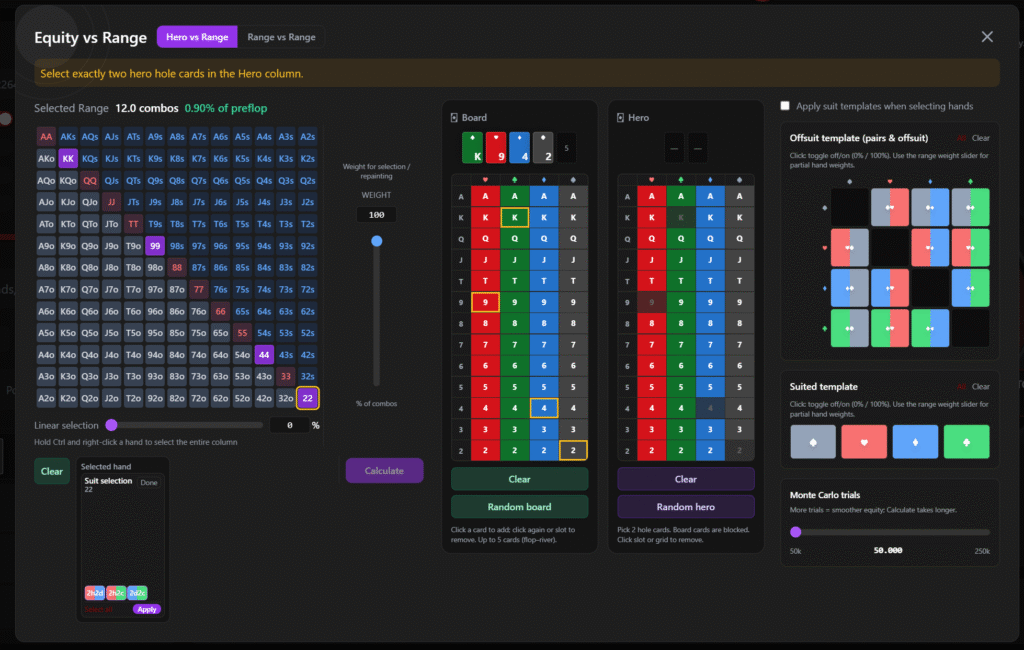
Then you count the bluffs. Maybe they were semi-bluffing a straight draw that just bricked, and you figure there are around eight combos of those busted draws in their range. Now compare. Twelve value combos versus eight bluff combos. That ratio tells you they are weighted toward value here, so unless you are getting an excellent price, folding your bluff-catcher looks correct. You did not guess. You counted, and the count gave you an answer.
This process feels slow the first few times, but it becomes second nature with practice. Eventually you stop doing the full arithmetic and start sensing the ratios instinctively, the same way an experienced driver no longer thinks about every gear shift. The combos are still there in your decision, just running quietly in the background.
Why Combos Beat Gut Feeling
Let me be direct about why this skill matters so much. Because plenty of players win for a while on instinct alone, only to hit a ceiling they cannot break through. That ceiling is almost always the gap between feeling and counting.
Gut feeling fails you in exactly the spots that matter most, the close decisions for big pots. When the pot is small, a slightly wrong read costs you little. But when stacks go in on the river, the difference between a profitable call and a losing one often comes down to a handful of combinations. Players who count combos make the right call in those moments far more often than players who trust their stomach, and over a career, those moments add up to the entire difference between winning and losing.
Moreover, combinatorial thinking connects to nearly every other advanced concept in poker. It feeds your understanding of pot odds in poker, because knowing the ratio of value to bluffs tells you exactly what price you need. It sharpens your hand reading and review, because counting combos after a session reveals whether your in-game reads held up. The skill does not exist in isolation. It quietly upgrades everything else you know.
Building Combo Skills Through Hand Review
Although you can read about combinations all day, the skill only sticks when you practice it on real hands. So here is how to actually build it into your game rather than just nodding along to the theory.
Whenever you finish a session, pick a few hands where you faced a tough decision and reconstruct your opponent’s range by counting combos. Ask yourself how many value combos they could have held versus how many bluffs, and then check whether your in-the-moment decision matched what the combo count suggests. Often you will discover that a call you agonized over was actually trivial once you count, or that a hero call you felt great about was mathematically a disaster.
This kind of deliberate practice is where combinatorial intuition gets forged, and a visual replayer like Check Replay makes it far easier. You replay the hand, freeze the decision point, and count the combos with the full board context right in front of you instead of trying to remember how the runout looked. Do this for a few hundred hands and the counting stops feeling like work. It becomes simply how you see poker.
Final Thoughts
Poker combinations turn range reading from a guessing game into a counting game, and that shift changes everything. Once you know that a pocket pair has six combos, that card removal shrinks those numbers, and that blockers tilt the math in your favor, you start seeing the board the way strong players do. You stop asking what your opponent might have and start counting how likely each possibility truly is.
So spend some time with the core numbers until they feel automatic. Six for pairs, sixteen for unpaired hands, four suited and twelve offsuit. Then take those numbers to your hand reviews and practice counting real spots until the arithmetic fades into instinct. Because the players who count combos do not just play poker. They read it, and reading the game is where the biggest edges have always lived.
Frequently Asked Questions
What are poker combinations?
Poker combinations, or combos, are the specific ways a player can hold a particular hand using two exact cards. For example, pocket aces has six possible combinations, while a suited hand like ace-king suited has only four. Counting combos lets you measure how likely each hand in your opponent’s range actually is.
How many combos does a pocket pair have?
A pocket pair always has six combinations before any cards appear on the board. However, if a card of that rank shows up on the board, the count drops. For instance, if one king is on the flop, your opponent can only hold three combos of pocket kings instead of six.
How many combinations does an unpaired hand have?
An unpaired hand like ace-king has sixteen combinations in total. Of those, four are suited and twelve are offsuit. So if you put your opponent on ace-king suited specifically, you are looking at just four combos, which makes it a much rarer holding than people assume.
What is a blocker in poker?
A blocker is a card in your own hand that reduces the number of strong combos your opponent can hold. If you hold the ace of a flush suit, you block them from having the nut flush. Skilled players use blockers to choose better bluffs and more profitable bluff-catches.
Do I need to count combos perfectly to use them?
No, and most players never count with total precision in real time. The goal is to develop a feel for the ratios, especially the balance between value combos and bluff combos. Even rough counting beats pure guessing, and your accuracy improves naturally the more you practice during hand reviews.