If you play poker with any kind of regularity, you’ve probably heard someone talk about ROI, sometimes in a serious conversation.
Sometimes almost as a joke, and sometimes in a way that sounds more confusing than helpful, at first most players do not pay much attention, they just want to know if they won or lost that day.
The issue is that poker does not really reward this kind of short-term thinking, you can play badly and still win, you can play well and still lose.
And that is exactly why poker ROI exists, it helps you step back and look at what is happening over a longer period of time.
+1000 players have transformed their studies and earnings with Check Replay
What does ROI mean in poker?
ROI stands for return on investment, in poker it is simply a way to compare how much money you put into the game with how much you get back.
When people ask what is ROI in poker, they are usually asking something very basic, is this player actually winning over time, not in one session, not in one lucky tournament, but across many games played under similar conditions.
The poker ROI meaning only really starts to make sense when you stop focusing on individual results, one tournament does not prove anything, a few bad sessions do not either.
ROI only becomes useful when repetition enters the picture and patterns slowly begin to appear.
Why ROI matters for poker players?
Poker can be very misleading, you can feel confident after a big win even if you made several mistakes, and you can feel terrible after a losing streak even if you played solid poker the whole time.
This is where poker ROI helps, it does not care about emotions or short-term swings, it forces you to look at results over time and ask better questions. Am I actually making money in the long run, are my decisions improving, am I choosing games that fit my skill level.
The ROI does not eliminate variance and it will not protect you from downswings, but it does reduce overreaction, which is something most players struggle with at some point.
How to calculate ROI in poker?
Learning how to calculate poker ROI is easy, dealing with the number is usually the harder part.
The basic idea is simple, you take your total profit, divide it by your total buy-ins, and multiply by 100.
For example, if you spent $2,000 on tournament entries and cashed for $2,400, your profit is $400, divide $400 by $2,000 and your ROI is 20 percent.
The important detail here is volume, calculating ROI after a small number of games does not say much, the number will move a lot, one deep run can completely change it, ROI only starts to settle after a large sample, and that usually takes longer than players expect.
ROI in cash games vs tournaments?
You will hear far more about tournament poker ROI than cash game ROI, and that is not by accident.
Tournaments make ROI easier to track, buy-ins are fixed, payouts are clear, and results can be compared over time, which is why ROI became the standard metric for tournament players.
Cash games work differently, instead of ROI most cash players look at win rate, usually measured in big blinds per 100 hands. You can still think about ROI in cash games if you want, but it is not the most common or useful approach there.
Because of this, most discussions about good ROI in poker end up focusing on tournaments.
What is considered a good ROI in poker?
This is where many players get frustrated, because there is no single answer.
In large-field tournaments with tough competition, even very strong players might show an ROI between 10 and 20 percent over a big sample, that does not mean they are underperforming, it usually means the games are competitive and variance is doing its job.
At lower stakes or in smaller fields, higher ROIs are more common, especially early on, as players move up in stakes ROI usually drops, which is normal and does not mean the player suddenly got worse.
A good ROI only makes sense when you look at stakes, volume, and field strength together.
Common mistakes when thinking about ROI
One common mistake is treating ROI like a score, a bad month makes players panic, a good month makes them overconfident, and both reactions can lead to poor decisions.
Another mistake is comparing ROIs without context, two players can have the same ROI while playing completely different games, with different buy-ins, schedules, and levels of competition, numbers alone do not tell the full story.
ROI should be used as a guide, not as a judgment.
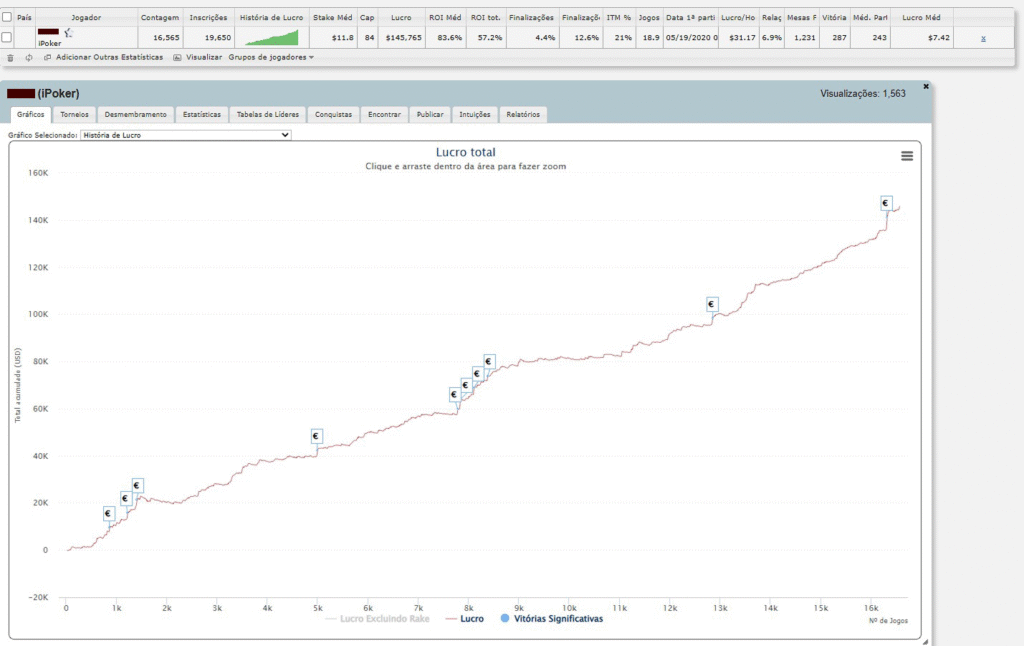
When analyzing poker ROI, it is essential to adjust expectations based on stakes and variance. In micro and low stakes tournaments, it is still common to see very high ROI figures, sometimes reaching 80 percent over a large sample size. At these levels, an ROI above 30 percent is already considered excellent.
As players move up in stakes, especially into high stakes, this level of ROI becomes extremely rare due to stronger competition and smaller edges. A player showing an 80 percent ROI in low or mid stakes is almost certainly a winning player with the technical ability to beat higher limits. However, the same average profit behaves differently across stakes.
Earning eight dollars per tournament may represent an 80 percent ROI at micro stakes, but only an 8 percent ROI at an average buy-in of $100. While an 8 percent ROI is still strong, it comes with significantly higher variance and deeper downswings. In general, the higher the poker ROI, the lower the relative impact of variance, which is why players with high ROI tend to show smoother long-term profit graphs, while lower ROI players, especially at higher stakes, experience greater volatility.
Conclusion
Poker ROI is not about showing off or proving anything to other players, it is about staying realistic.
Understanding what ROI means in poker, how to calculate it, and how to read it properly helps players focus on long-term improvement instead of short-term results, it encourages patience, better decision-making, and more realistic expectations.
Poker will always have ups and downs, ROI does not remove that, but it helps you keep your feet on the ground, and for most players, that mindset makes a real difference.
Also read: