What is ROI in online poker? This simple guide explains what Return on Investment is, how to learn it in poker, and what a good ROI looks like for tournament players.
If you play online poker tournaments, you need a way to measure if you are truly winning money over time.
That measure is the Return on Investment (ROI). Simply put, ROI tells you how much profit you are making for every dollar you spend on tournament buy-ins.
To learn ROI in poker is the first step to playing poker like a business and moving up the stakes successfully.
Check Replay is used to review hands, spots, and analyze positions and plays. It’s a fundamental part of poker study alongside metrics of earning and profits. You must understand concepts like ROI and ICM to take full control of your game.
What is ROI and How Do You Calculate It?
ROI is a percentage that shows your total profit compared to your total investment. It’s the best way for tournament players (MTTs and Sit & Go’s) to track their success.
The formula is easy to understand:

A Simple Example
Imagine you play 100 tournaments at a $10 buy-in each.
- Total Buy-ins (Investment): $10 \times 100 = $1,000$
- Total Money Won (Winnings): You cash for a total of $1,250
- Net Profit: $1,250 – $1,000 = $250
This means that for every dollar you spend on a tournament, you are getting $1.25 back, which is a 25-cent profit.
If you want to learn ROI in online poker and improve, you must track this number.
What is a Good ROI in Online Poker?
What counts as a “good” ROI depends entirely on the stakes you play. The higher the stakes, the tougher the players, and the lower the expected ROI
Here are the general benchmarks for winning players:
| Stake Level (Average Buy-in) | Good ROI Range | What it Means? |
| Micro-Stakes (< $20) | 25% – 40%+ | You have a big skill advantage over the field. |
| Mid-Stakes ($50 – $200) | 15% – 25% | You are a very strong, consistent winner. |
| High-Stakes ($500+) | 5% – 10% | You are one of the best players in the world. |
If your ROI is 0% to 5%, you are breaking even or making a very small profit. If it’s negative, you are losing money and need to focus on improving your game.
You must imagine a player playing AVG $100 with a 5% ROI. Know that he would make more money playing at AVG $40 with a 25% ROI.
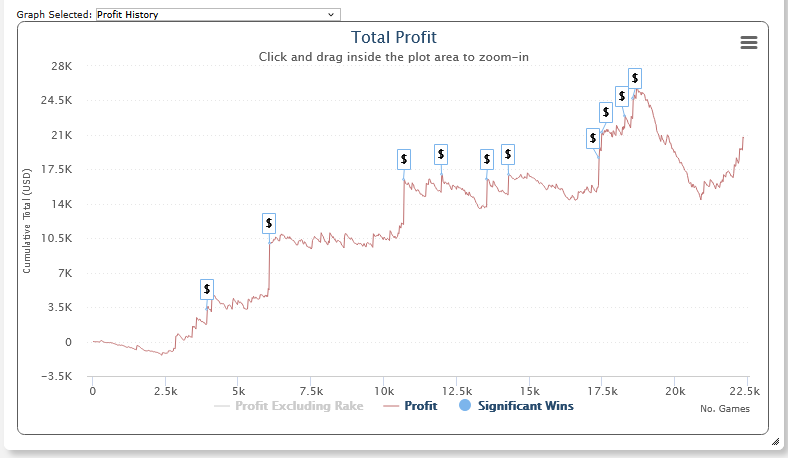
Having a low ROI will result in higher swings. Having a high ROI will make sure of profit without considerable swings.
However, you must always seek playing higher stakes.
You must play higher and higher stakes in order to evolve your game and always seek a bigger challenge.
Maximizing Your Profit: Learn ROI vs. Hourly Rate
For professional players, the Hourly Rate ($/hr) is often more important than the ROI percentage.
You can increase your hourly rate by playing more games faster. For example, playing “Turbo” tournaments might give you a lower ROI (because there’s less time to outplay opponents), but if you can play twice as many games in an hour, your total profit per hour goes up.
Conclusion: ROI as a Basic Metric to Learn in Poker.
The Return on Investment (ROI) is unequivocally the most critical metric for any player serious about Multi-Table Tournaments (MTTs) and Sit & Go’s (SNGs) in online poker.
It moves the conversation beyond simple wins and losses, providing a clear, percentage-based measure of a player’s long-term profitability and skill edge against the field
Ultimately, the ROI serves as a strategic compass. It informs game selection. A higher ROI is achievable in softer, lower-stakes fields, and guides the crucial trade-off between efficiency and volume.
While a player may accept a slightly lower ROI in faster-structured games, the resulting increase in volume can lead to a higher Hourly Rate ($/hr), which is the ultimate goal for any professional.
When using Check Replay, make sure to pair your knowledge of earning metrics with your statistic based position learning. The mastery of both can only lead to a highly profitable player that stomps variance and crushes on a regular basis.