
There is a moment that sticks with almost every tournament poker player. After days of review, you replay a hand, maybe with your friends or a coach, and realize the result is clear: the all-in you made was profitable in chips, but it left you staring at the payout sheet with regret. That realization hits hard. I felt it the first time I made the money in a big field, but missed out on a huge ladder because I went broke on an all-in that, by chip expectation, was “correct.”
It’s at that point you see poker is not just about making “good chip decisions.” The way tournament chips translate to cash is anything but straightforward. If you want to be a long-term winner, especially when playing on the bubble or at a final table, you need to understand the difference between chip EV (expected value in chips) and tournament EV (expected value in prize money).
What is chip EV? The language of cash games and early tournament play
Let me start with chip EV. This is the kind of math that makes simple sense at first. Say you get all-in preflop with pocket kings against ace-queen. If you have 70% equity and your all-in puts 1,000 chips at risk to win 1,500 more, you simply multiply: 70% of 2,500 chips is 1,750 chips, so your expected gain is 750 chips. Chip EV is like cash game thinking, gain chips, win money.
Chip EV is very useful in spots where chips have a direct value, with no outside pressure. For example:
- Cash games, where every chip equals money
- Early stages of tournaments, before payout pressure
- Situations with no bubble or pay jump risk
Most chip EV calculations treat every chip as equally valuable, no matter when or how you win it. That’s a good starting point, but as tournaments move forward, something strange happens: chips change value.
Understanding tournament EV: When chips don’t add up like cash
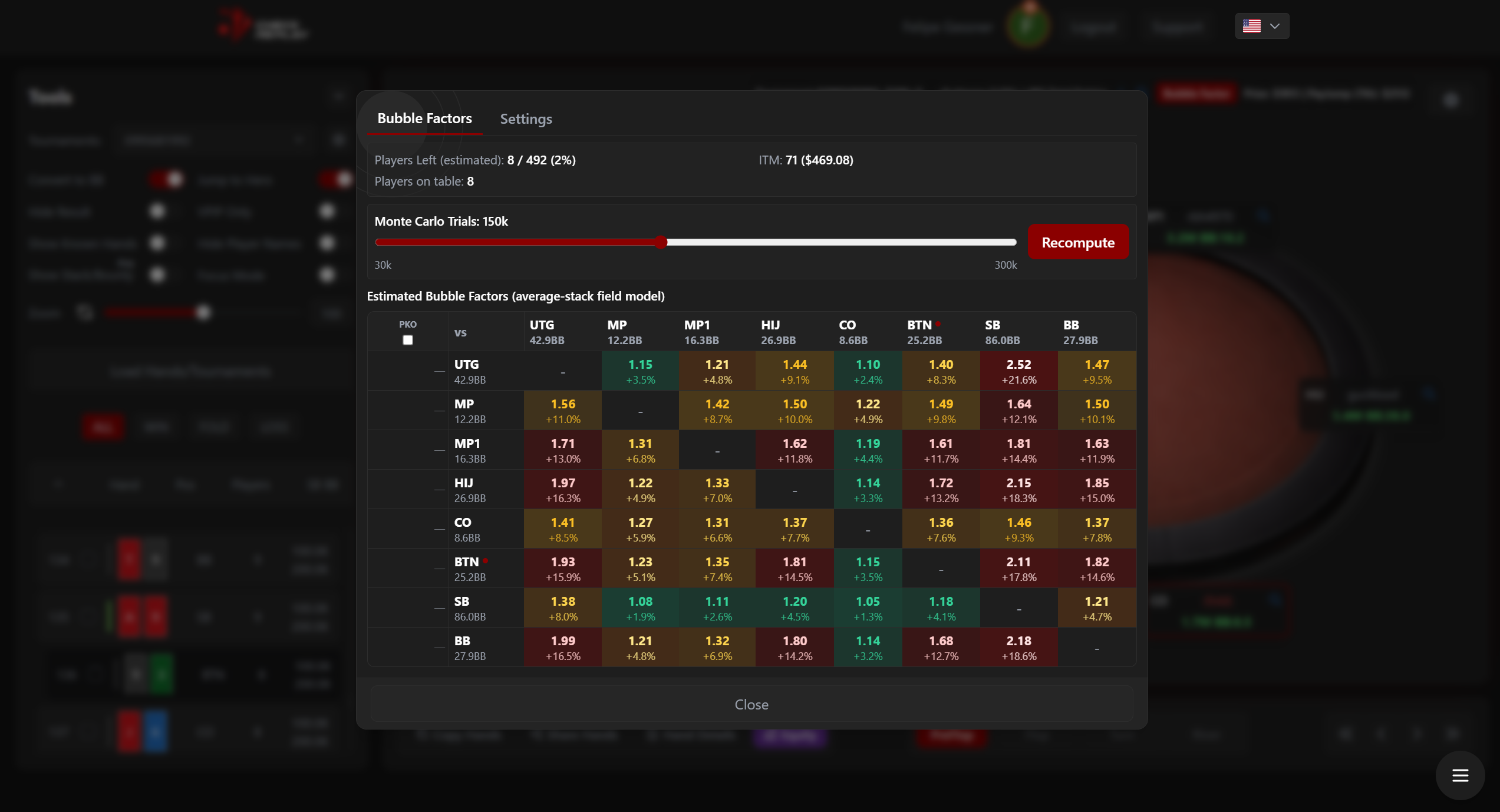
When you move into the bubble or reach a final table, those same chips no longer move 1-to-1 with your payout. This is where tournament EV, or $EV, becomes a must for making the right decisions. Tournament EV asks a different question:
How much does this play change my chance of winning real cash prizes?
Tournament EV is a measure of how much your actions increase your expected payout, not just your chip stack. Suddenly, losing that last chip isn’t just about being out of the hand, it’s about dropping to zero in the payout chart. Adding another chip when you already have the chip lead is nowhere near as valuable as doubling up when you are the short stack on the bubble.
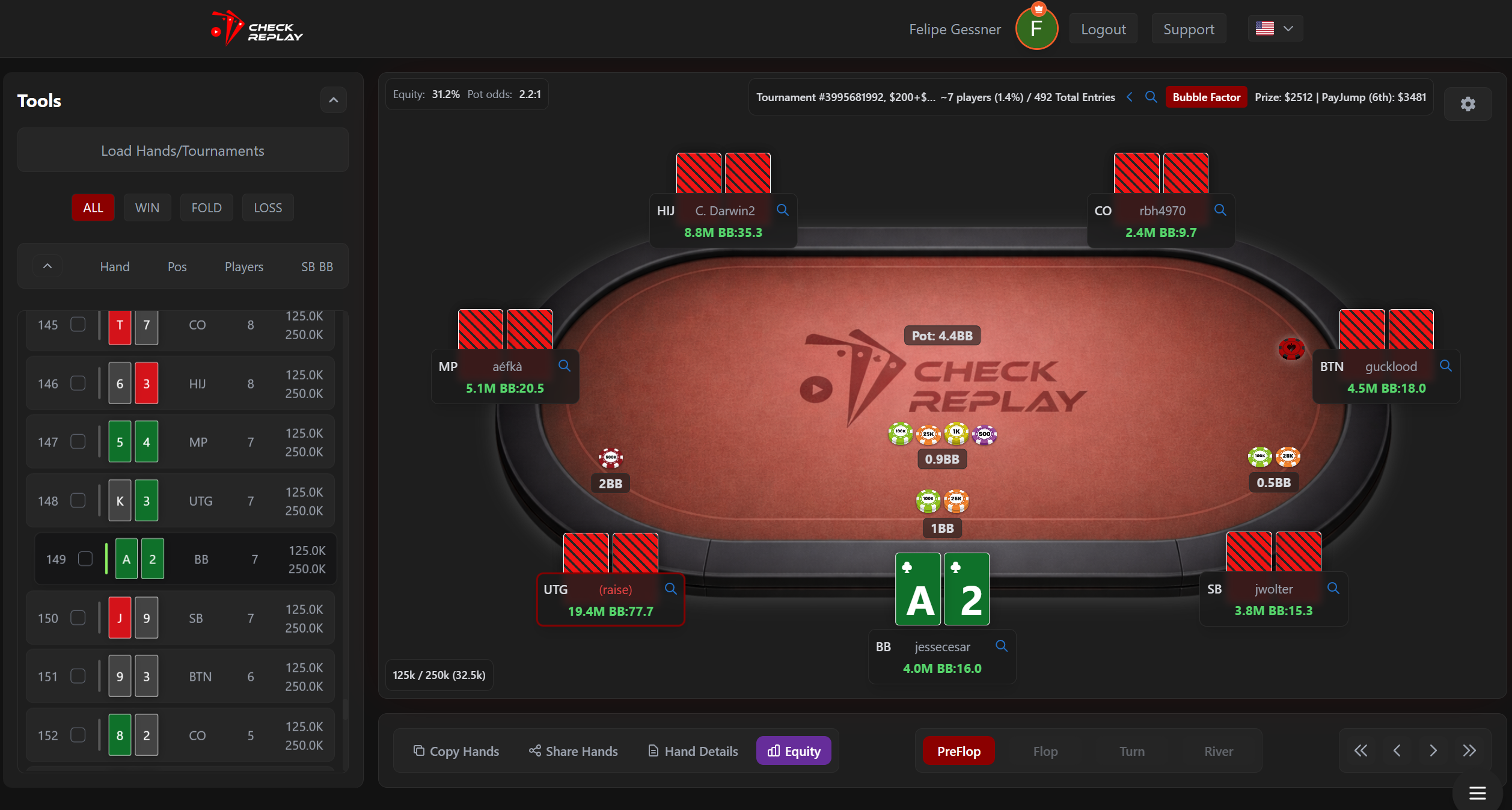
This is where tools like Check Replay shine, letting me upload hands and replay real tournament moments from the bubble or the final table, so I can see not just the chip result but how it impacts my bottom line.
The moment it clicks: Why a chip-ev all-in might be a tournament mistake
Here’s an example I’ve seen countless times, both in my play and working with students. You are at the final table, 7 players left. You are fourth in chips, and someone open-shoves. You have pocket nines. By chip EV thinking, if you’re ahead of their range, you snap-call. But when I run this spot through a replayer with ICM (Independent Chip Model) considerations, as we do on Check Replay, I see this:
- Calling can win me a lot of chips, yes.
- Losing means I bust out 7th, with little chance to ladder.
- Folding lets someone else risk their stack, while my chance to move up the pay jumps is alive.
Even if the call is plus-chip EV, it could be a big negative in tournament $EV, because “laddering up” brings in far more expected value than the chips I might gain.
Why tournament chips are not cash: The nonlinear truth
Most people assume each tournament chip has the same “cash value.” The truth is, tournament chips are not distributed linearly. The next chip you win is not worth the same amount in dollars as your last chip. Especially as you near the bubble or the top prizes, the value of survival, and having more chips left to play, skyrockets.
Here’s a way I think of it:
In tournaments, the last chip you lose is always the most expensive.
The nonlinear relationship can play out like this:
- Losing half your stack early in a tournament barely dents your real $$ expectation. Blinding out on the bubble? That costs max dollars.
- Eliminating a short stack gets you more chips, but rarely increases your real payout as much as you hope, unless you’re knocking them out on the bubble.
- Calling all-ins with a modest edge becomes a mistake if a bust drops you from a jump in the payout structure.

Final table and bubble: Where chip EV and tournament EV split
I’ve watched talented players throw away thousands chasing chip EV wins at the worst possible time: the tournament bubble, or nearing the biggest prizes. That’s when the real challenge begins. Do you take a marginal edge, or do you hold out for a better chance to climb a payout ladder?
Here’s what I pay attention to:
- Stack sizes: Being short forces action, big stacks threaten everyone, but medium stacks often must tread carefully due to ICM pressure.
- Payout jumps: A jump from 10th to 9th may be tiny, but from 3rd to 2nd is often huge.
- Player tendencies: Risk-takers on your left? Sitting tight may bring more payout than chasing a slim edge.
These spots are where Check Replay helps me (and plenty of other players) study actual outcomes, spot the chip EV vs tournament EV gap, and share those tough hands with coaches or friends for a second opinion. Reviewing real-world final table hands, especially those close bubble spots, makes the effect of tournament EV much clearer.
How you can study chip EV and tournament EV
One thing I recommend is to use hand replayers that allow you to upload and review tournament hands with payout structures included. Look for ways to analyze not only chip gains but also your change in likely prize money. Check Replay, for example, offers instant upload and custom payout integration, making these reviews much simpler.
For a foundational explanation that can take you step by step through chip EV math, I suggest this clear overview on chip EV explained. Want to practice more advanced tournament EV strategy? Take a look at the detailed breakdown in tournament EV strategies.
Conclusion: Take the next step with your tournament decisions
I believe that recognizing the difference between chip EV and tournament EV is a big turning point for anyone serious about tournament success. If you want to make final tables, not just min-cash, this is the difference. Study and review your key spots, especially on the bubble or with huge pay jumps, with real hand histories and payout structures. Next time, you won’t wonder if “the math” was right; you’ll know if it served your bankroll. Want to get started? Try Check Replay for free, upload your own tournament hands, and experience the clarity that comes from seeing both sides of the story.
Frequently asked questions
What is chip EV in poker?
Chip EV (chip expected value) in poker is the average amount of tournament chips you expect to win or lose by making a certain play. It calculates the expected gain in chips, treating every chip equally, and is mostly used in cash games or early-stage tournaments when payout pressure isn’t a factor.
What is tournament EV in poker?
Tournament EV, or $EV, is the expected value of your actions measured in terms of the tournament’s prize money, considering payout jumps and survival. This uses the current chip stacks, remaining field, and the payout structure to show how much your stack is worth in real dollars.
How does chip EV differ from tournament EV?
Chip EV treats every chip won or lost as equally valuable, but tournament EV recognizes that chips have a nonlinear cash value, especially near the bubble and final table. A plus-chip EV play can sometimes lower your tournament EV if it risks a big payout jump or survival.
When should I use chip EV vs tournament EV?
Use chip EV for cash game or early tournament strategy, where each chip’s value remains constant relative to your buy-in. Use tournament EV (including ICM) once you near the bubble or any situation with big payout jumps. There, your main goal is maximizing your expected payout, not just your stack.
Why is tournament EV important for success?
Understanding tournament EV is the difference between cashing often and making the final tables and big scores that define tournament poker success. It allows you to avoid risky chip EV calls that hurt your bottom line when real money is at stake, especially during the bubble and at final tables.