I have seen many serious players fall into the same trap. They study a solver output, memorize a few frequencies, feel smarter for a week, and then sit in a real game where one small thing changes. The stack is 75 big blinds instead of 100. The flop size is odd. The turn card shifts the nut advantage. Suddenly, the memorized answer no longer fits.
That is why good poker heuristics beat raw solver memorization.
I do not say this to dismiss theory. Quite the opposite. In my experience, the best form of Poker GTO study is not trying to store endless outputs in memory. It is trying to understand the logic that created those outputs. Theory is the target. Heuristics are the bridge that lets a human being get close to it under pressure.
A solver can calculate every spot from scratch. I cannot. You cannot. No one can at the table. Human decision-making needs compression. It needs patterns, rules of thumb, and mental shortcuts that are grounded in sound poker strategy, not guesswork.
GTO is the map. Heuristics are how humans travel.
Why memorization breaks so fast
When I first studied high-level theory, I thought the hard part was finding the right answers. Later, I realized the harder part was keeping those answers useful in live play or fast online decisions.
A solver gives a clean answer to a specific problem:
- Exact positions
- Exact ranges
- Exact stack depth
- Exact bet sizes
- Exact board
Change one variable and the solution can shift a lot. Change three and your memorized line may become almost worthless.
Humans do not win by recalling millions of exact outputs. They win by building mental models that survive change.
This matters because poker is rarely neat. People use strange sizes. Recreational players defend too wide. Strong regulars adapt. Some pools under-bluff rivers. Others over-attack capped ranges. If your whole game is based on memory, your edge disappears as soon as the script changes.
That is why I think bad players often memorize charts, while great players ask why those charts exist. The chart is a surface layer. The reason behind it is the real lesson.
What a heuristic really is
A heuristic is not a lazy shortcut. It is a simplified principle that captures a deeper truth.
In poker, a good heuristic might sound like this:
- When I have range advantage on a dry board, I can often c-bet small at high frequency.
- When my opponent’s range is capped and mine is not, bigger bets and overbets become more attractive.
- Hands with key blockers make better bluffs because they reduce the chance villain holds strong bluff-catchers or value hands.
- Thin value bets work best when weaker calls are plentiful and stronger hands are limited.
None of these lines is a full solution. But each one is a compressed piece of theory. That is the point.
Heuristics are approximations of theory, not escapes from theory.
I like to think of them as answers to repeated solver lessons. When a solver makes a play that feels odd, I do not want to stop at “it mixes here.” I want to know what pressure the action creates, what part of the range benefits, and what structural feature of the spot made the play appear.
Why solver study still matters
Some players hear this argument and take it too far. They decide that intuition is enough and that studying game theory is optional. I strongly disagree.
Without theory, heuristics become myths. They sound smart but break under stress.
Good heuristics come from repeated contact with sound Poker GTO work. They are shaped by reviewing hand histories, testing assumptions, and seeing how principles repeat across spots. This is where post-session review becomes powerful. When I revisit hands carefully, I am not just checking whether one river call was right. I am refining the model I will carry into future spots.
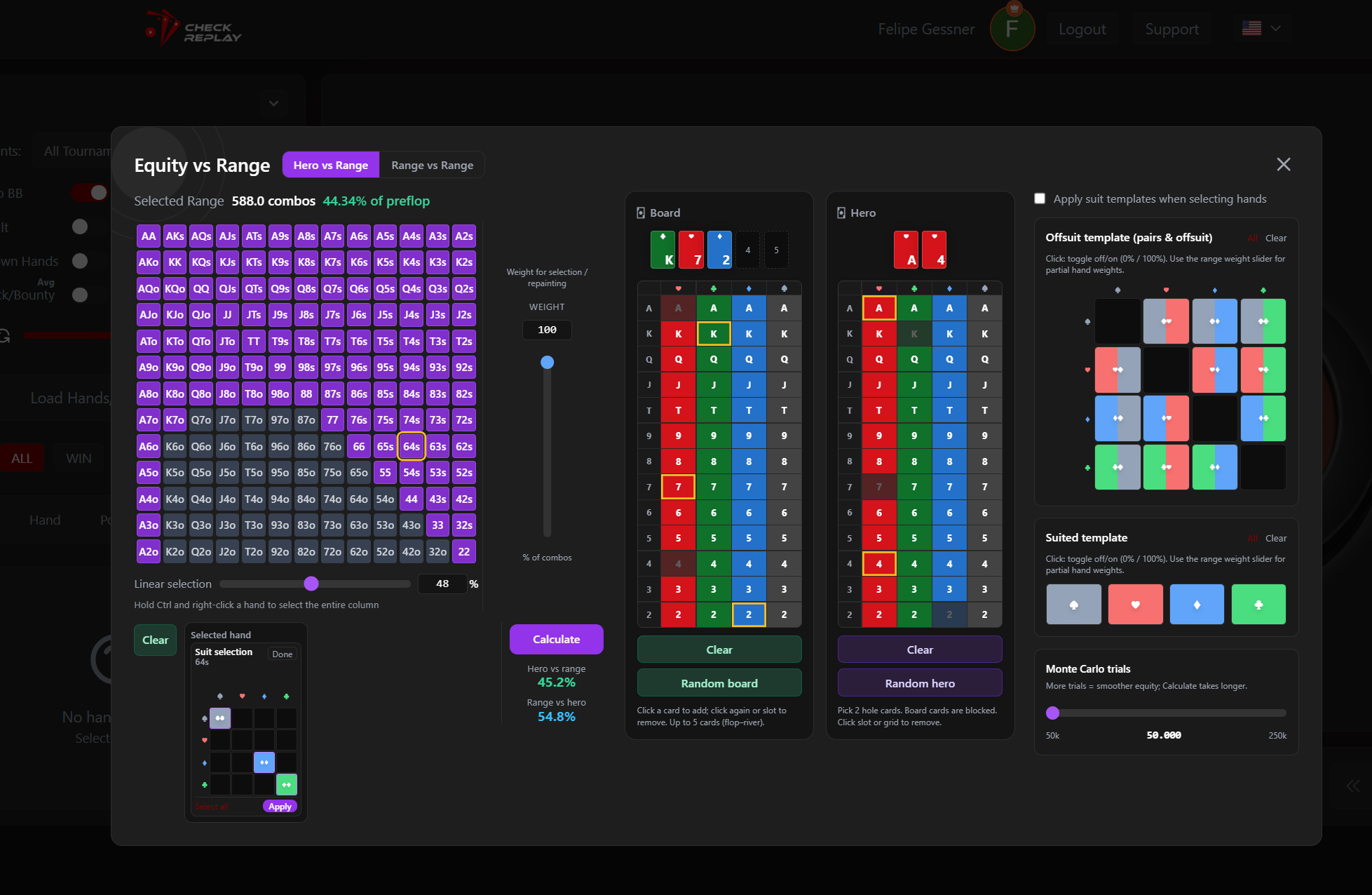
That is one reason I like tools built for clear hand review. With Check Replay, for example, I can revisit a hand, inspect the line, share it with someone else, and focus on the decision logic instead of just replaying action. Over time, that process builds better instincts because the review is tied to understanding.
How strong players compress theory
In my experience, advanced players do something subtle. They do not try to memorize everything. They sort spots into families.
For instance, they may not memorize every button versus big blind flop at every stack depth. Instead, they build a framework around recurring truths:
- Who has range advantage here?
- Who has nut advantage here?
- Whose range is capped?
- Which hands improve on future cards?
- Which blockers matter most for betting or bluff-catching?
Once those questions become habit, decisions get cleaner. A player no longer needs an exact stored answer for every node. He can reason.
The strongest poker players do not memorize more solutions. They build better mental models.
This is also why understanding uncapped and capped ranges changes everything. If I know my opponent cannot have the top of range after a passive line, I do not need a chart to tell me that attacking with larger bets may work well. If I know my own range retains many nuts while his does not, I have a theory-based reason to apply pressure.
A practical example on the flop
Let me show the difference between memorization and understanding.
Imagine a player studies a single solution in a raised pot. He sees that in position c-bets one-third pot very often on K-7-2 rainbow. He memorizes that line.
Then a real hand comes up. Same broad shape, but stacks are different, preflop ranges are a bit wider, and the board is K-8-2 with a flush draw. He still fires one-third pot automatically because that is what he memorized.
The second player thinks differently. He asks:
- Do I still have range advantage?
- Has the draw changed who holds more strong continues?
- Do deeper stacks make future street play more valuable?
- Would checking some medium hands protect my range better?
Maybe he still bets small. Maybe he does not. But his choice comes from logic that transfers to nearby spots.
A memorized action works in one spot. A good heuristic works across many related spots.
This is where many players stall. They know what the solver did, but not what the solver saw.
When “unnatural” solver plays teach the most
Some of the best lessons come from lines that feel strange at first. A tiny river block. A turn overbet with a hand that looks too thin. A check with a hand that seems “too good” to check.
When I see these spots, I try to resist the urge to label them fancy or random. Usually there is a very clear reason underneath.
That reason often becomes a useful heuristic, such as:
- Overbetting appears when one player owns a strong nut advantage and can polarize hard.
- Thin value betting becomes better when the opponent is forced to arrive with many bluff-catchers.
- Checking strong hands can protect a checking range that would otherwise be too weak.
- Blockers shape bluff selection because not all missed hands are equal.
These are not isolated tricks. They are repeated expressions of theory.
If you want a deeper companion read on this line of thinking, I think this discussion on poker heuristics fits well with the way strong players turn study into action.
Why unusual sizings expose weak understanding
One of the fastest ways to tell whether someone only memorized outputs is to watch how he reacts to weird sizes.
A player who learned one clean tree often looks lost when facing:
- A turn bet size that was not in his study tree
- A river jam at a stack-to-pot ratio he never reviewed
- A limp pot or multiway branch
- A line with delayed aggression on a changing runout
He starts guessing. Or worse, he forces the closest memorized answer onto a different problem.
The player with better heuristics stays calmer. He identifies incentives. He sees which side is capped, which side blocks value, who can credibly represent the nuts, and whether a thin value bet is likely to get called by enough worse hands.
I have watched this happen many times in hand reviews. The player with the stronger framework may not know the exact equilibrium output. Yet he lands much closer to it than the player who memorized one branch and then froze.
Understanding survives noise.
Building heuristics through review
I think this is the part players underrate most. Heuristics are not built in one study session. They are built through repeated review.
Every time I review a hand well, I add a little structure to my thinking. Maybe I notice that a board I treated as neutral was actually much better for my range. Maybe I see that my river bluff used the wrong blocker. Maybe I learn that my check on the turn gave up pressure against a capped range that could not defend enough.
That learning compounds.
Each reviewed hand slightly upgrades the mental model you bring into the next session.
This is why I think the quality of review matters as much as volume. Fast review with no questions changes very little. Thoughtful review creates transfer. A good process often looks like this:
- Mark the hand during or after play.
- Rebuild the ranges honestly.
- Ask what each player is trying to protect or attack.
- Look for structural ideas, not just final actions.
- Write down one heuristic you can carry forward.
That final step matters. If my review ends with “solver bets 67 percent here,” I have not learned much. If it ends with “when villain caps himself on the turn and I retain nut hands, larger river sizing gains value and fold equity,” that lesson is portable.
For players who want to sharpen that kind of post-session work, I think using a study setup like Check Replay helps because it keeps the hand accessible and easy to revisit, discuss, and frame around decisions. The hand is not just stored. It becomes teachable.
From concepts to usable rules
Many advanced terms sound abstract until they become practical. I try to turn each one into a question I can ask at the table.
- Range advantage becomes: who connects better with this board overall?
- Nut advantage becomes: who owns more of the very strongest hands?
- Capped range becomes: what premium hands has this line removed?
- Uncapped range becomes: can I still credibly hold the nuts?
- Blockers become: which hands do I want my opponent to have less often?
- Thin value becomes: what worse hands can really call me?
These are the kinds of questions that keep theory alive in real time.
If your study has mostly been about outputs and frequencies, I suggest spending more time with the reasoning layer. I also think this piece on solver strategies pairs well with that shift from copying solutions to understanding them.
The mental side of simpler rules
There is also a psychological benefit here. Under pressure, the brain works better with clear principles than with overloaded recall. In long sessions, fatigue makes this even more obvious.
I have felt this myself. Early in a grind, I may remember a studied spot with good detail. Four hours later, after many close decisions, I need something more durable. A simple rule based on sound poker strategy holds up better than half-remembered frequencies.
Simple rules built from theory are easier to trust when the game gets fast and messy.
This does not make poker easy. It just makes strong decision-making more stable. And stability matters a lot over large samples.
 Conclusion
I believe the modern player needs both theory and compression. Poker GTO gives us the benchmark. But no human plays great poker by becoming a storage device for solver trees. Strong players study those trees, question them, and then turn the answers into usable heuristics.
The goal is not to memorize more. The goal is to think better.
When stack sizes shift, when bet sizes get strange, when board textures change, and when opponents leave the script, mental models beat memory. That is why I keep coming back to the same question in study: why did the solver choose this action? The more honestly I answer that, the better my decisions become in spots I never studied directly.
If you want to build that kind of understanding over time, start by reviewing your hands with more care and more structure. Check Replay can help you do exactly that, so you can study decisions, refine your heuristics, and keep turning theory into better poker.
Frequently asked questions
What is Poker GTO strategy?
Poker GTO strategy is a theory-based approach that aims to make your play hard to exploit. It uses balanced ranges, proper bet sizing, and mixed actions so opponents cannot gain much by adjusting against you. In practice, most players do not copy exact equilibrium outputs in real time. They study them to understand the logic behind strong decisions.
How can poker heuristics improve my play?
Poker heuristics improve play by giving you simple, reliable rules built from theory. They help you make better choices when the exact spot is unfamiliar, such as when stack depth, sizing, or runout changes. Good heuristics let you apply ideas like range advantage, blocker effects, and pressure against capped ranges without needing perfect recall.
A player who understands theory can adapt.
A player who only memorized outputs becomes lost as soon as the script changes.
Is memorizing solver outputs effective in poker?
Memorizing solver outputs can help in narrow, repeated spots, but by itself it is limited. Real games change too often for memory alone to carry your whole strategy. A better approach is to study solver outputs and ask why they work. That lets you form heuristics that transfer across many situations.
What are the best poker strategies for beginners?
For beginners, the best poker strategies are simple and disciplined. Start with solid preflop ranges, value bet strong hands, avoid calling too much with weak bluff-catchers, and pay attention to position. As your game grows, begin studying theory-based ideas like board texture, range interaction, and basic bluff selection so your strategy develops on a strong base.
How do I balance theory and intuition in poker?
I think the best balance comes from building intuition out of theory. Study strong strategic ideas away from the table, review hands after sessions, and turn repeated lessons into clear heuristics. Then, during play, trust those mental models instead of trying to recall exact frequencies. That way your intuition becomes trained judgment, not random instinct.