I used to think the time bank was just a safety net. A buffer. A way to avoid timing out when too many tables were running or when a spot looked messy. Over time, I changed my mind. The stronger the players I studied, the more I saw that the time bank was not just a convenience. It was part of their strategy, part of their decision process, and part of their poker mental game.
The best players are not the fastest thinkers. They are the players who know when speed is good and when speed is dangerous.
That difference matters more than many players admit. In poker, a lot of decisions should be fast. If I open from the cutoff, the big blind calls, and the flop gives me a standard small c-bet on a dry board, I usually do not need a long tank. But some spots are not standard. Some hands ask for a second gear. That is where the time bank stops being passive and starts becoming a weapon.
When I review hands, especially with tools like Check Replay, I often notice the same pattern. The mistake is not always bad theory. Sometimes the mistake happened one step earlier. I failed to notice that the hand needed deeper thought. I stayed on autopilot when I should have slowed down.
Fast thinking and slow thinking at the table
One of the clearest ways I can explain this is through two types of thinking. One is fast, intuitive, and pattern-based. The other is slower, effortful, and more deliberate. Both matter in poker.
Strong players rely on intuition because they have seen thousands of similar patterns before.
That fast mode is not random guessing. It comes from experience. A good player has built mental schemas over years of play and study. Board textures, stack depths, population habits, common bet sizes, turn barreling spots, river node tendencies. These patterns become familiar. So when a standard spot appears, the response feels quick and natural.
I think this is where many people misunderstand poker instinct. Instinct is often trained memory. It is compressed experience. It is not magic.
Still, fast thinking has a weakness. It likes normal spots. It likes clean patterns. It can fail in unusual situations, especially when emotions enter the hand.
Autopilot is cheap until it becomes expensive.
The biggest errors I see are not from players who know nothing. They come from capable players who misclassify a hard spot as an easy one. They treat an uncommon line as routine. They see a weird river overbet and respond with a default bluff-catch rule. They face a bubble reshove and react as if it were a cash game. They feel pressure, but they do not slow down enough to think through it.
The time bank is the bridge between automatic pattern recognition and careful thought.
When great players slow down
I have watched many skilled players act very quickly for most of a session, then suddenly pause when the hand demands it. That pause is not weakness. It is discipline.
There are some spots where I believe using the time bank is often wise:
- ICM decisions late in tournaments
- Bubble situations with medium stacks
- Facing very large river bets
- River bluff-catching spots with bluff blockers or thin bluff-catchers
- Unusual bet sizes that break normal patterns
- Unexpected lines from opponents, such as delayed raises or rare donk sizes
- Big preflop all-in decisions for tournament life
- Any spot that feels emotionally charged after a bad beat or big loss
Those moments deserve more than instinct. They ask for structure. I try to stop and run a simple internal check:
- What range gets here this way?
- What hands value bet this size?
- What bluffs make sense?
- What blockers matter?
- What tournament pressure changes this decision?
If I skip that process in a big pot, I am often trusting a feeling that may not fit the hand.
Why unusual spots cost so much
Standard mistakes can hurt, but unusual mistakes hurt more because the pots are often larger and the edges are thinner. A simple preflop open size error may cost a little. A bad hero call in a giant river pot can erase a lot of good work.
The expensive mistake is often not the wrong answer. It is failing to realize the question was hard.
I remember a hand from a tournament review where a strong regular faced a large river jam on a paired board after the opponent used an odd flop size and a checking line that made little sense. The call looked close. But the player called almost instantly, as if the hand were obvious. In review, the line was rare enough that the hand deserved a full range breakdown. The player did not lose because he lacked skill. He lost because he stayed in fast mode.
This is one reason I like reviewing difficult spots in Check Replay after a session. The replay format makes it easy to revisit timing, stack sizes, action order, and river logic without friction. I can ask a better question than “Was my call right?” I can ask, “Did this hand deserve more time than I gave it?”
ICM and bubble pressure change everything
Tournament players know this, but many still move too fast when payout pressure rises. In cash games, chip EV is the whole story. In tournaments, that is not enough. A call that looks profitable in chips can still be poor when stack survival and payout jumps matter.
ICM spots are exactly where many players must force themselves to slow down.
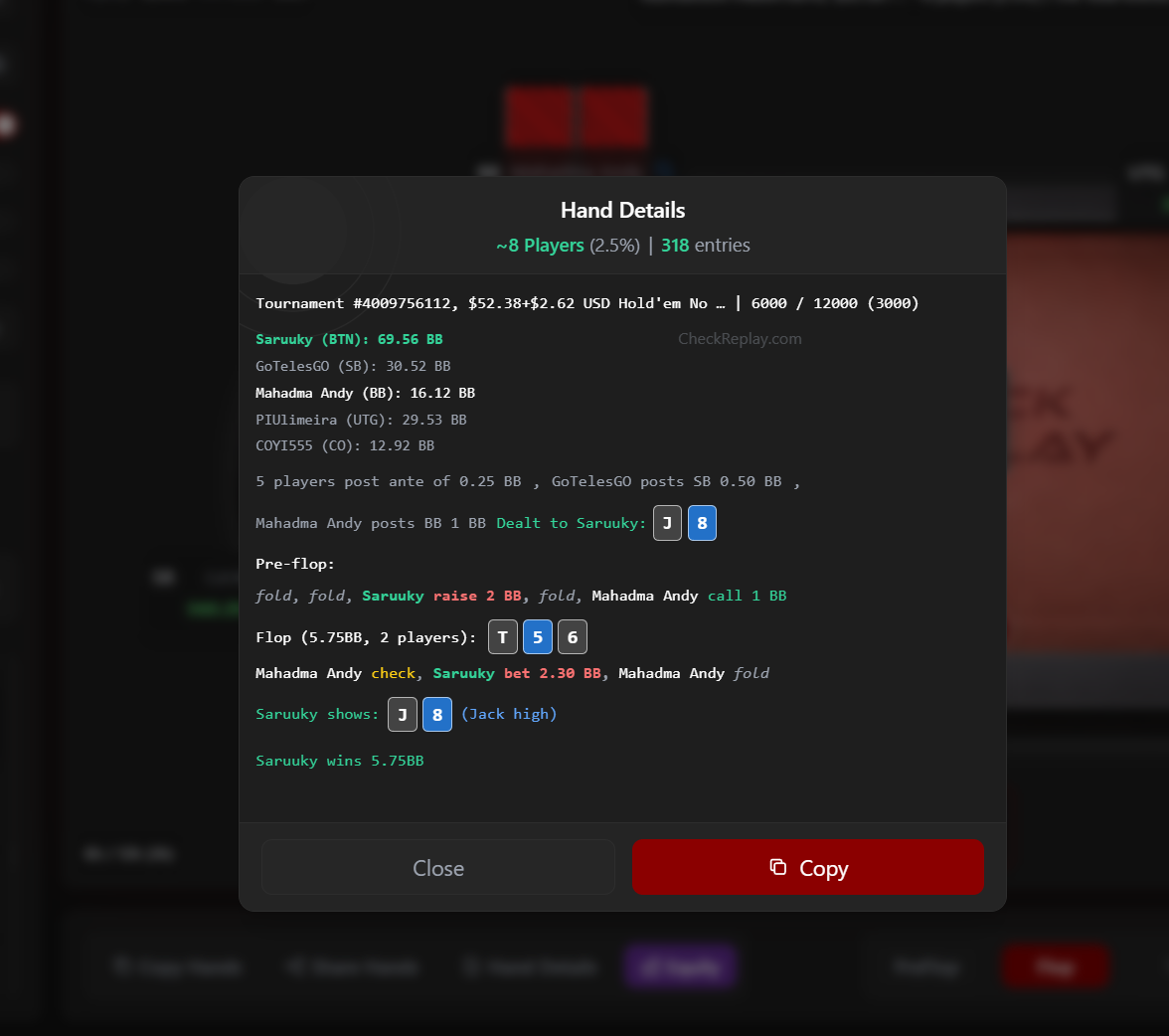
On a final table bubble, for example, a reshove with Ace-Queen suited may look standard if I only think in terms of raw hand strength. But if shorter stacks are near busting and my stack has room to wait, that same hand can shift from clear continue to clear pass. The danger is that preflop all-in spots often trigger habit. I see a good hand, I know common charts, and I want to act. That is where the time bank earns its place.
The same is true on soft bubbles. Some players tighten too much. Others refuse to adjust at all. Neither mistake is rare. The players I trust most are the ones who pause and ask what the tournament situation is doing to both ranges.
If this part of your game feels rushed, I suggest pairing hand review with broader study on tournament decisions. I have found that reading material on time management in poker helps connect the mental side of the game with actual table decisions.
River decisions deserve more respect
Many players burn their time in medium spots and then act too quickly on rivers. I think that is backwards. River decisions often carry the cleanest EV swing because there are no future cards to recover mistakes.
Consider these examples:
- You face a 150 percent pot river shove after your opponent used small sizes on earlier streets.
- You block missed draws but unblock value on a four-liner board.
- Your opponent takes a line that population rarely bluffs.
- You hold a hand near the top of your bluff-catching range, but the sizing looks polar.
These are not spots for pride. They are not spots for speed. They are spots for care.
Large river bets should trigger a mental alarm that says: stop, classify, count, then decide.
In my own game, I try to use the first seconds to identify whether the hand is routine or strange. If it is strange, I shift into slower thought. That one habit has saved me many poor calls and many timid folds.
Your timing also speaks
There is another side of the time bank that many articles barely touch. Your timing gives information away. Online players often focus on bet sizing tells, line construction, and HUD data, but timing can be part of the same picture.
Every action has two outputs: the decision itself and the story your timing tells.
If I snap all-in in one class of hands and tank with another, observant opponents can start sorting my range. Not perfectly, of course. But even a small timing pattern can help them.
Common timing tells include:
- Snap all-in with draws or panic hands
- Snap call with medium-strength bluff-catchers
- Snap fold in capped, weak spots
- Long tank before bluffing because the player is building courage
- Long tank before value betting because the player wants to look weak
- Always snap c-betting range boards
- Always using maximum time before difficult folds
I have seen players become almost face-up through timing alone. Not because they were careless in theory, but because their speed changed too predictably with hand strength or emotional state.
Timing can turn a hidden range into a visible one.
This matters online more than many players think. Live poker has posture, chip handling, breathing, and conversation. Online strips much of that away. So timing stands out more.
How strong players protect their timing
Advanced players do not try to act like machines on every hand. That would be unrealistic and often harmful. But many of them do try to normalize timing in a broad way, especially in recurring spots.
This can look like:
- Taking a similar short pause before c-betting common boards
- Avoiding instant folds in spots where range information matters
- Not always tanking only when bluffing rivers
- Using a stable decision rhythm when multi-tabling
The goal is not to perform fake theater every hand. It is simply to avoid giving away free information. If my timing constantly splits my range into weak, medium, and strong buckets, I am helping my opponents for no reason.
Good timing habits do not hide everything. They just stop you from exposing too much.
That distinction matters. Poker is already hard enough without donating clues.
Emotions are a hidden trigger for bad timing
Some players think time bank mistakes come only from technical spots. I disagree. Emotional pressure changes timing too. After a cooler, players rush. After a bluff gets caught, they overthink simple spots. After a long downswing, they hesitate in normal value jams because fear enters the process.
In those moments, the clock is not just measuring time. It is exposing state of mind.
I have had sessions where I knew the next big pot was dangerous for me, not because of stack depth, but because I was irritated. My fast decisions became less reliable. My slow decisions became dramatic instead of clear. That is why I think any emotionally charged hand deserves more care than usual.
If a spot feels personal, it probably needs distance. A few extra seconds can restore structure.
For players who want to sharpen this part of the game, I think it helps to combine technical review with broader poker strategy tips that connect thought process, discipline, and decision quality.
How I decide when to spend time
I try to keep a simple rule in mind during play. If the hand is common, I trust trained pattern recognition. If the hand is rare, polar, high-pressure, or emotionally loaded, I slow down.
Here is the checklist I use when I feel that internal warning sign:
- Is this spot normal for the pool or unusual?
- Is the pot size large enough that a mistake hurts a lot?
- Does tournament pressure change normal chip EV?
- Am I reacting to logic or to emotion?
- Will my timing reveal something if I act instantly?
If two or more of those answers point to danger, I use my time bank.
This is not complicated. But it takes discipline. Poker speed can feel good. It can feel confident. Yet confidence and accuracy are not the same thing.
Reviewing timing mistakes after the session
Most players review hands by looking only at lines and outcomes. I think that leaves value on the table. I want to review timing too. Did I act too quickly in a river bluff-catch? Did I tank in a way that made my range obvious? Did I miss an ICM pause because I was tired?
When I replay hands in Check Replay, I can look at the whole sequence and revisit not only what I did, but how I arrived there. That is where real growth often starts. I can mark hands where my instinct was right, and hands where instinct should have been interrupted by deeper thought.
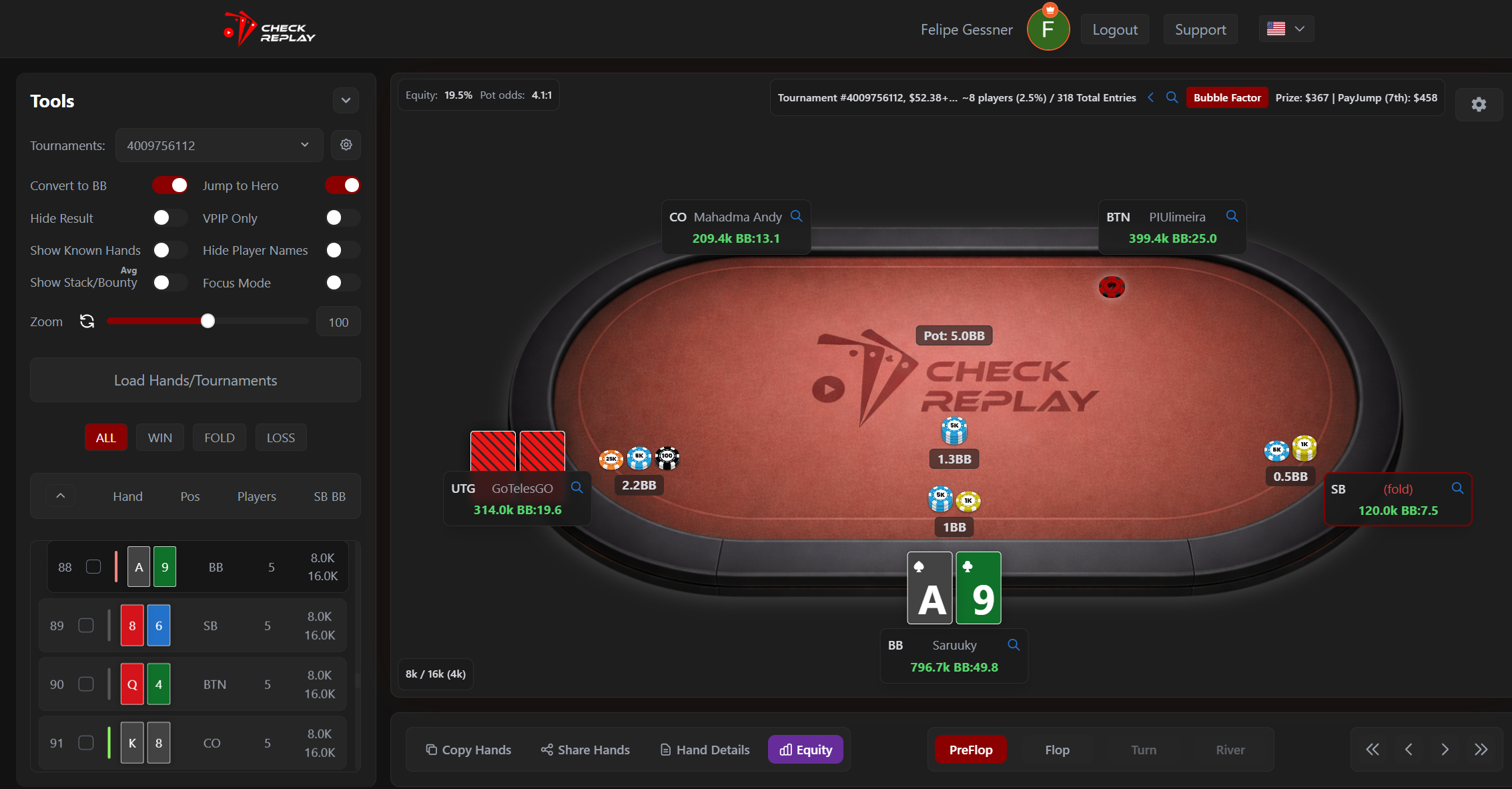
Review is where I learn whether my timing reflected clear thought or lazy habit.
Conclusion
The time bank is not just there to save me from timing out. It is there to help me choose the right mode of thought. Great players use fast judgment in familiar spots because they have earned that speed through repetition. But they also know when to stop, breathe, and think harder. That switch is part of high-level poker mental performance.
There is also a second layer that should not be ignored. My timing is visible. It can help opponents narrow my range, read my comfort level, and respond better against me. So every decision carries two values: the EV of the action itself, and the information my action speed gives away.
If I want to improve, I need to review not only whether I bet, called, or folded, but whether I gave the hand the kind of thinking it deserved. That is one reason I like studying difficult hands with Check Replay. It helps me revisit the hands where I should have slowed down, switched from instinct to deliberate thought, and made a cleaner choice. If you want to sharpen that part of your game, get to know Check Replay and use it to review the spots where your clock said more than your cards.
Frequently asked questions
What is a poker time bank?
A poker time bank is extra decision time that a player can use when the normal action clock is not enough. It exists so players can think more deeply in difficult spots instead of being forced into rushed decisions. In practice, strong players save it for hands with high pressure, strange lines, or large pots.
How does time bank affect poker focus?
Time bank helps poker focus by creating space between reaction and action. That pause can reduce impulsive choices, especially after emotional hands or in confusing spots. I think it works best when I use it with a clear process, such as checking ranges, sizing logic, blockers, and tournament pressure rather than just staring at the screen.
How do pros use time banks wisely?
Pros usually do not spend extra time on routine hands. They act quickly in standard spots, then slow down when a decision is rare, close, or high value. Wise time bank use means knowing which hands deserve deeper thought and which hands do not. They also pay attention to timing tells, so they avoid becoming too predictable.
Does using time bank improve mental game?
Yes, it often does. Time bank can improve the mental side of poker because it helps a player interrupt autopilot, regain calm, and move from emotion to structure. It will not fix tilt by itself, but it can create a small pause that leads to better judgment when stress is high.
Can time bank help with poker decisions?
Yes. It can help most in ICM spots, bubble pressure, large river bets, bluff-catching decisions, odd bet sizes, and big preflop all-ins. Time bank is most useful when the situation is unusual enough that instinct alone may not be reliable. Used well, it can improve both technical accuracy and the discipline behind each decision.