
If you have played poker tournaments for any amount of time, you already know how much the format can change the way you approach every hand. When I first discovered Mystery Bounty events, what struck me most was not just the excitement of random big prizes, but how radically it forced me to rethink every step of my tournament plan. In this article, I want to share how I shaped my thinking to maximize ROI in mystery bounty tournaments—and give you some practical, real-world examples of decisions that can change your bottom line.
Understanding the mystery bounty format
When I explain this format to friends, I like to compare it to a regular knockout where every elimination gives you a set prize, except in mystery bounty, the amount you win from each knockout is hidden until you claim it. The envelopes hold anything from a small sum to a massive payday. But what matters even more than the thrill? The way it disrupts traditional tournament thinking.
That is because, as soon as you are “in the money” and the bounty envelopes are live, the payout for busting an opponent can become much more significant than laddering up another spot.
This is not just a bountiful twist—it’s a shift in priorities.
I learned early that maximizing your tournament investment in this structure requires a new set of decision points compared to classic poker tournament play. You need to value bounties, survival, and stack growth differently at each stage.
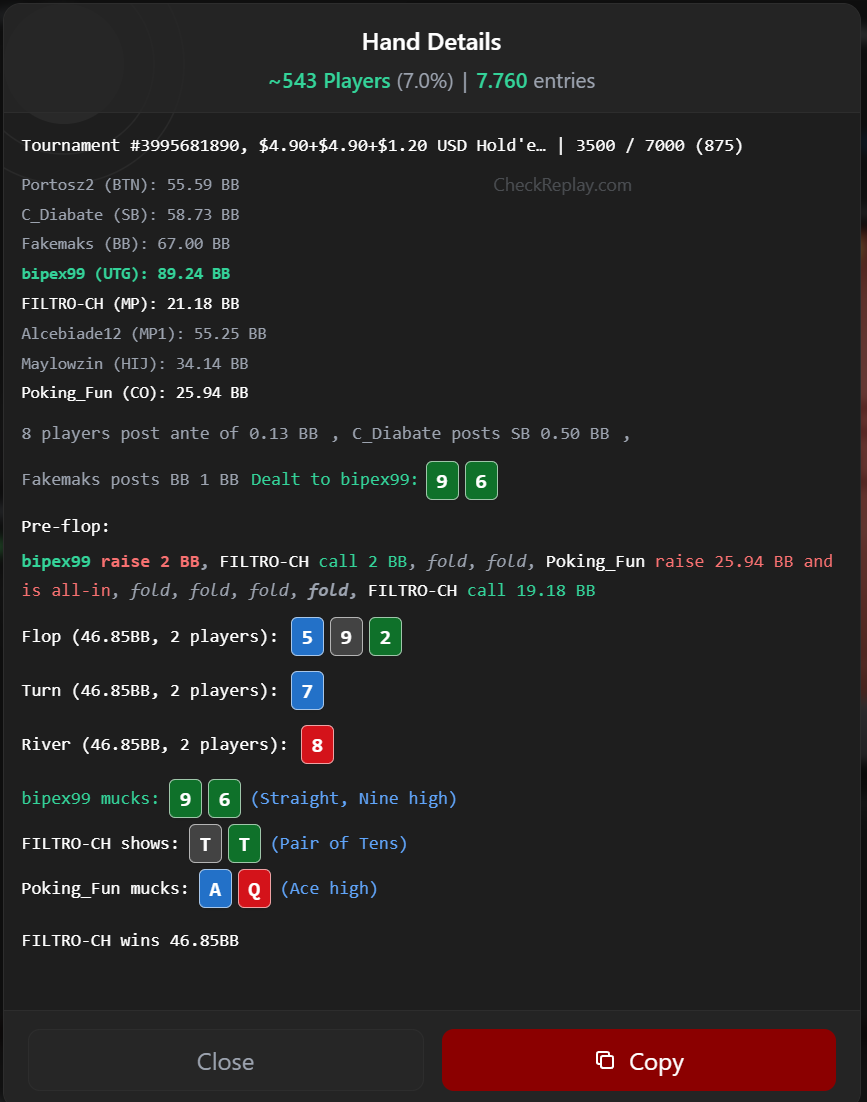
On Check Replay, you can see the percentage of the field left, making it a lot easier to identify when the mystery bounty phase is activated!
Early stage: Building for later
Before the bounties are even available, the event is much like a standard freezeout tournament. Your aim is to collect chips without risking tournament life unnecessarily. Many players get too excited and chase every knockout early, but there’s not even a payout for it yet.
Instead, early on, I try to:
- Play a balanced, conventional approach—prioritizing strong hands and solid chip accumulation
- Avoid big confrontations without serious value hands
- Spot weaker players and tag them mentally for later, when their bounty is up for grabs
This might not sound flashy, but it builds the foundation for everything that comes next. As I wrote about in improving tournament ROI, chip accumulation before money stages always boosts your leverage later.
The money bubble: Prepare for the shift
Everything changes when the bubble approaches. Here is where I try to anticipate when the bounties will come into play and adjust my thinking. If I have a medium or big stack, I focus on abusing shorter stacks who want to survive to the money. If I am short, I recognize that surviving a few more eliminations means not just cashing in the main prize pool, but unlocking those mystery prizes for myself.
When near the bubble, my checklist:
- Apply pressure to short stacks (if I am deep)
- Tighten up if I am one of the shortest stacks
- Monitor which opponents pose the greatest bounty profit once we are ITM
After the Bubble: When Bounties Go Live
Once the tournament reaches the money and the mystery bounty envelopes become active, the strategy changes dramatically.
In classic Mystery Bounty tournaments, the average bounty value is often around three times larger than the payout you lose if you are eliminated. This has a huge strategic implication: the amount of equity you need to justify calling an all-in drops significantly.
In other words, you should be much more willing to gamble.
When the reward for knocking out an opponent is substantially larger than the cost of busting, survival becomes less important than in a regular tournament. Capturing bounties is now a major part of your expected value.
A large portion of the prize pool is no longer tied to laddering up—it is tied to eliminating opponents.
Practical Adjustments I Make
Once the bounties are live, I adjust my strategy by:
- Calling all-ins much wider when I can win a bounty
- Re-shoving more aggressively over short stacks
- Isolating all-in players to maximize my chance of claiming the envelope
- Prioritizing knockout opportunities over small payout jumps
- Accepting higher variance when the bounty value justifies it
A Simple Example
Suppose:
- The next pay jump is $500
- The average mystery bounty is $1,500
- An opponent is all-in for 10 big blinds
In a standard tournament, calling with a marginal hand may be too risky because busting costs you future payout opportunities.
In a Mystery Bounty, however, the expected reward from winning the bounty can be worth several times more than the value of surviving one more place. This means hands that would normally be folds can become profitable calls.
The Key Insight
After the bubble bursts, you should actively hunt bounties.
Many players continue to play too cautiously, focusing only on laddering. The strongest players recognize that the real money is often in the bounty pool, and they are willing to take well-calculated risks to capture it.
If you are not significantly widening your calling and shoving ranges after the bounties go live, you are likely leaving a large amount of expected value on the table.