This question usually shows up quietly. Not when someone is winning, but after a few confusing sessions, or maybe after watching another player hit a big tournament score, you start wondering if you are even playing the right format.
At first glance, poker looks the same everywhere. Same deck, same hands, same table.
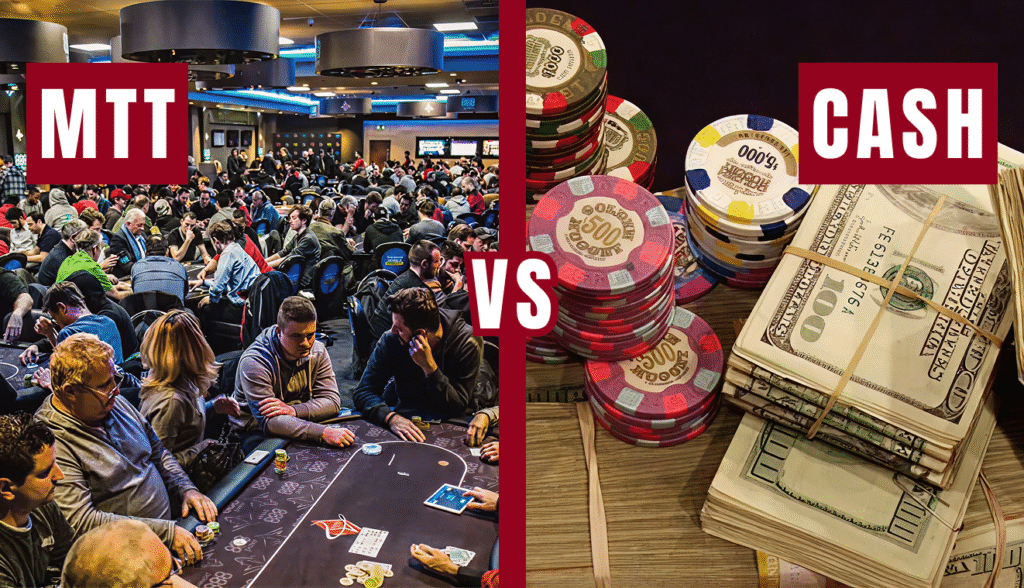
But once you spend real time in both environments, the difference between cash games vs tournaments feels much bigger than the rules suggest.
It’s less about cards and more about how the game moves, and how you react to that movement.
Read more:
What is a warm-up in poker, and why it can change your results
The 5 Biggest Mistakes That Hold Back Online Poker Players
How to Study Poker Online Efficiently?
Cash Game vs Tournament Poker
The clearest difference is what chips actually mean. In a cash game, they are real money the entire time.
You can sit down, play a few hands, stand up, and leave without any larger story attached to the session.
Tournaments change the feeling immediately, you pay once, get a fixed stack, and now the only direction is forward. There is no reset button. When the chips are gone, the run is over.
Blinds tell another part of the story. In cash games, nothing pushes you. In tournaments, the clock is always pushing, slowly at first, then faster than expected.
That pressure alone makes the formats feel unrelated, even though they share the same rules.
Competitive Poker and Player Skill Sets
Some players naturally drift toward one format without planning it.
Cash games attract people who like control, patience, and decisions that unfold slowly. You can think deeper, wait longer, and build results piece by piece.
Tournaments feel different from the inside, hours of nothing can suddenly turn into a single moment that decides everything. For some players, that swing is exciting. For others, it’s exhausting.
Variance shows up in opposite ways too, cash games move in small waves. Tournaments move in long silence followed by sharp spikes.
Neither path is easier. They simply test different parts of a player’s mindset.
How Does a Poker Tournament Work?
A tournament always begins with calm energy. Everyone has the same stack, the same chance, the same quiet optimism that this might be the day.
Then time starts changing things. Blinds rise. Decisions shorten. Tables break.
Players disappear without much ceremony.
Most people leave with nothing, or a few reach the money. Even fewer reach the end, where the real prizes sit.
That structure creates tension you don’t feel in cash games., you’re not just playing hands, you’re trying to stay alive long enough for the story to matter.
Cash Games Strategy Fundamentals
Cash-game thinking is steadier, because nothing forces action, patience becomes powerful. Folding isn’t frustrating, it’s normal.
Profit usually comes from repetition, small edges, applied carefully, again and again. Nothing dramatic, just consistent pressure in the right spots.
Bankroll swings feel smoother too. Losses still happen, of course. They just don’t end the entire session in one moment.
For many players, that emotional stability is the real advantage of cash games.
How to Play in Poker Tournaments
Tournament strategy feels more like timing than control. Early on, survival matters.
Later, survival without aggression becomes dangerous.
Stacks shrink, options narrow, and moments appear where hesitation costs more than risk.
Those moments define tournament runs more than any single hand.
Emotional discipline becomes essential here, because one rushed decision can erase hours of careful play. That kind of pressure doesn’t exist in the same way at a cash table.
And yet, that intensity is exactly what draws players toward tournaments in the first place.
Choosing Based on Lifestyle and Goals
Cash games usually fit better into flexible schedules, because you can play for twenty minutes or several hours and stop whenever you want, without losing progress.
That makes them easier to combine with work, study, or family time.
Tournaments ask for something different. You need long, uninterrupted sessions, and once you start, leaving early usually means giving up your entire buy-in. For players with limited free time, this alone can decide everything.
Personal goals matter too, if the focus is steady improvement and controlled risk, cash games often feel more comfortable.
If the motivation comes from big moments, deep runs, and competitive pressure, tournaments naturally become more appealing.
In the end, the right format is often the one that fits your real life, not just your poker ambition.
Cash Games or Tournaments?
In the end, the choice between cash games or tournaments isn’t theoretical. It becomes obvious through experience.
Some players feel comfortable in steady environments where progress is quiet and predictable, others feel alive only when something meaningful is at stake.
Both formats belong to competitive poker, both demand skill, patience, and emotional control.They just express those qualities in different ways.
Most players eventually discover where they fit. Not through analysis, but through the simple question of where they want to sit down again tomorrow.
And usually, that answer is clearer than any strategy chart.
Join our Discord community and stay up to date with everything about poker.