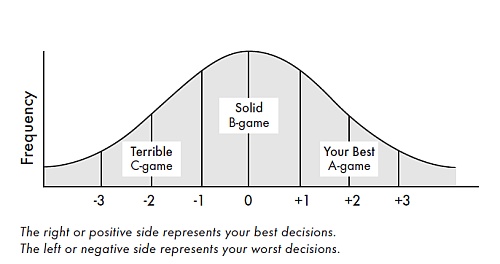
If you’re on Jared Tendler’s email list, you may have recently received an email about the C-game.
Anyone who works with me knows how much we focus on this topic and on the strategies we use to improve both our game and our overall performance.
I found Jared’s article very interesting, so I put together a summary and wanted to share some of the key ideas.
The Foundations of Your C-Game
Your C-game works almost like gravity: it is always pulling you down.
Preparation — sleep, nutrition, energy management — is important, but it is only the minimum requirement for escaping your C-game.
The deeper problem is that your C-game is strongly rooted in unconscious competence. It is your automatic game: the patterns and behaviors that tend to appear when you are no longer performing at your best.
This is why simply acquiring more technical knowledge is not enough to solve it.
The problem is often more mental and emotional than technical.
You may know what the correct decision is when you are playing your A-game or B-game. The challenge is being able to access and execute that knowledge when your performance begins to deteriorate.
Why Your C-Game Prevents You From Improving
Your goals are at risk if you do not identify the weaknesses that can sabotage your performance.
One of the common mistakes is relying only on willpower to improve.
Improving your C-game requires continuous effort. Think of it like going to the gym. You do not become stronger from one great workout. Progress comes from repetition.
The same principle applies here.
Improving your C-game is largely about repetition and consolidating what you already know and can execute in your A-game and B-game.
The goal is not simply to keep adding new knowledge.
It is to make your existing knowledge increasingly accessible when you are under pressure, tired, frustrated, emotional, or simply not performing at your highest level.
Monitoring and Understanding Your C-Game
The first step is learning to recognize it.
Record the moments when you are performing at your worst. Understanding your emotions and thought patterns in those moments can help you recognize them earlier in the future.
Writing about what is happening while you are experiencing it can also bring clarity and activate your problem-solving skills.
Start looking for patterns:
What triggers your C-game?
How does it manifest itself?
And look at it from different perspectives:
- Technically
- Mentally
- Emotionally
The more clearly you understand these patterns, the easier it becomes to recognize when your C-game is beginning to take control.
How to Improve Your C-Game
Pay attention to your emotions, especially when they begin to dominate your decision-making.
Set goals that account for the weaknesses of your C-game, rather than setting goals based only on the potential of your A-game.
This distinction is important.
It is easy to plan around the player you are when everything is going well. But your real performance also includes the version of you that appears when you are tired, frustrated, under pressure, or emotionally affected.
Old challenges can also return.
Being aware of previous weaknesses makes it easier to recognize them before they begin influencing your decisions again.
And be careful with subtle overconfidence.
Simply expecting this year to be better than the previous one without addressing the risks, weaknesses, and challenges that caused problems before is not a strategy.
Real improvement requires working on them.
Now That You Understand Your C-Game, Work on Improving It
Your C-game is not something you fix once and forget about.
It requires observation, repetition, awareness, and continuous work.
Technical study can make your A-game better. But long-term improvement also requires raising the level of the game you play when you are not at your best.
Understanding your C-game is the first step.
The next one is working on it.
If you are interested in contacting Renato, you can visit his website www.eliteperformance.gg,
or follow him on instagram @renatonunes.ep