Serious online poker players rarely play in just one ecosystem. One day the session is on GGPoker. The next grind happens on PokerStars. A tournament run comes from Winamax. Some cash volume shows up on CoinPoker. Then there are hands from 888poker, WPN and Americas Cardroom, plus rooms on the iPoker network.
The poker changes very little. The hand history workflow changes all the time.
After a few weeks, thousands of hands can be scattered across different folders, formats and sites. Good hands become difficult to find. Tough river spots get lost. Bubble decisions are remembered only in fragments.
The game should not become harder to study just because it was played on a different site.
That’s why we built Check Replay around a simple idea:
One place for every poker hand you play.
Replay it. Find it. Analyze it. Solve it. Share it.
One hand review workflow for major poker sites
Check Replay is built around a very practical idea. Poker players should not be forced into one room, one format, or one narrow import method. The platform supports hand histories from major online poker ecosystems, so the same review habit can follow the player instead of the site.
The supported rooms include:
- GGPoker
- PokerStars
- Winamax
- CoinPoker
- 888poker
- WPN / Americas Cardroom (ACR)
- IPoker network rooms
Where support is available, players can work with both tournament and cash-game hand histories, including Hold’em and supported Omaha formats. Real online volume rarely comes from only one game type. Many players mix MTTs, sit and gos, and ring games. Some switch between Hold’em and Omaha depending on the schedule.
That is one of the quiet strengths of Check Replay. It is not trying to make the hand history itself more dramatic. It simply makes it easier to bring hands from the sites people actually play, then turn those logs into something readable and useful.
What about WPT Global?
WPT Global deserves a direct answer because many players ask about it. Right now, WPT Global does not provide downloadable hand histories in a format that Check Replay can import. For that reason, WPT Global is not currently supported.
Check Replay cannot currently replay WPT Global hand histories because those histories are not available in an importable format.
We are watching this closely. If WPT Global makes hand histories available to players in a usable import format, we intend to implement support.
Why full-session review matters
Some people think a poker hand replayer is just a place to paste one dramatic hand after a bad beat. That is a very limited use. Serious study is broader than that. Check Replay lets players upload large hand-history files, including entire sessions or full tournaments, and that changes the value of the review completely.
Memory is one of the biggest problems in poker study. We remember the biggest pot and forget the pattern that created it. We remember the bustout and ignore the four weaker decisions that came before it. The real gain from hand review comes from patterns, not just highlights.
With a full session or tournament loaded, players can go back and inspect spots such as:
- Early-game decisions with deeper stacks
- Large pots that changed my stack direction
- All-in confrontations before and after ICM pressure
- Questionable hero calls or folds
- Unusual bet sizes from me or my opponents
- Bubble situations
- Final-table action
- Repeated lines that may point to a leak
This is where Check Replay stops being just a convenient hand viewer and becomes part of a real study process. It is not just about seeing one hand again. It is about seeing the whole chain.
Tournament Hands Need Tournament Context
A tournament hand cannot be fully understood from stack sizes and cards alone.
Imagine playing the exact same hand with 20 big blinds in three different moments: early in the tournament, on the direct bubble, and at a final table with major pay jumps.
The cards are the same. The stacks may even be the same.
The value of those chips is not.
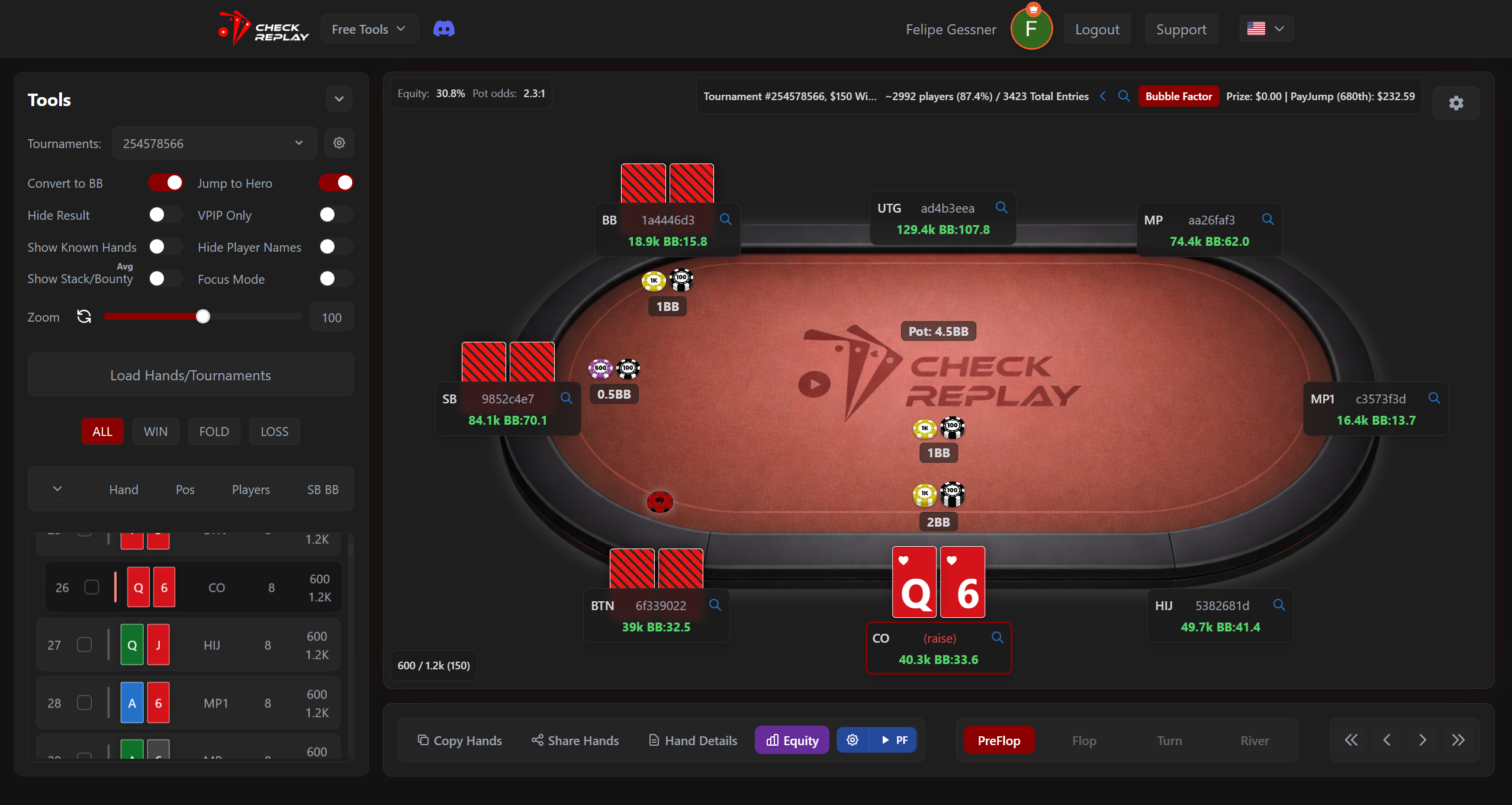
That is why Check Replay goes beyond simply reconstructing the action. Tournament review becomes much more useful when the hand can be placed back into the context where the decision actually happened.
Understanding How Much of the Field Is Left
One of the simplest pieces of tournament information is also one of the easiest to ignore during hand review: how much of the field was still playing?
Check Replay includes a Field Left Calculator to help players understand where they were in the tournament when a hand occurred.
Having 30 big blinds with 90% of the field remaining is very different from having 30 big blinds with 5% of the field remaining.
As the tournament progresses, stacks change, payouts become relevant, average stack depth evolves, and survival begins to have monetary value.
A tournament hand should not be studied in isolation from the tournament it came from.
This is particularly useful when reviewing complete tournaments. Instead of seeing a collection of unrelated hands, the review begins to show how decisions evolved as the tournament moved from the early stages toward the bubble and eventually the final table.
Bubble Factor: When Losing Chips Hurts More Than Winning Them Helps
This becomes even more important when ICM pressure enters the picture.
In a cash game, chips have a straightforward monetary value. In a tournament, that relationship changes because surviving has value.
This creates situations where losing chips costs more tournament equity than winning the same number of chips gains.
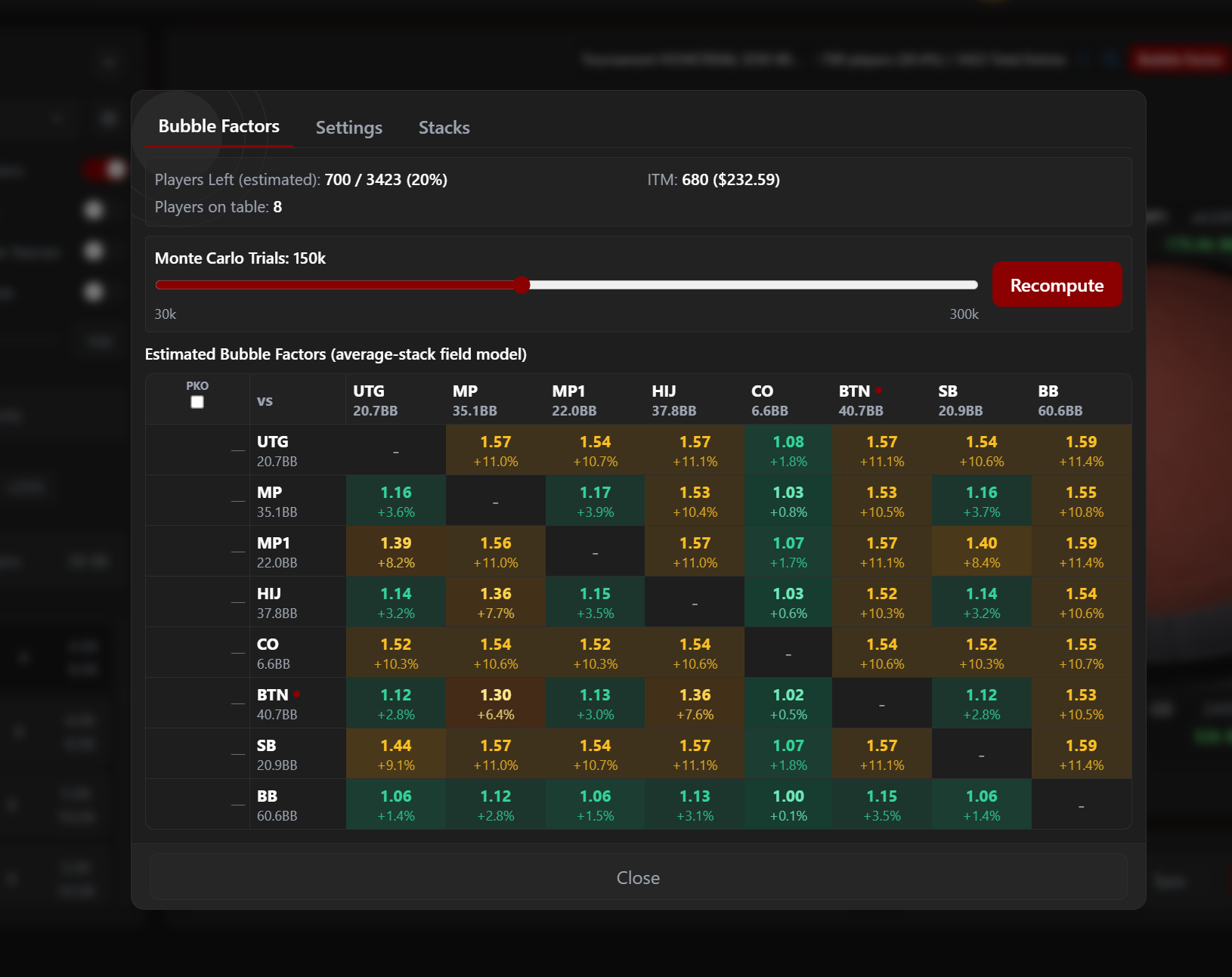
Bubble Factor helps quantify that asymmetry.
Check Replay can calculate Bubble Factor directly in tournament situations, making it easier to visualize how much ICM pressure a player is actually facing.
And Bubble Factor is not simply one number that applies to the entire table.
A big stack may be able to pressure a medium stack heavily while facing much less pressure in return. A short stack may have a completely different relationship with those same players.
This is why two players sitting at the same table can face very different strategic incentives against each other.
Understanding this helps explain decisions that can look strange when viewed only through chip EV. A profitable chip-EV call may become a fold under severe ICM pressure. A player covering the table may be able to attack ranges that would defend much wider earlier in the tournament.
A hand history tells us what happened at the table. Tournament context helps explain what those chips were actually worth.
Share One Hand — Or an Entire Group of Hands
Finding an interesting hand is only half of the process. Very often, the next step is discussing it with someone else.
That could be a coach, a student, a backer, a friend, or an entire study group.
Screenshots leave information out. Raw hand histories are difficult to read. And sending a different replay link for every hand quickly becomes messy.
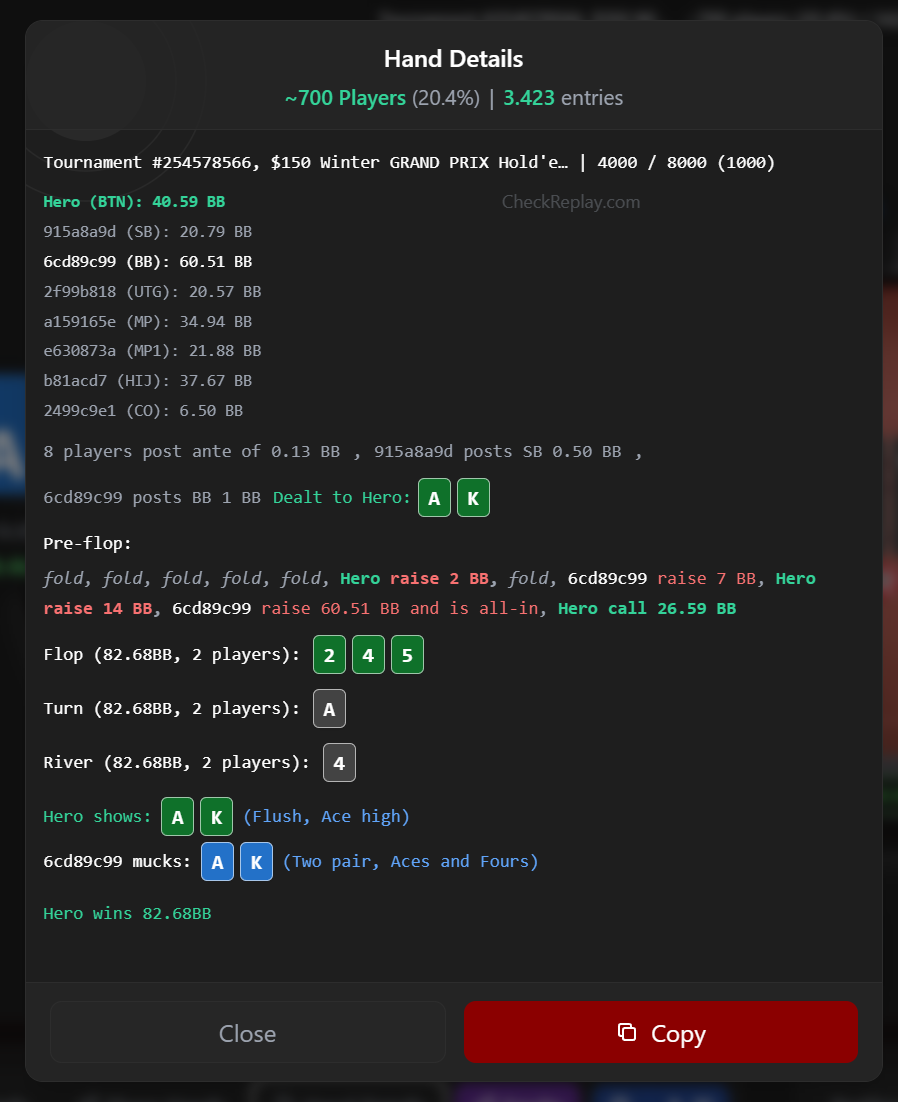
Check Replay lets players select multiple hands and share all of them through a single link.
This changes the workflow considerably.
Imagine finishing a Sunday session and finding 12 hands you want your coach to review.
Instead of sending 12 screenshots, 12 raw hand histories, or 12 different URLs, you can select those hands in Check Replay and generate one link containing the entire group.
The coach opens it and can move through the selected hands directly.
That makes the feature useful for:
- Coaching sessions
- Poker study groups
- Discord discussions
- Tournament reviews
- Team analysis
- Sharing interesting hands with friends
It also preserves the information that matters. Stack sizes, positions, actions, bet sizes and board runouts remain attached to the actual replay instead of being reconstructed from memory.
For coaches, this becomes particularly useful. A student can finish a session, select every questionable hand, and send one review package.
And reviewing several hands together often reveals something that one isolated hand cannot:
patterns.
One questionable river call may mean very little. Five similar river calls from the same session may reveal a leak.
One loose reshove may be defensible. Seeing the same tendency repeatedly may tell a different story.
Sharing multiple hands together makes it easier to study the player rather than just the hand.
Poker improvement rarely comes from one spectacular hand. It comes from finding patterns across many ordinary ones.
From Replaying Hands to Solving Them
For most of its history, poker hand review has focused on reconstructing the past.
What happened?
What did I bet?
What did Villain show?
Those questions matter. But eventually every serious review reaches a more interesting one:
What should I have done?
That is the direction we are now taking with Check Replay.
We are developing a preflop poker solver designed to bring solving closer to the hand-review process itself. Instead of finding an interesting hand, leaving the replayer, opening separate software, rebuilding the tournament situation, entering the stacks again, and only then running the analysis, the goal is to make that transition much more direct.
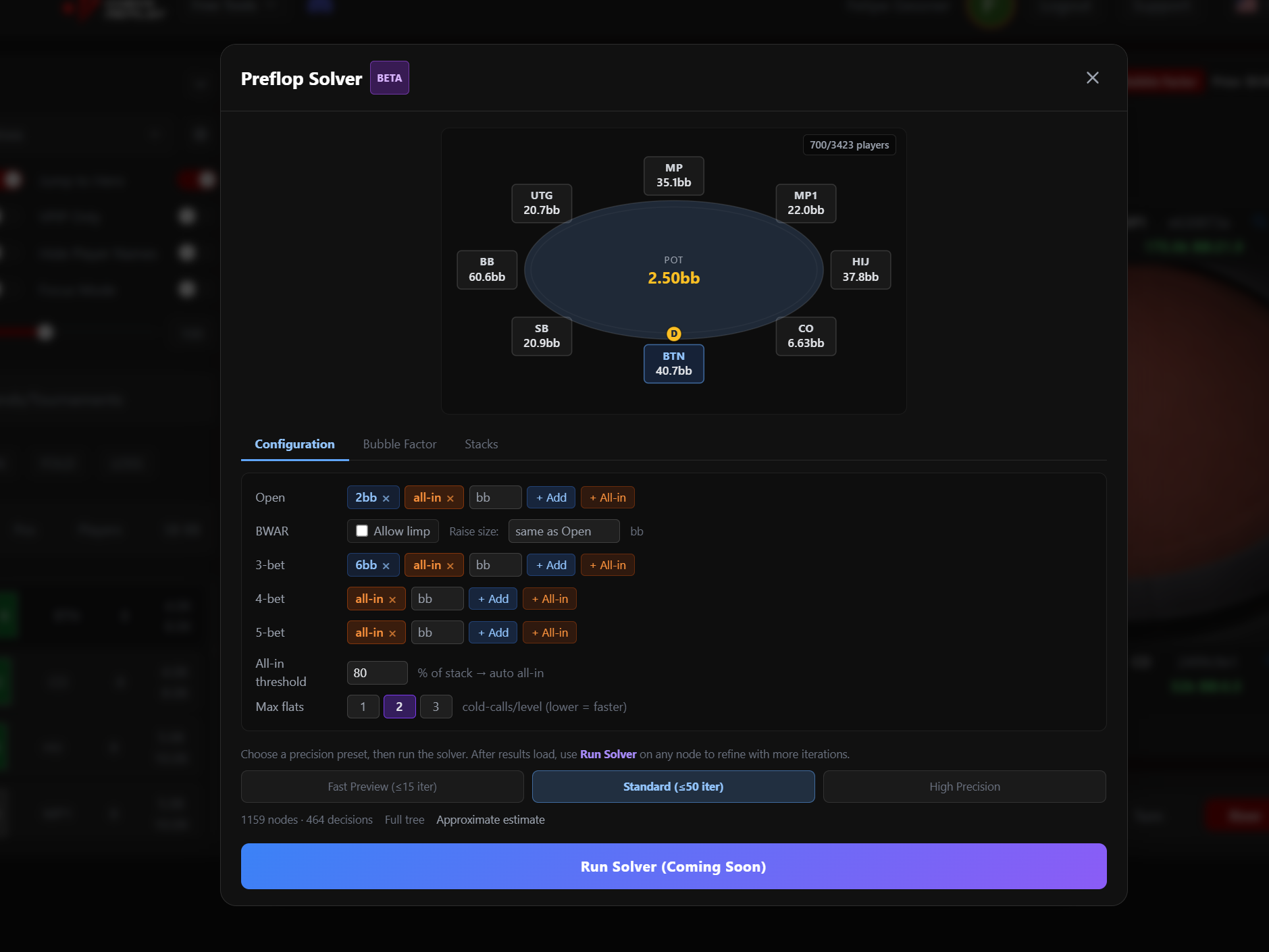
The solver is still under development, so Check Replay is not being presented as a finished full-game solver today. But preflop solving is already an important part of where the platform is heading.
The objective is to analyze decisions such as:
- Push/fold situations
- Preflop ranges
- Shoves and calls at different stack depths
- Player-specific stack interactions
- Tournament decisions affected by ICM
This is especially powerful when combined with the tournament information already available inside Check Replay.
A questionable shove is not just a generic “15bb shove.” It came from a real tournament, with real stacks, real payouts, a particular amount of the field remaining, and potentially significant ICM pressure.
That context matters when trying to solve the decision correctly.
The evolution is simple:
A replayer shows what happened.
Analysis tools help explain why.
A solver helps investigate what should have happened instead.
The long-term idea behind Check Replay is to reduce the distance between finding an interesting hand and actually understanding it.
The hand is already there. The stacks are already there. The tournament context is already there.
Why should studying the decision require starting from zero somewhere else?
That is how Check Replay is evolving from a poker hand replayer into a more complete poker study platform.
From Hand vs Hand to Equity vs Equity
Knowing that AK had 46% equity against QQ can be useful, but real poker decisions are rarely made against one exact hand.
We make decisions against ranges.
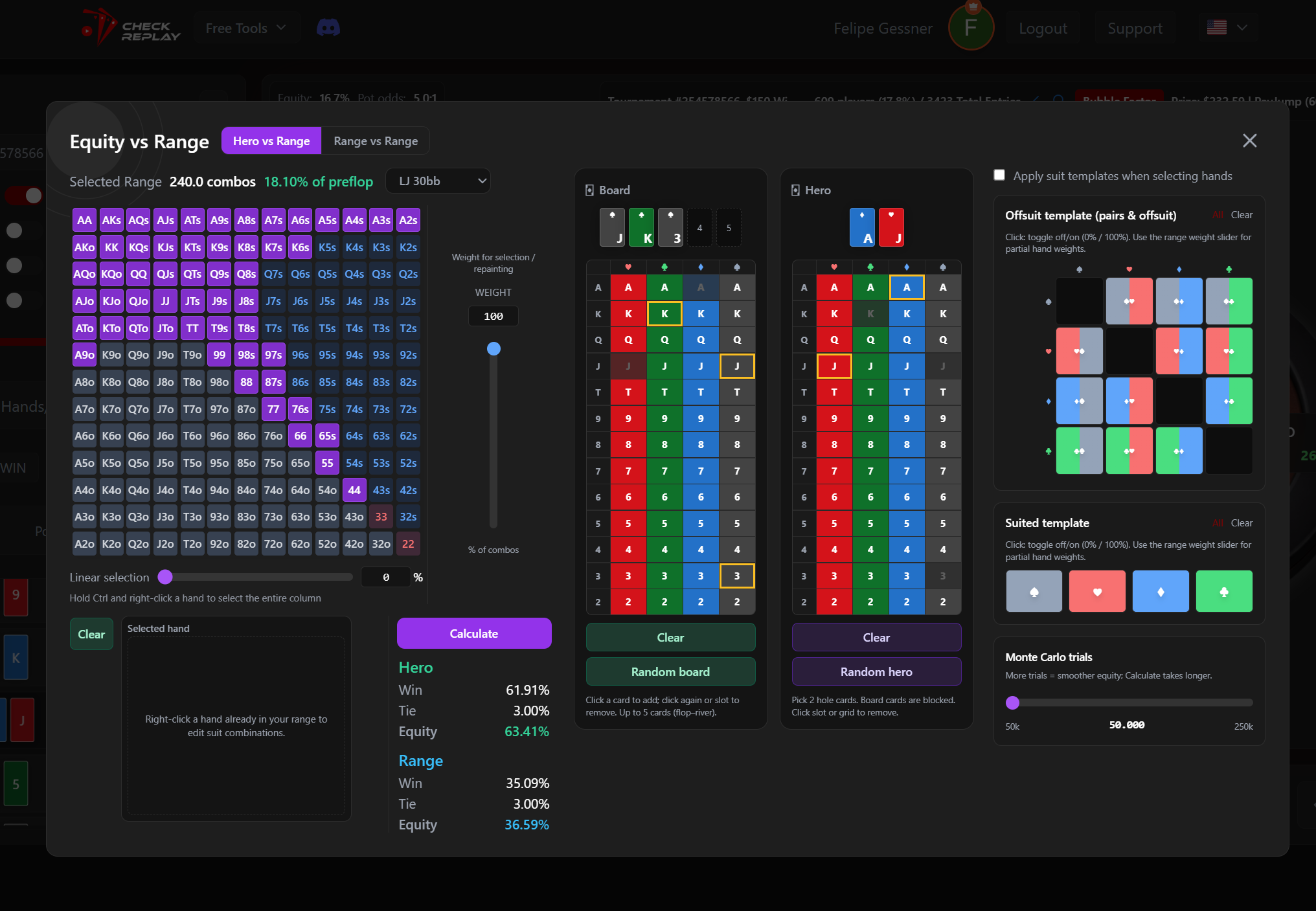
Check Replay’s Equity vs Equity tool allows players to compare how entire ranges perform against each other. Instead of asking whether one revealed hand was ahead of another, you can ask a much more useful question:
How does my range perform against the range I believe my opponent actually has?
This helps move hand review away from results-oriented thinking. The fact that Villain happened to show the top of their range does not mean the decision should have been made against that specific hand.
Poker strategy is built around distributions of possible hands, not the cards we happened to see at showdown.
Equity vs Equity turns “What did he have?” into the much better question: “What can he have?”
Turn Assumptions Into Actual Ranges
Poker players constantly say things like “he is probably strong here,” “his 3-bet range should be wide,” or “I don’t think he has many bluffs.”
Those assumptions become much more useful when they are turned into actual combinations.
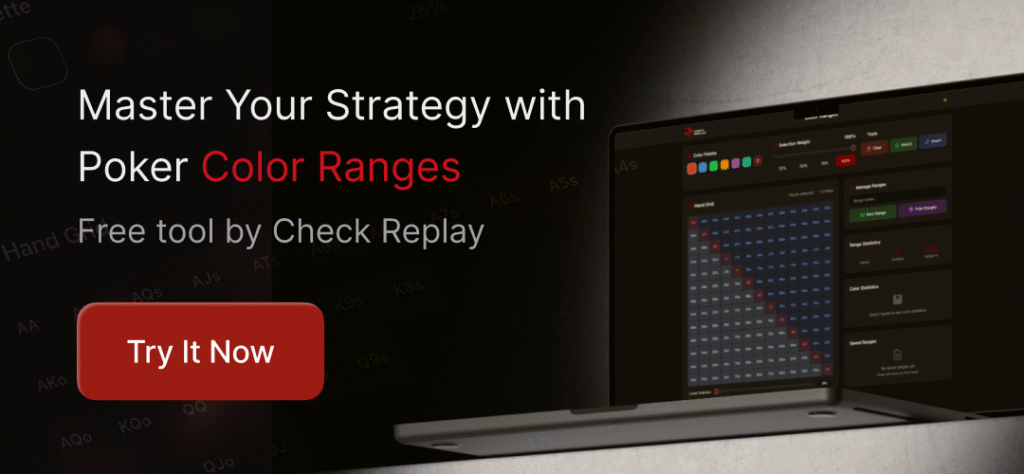
Check Replay’s Range Builder lets players construct and visualize ranges for openings, calls, 3-bets, shoves, bluff catches and other situations.
This creates a natural workflow inside a hand review:
Replay the hand → estimate the range → build it → compare the equities.
Instead of leaving an assumption vague, you can see exactly which hands are included and test how that range interacts with your own.
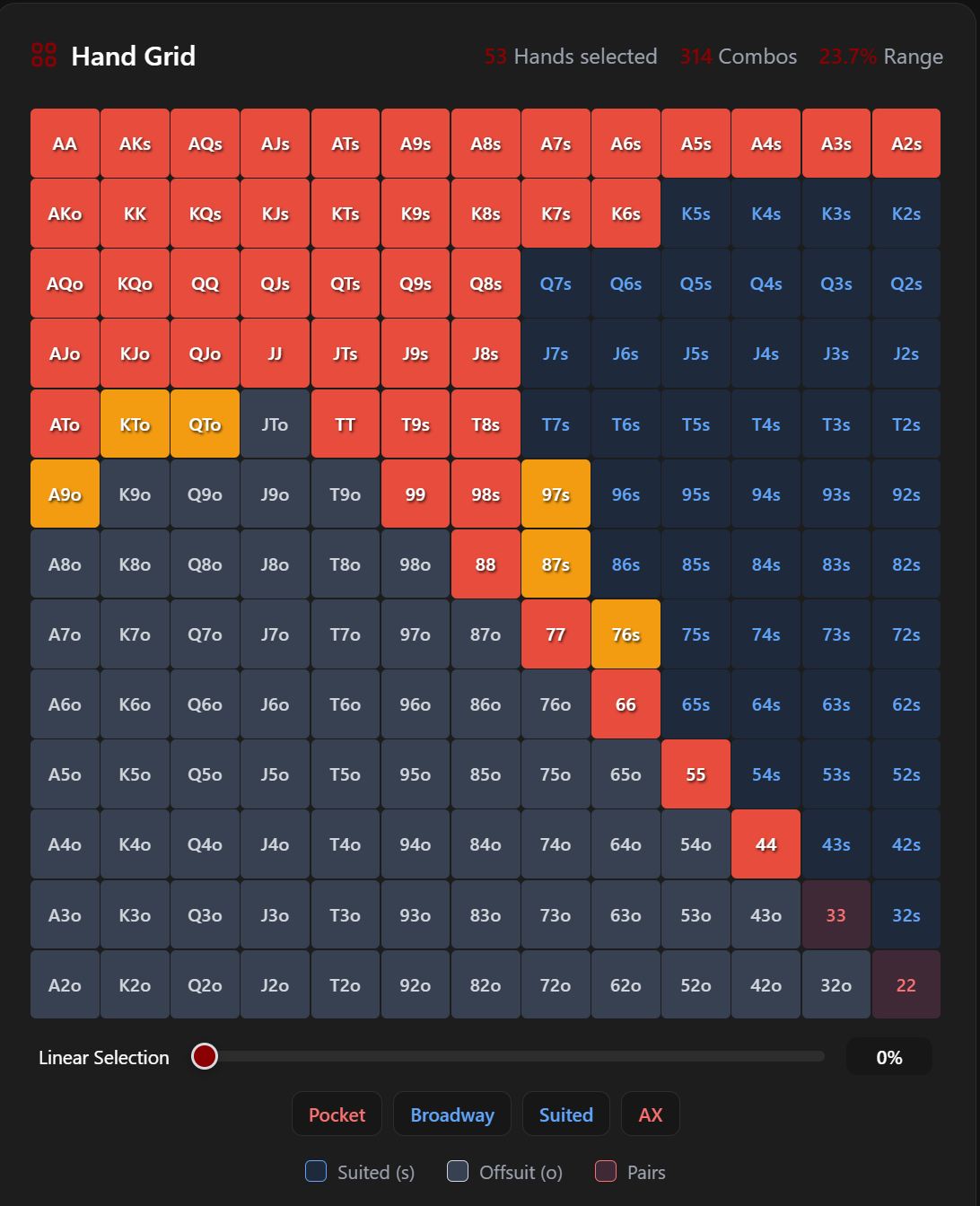
Good poker analysis begins when assumptions become ranges.
Odds and decision support
Not every review requires a full solver analysis. Sometimes the question is simply mathematical: Was the price good enough? Did the draw have enough equity? Was a turn continue mathematically justified?
Integrated odds support inside Check Replay helps connect the visual hand review with the numbers behind the decision. This is useful for all kinds of spots:
- Flush and straight draws facing pressure
- Pair plus draw combinations
- All-in decisions preflop
- River bluff-catch thresholds
Keeping those calculations close to the hand shortens the path from uncertainty to an answer. The review remains focused without requiring the player to rebuild the spot somewhere else just to check one number.
Conclusion
Your poker hands may come from different sites. Your study process shouldn’t have to.
We built Check Replay to bring that process into one place: upload complete sessions and tournaments, replay your hands, build ranges, compare equities, understand tournament context, calculate Bubble Factor, share multiple hands through a single link and, increasingly, solve the decisions themselves.
A hand history should be more than a record of what happened. Used properly, it becomes the starting point for understanding why a decision was good, where your assumptions were wrong, and what you can do differently the next time the same spot appears.
And we’re still building.
Try Check Replay for free. Upload a tournament or session you’ve already played and see how much information is hiding inside your own hand histories.
Frequently asked questions
What is a poker hand replayer?
A poker hand replayer is a tool that turns a hand history file into a visual replay of the hand. Instead of reading a raw text log, players can see positions, stack sizes, actions, bet sizes, board cards and showdown in order. A poker hand replayer makes poker hands easier to review, study and discuss.
How do I replay poker hands online?
You can replay poker hands online by importing or uploading hand history files into a browser-based hand replay platform such as Check Replay. Once the file is loaded, the tool reconstructs the hand visually so you can step through each street and inspect the action clearly. This works for single hands, full sessions or entire tournaments depending on the file.
Can I share hand histories with friends?
Yes. Check Replay lets players share hand histories through instant links, making it easy to send replays to friends, coaches or study partners. Multiple selected hands can also be shared through a single link, allowing someone else to review an entire group of hands without opening separate URLs.
Which poker sites are supported by this tool?
Check Replay supports hand histories from major poker rooms including GGPoker, PokerStars, Winamax, CoinPoker, 888poker, WPN and Americas Cardroom, plus iPoker network rooms. Where support is available, players can review tournament and cash-game hands, including Hold’em and supported Omaha formats. WPT Global is not currently supported because it does not provide downloadable hand histories in an importable format.
Is using a poker replayer free or paid?
Check Replay can be tried for free, with paid plans available for players who want additional access and features. The free option makes it possible to upload hands and experience the review workflow before deciding whether a paid plan makes sense.