One of the hardest moments in tournament poker is looking at a profitable Chip EV decision… and folding.
Not because you’re scared.
Not because your hand is weak.
But because the play that wins the most chips isn’t always the play that wins the most money.
That’s the mental shift that separates good tournament players from great ones.
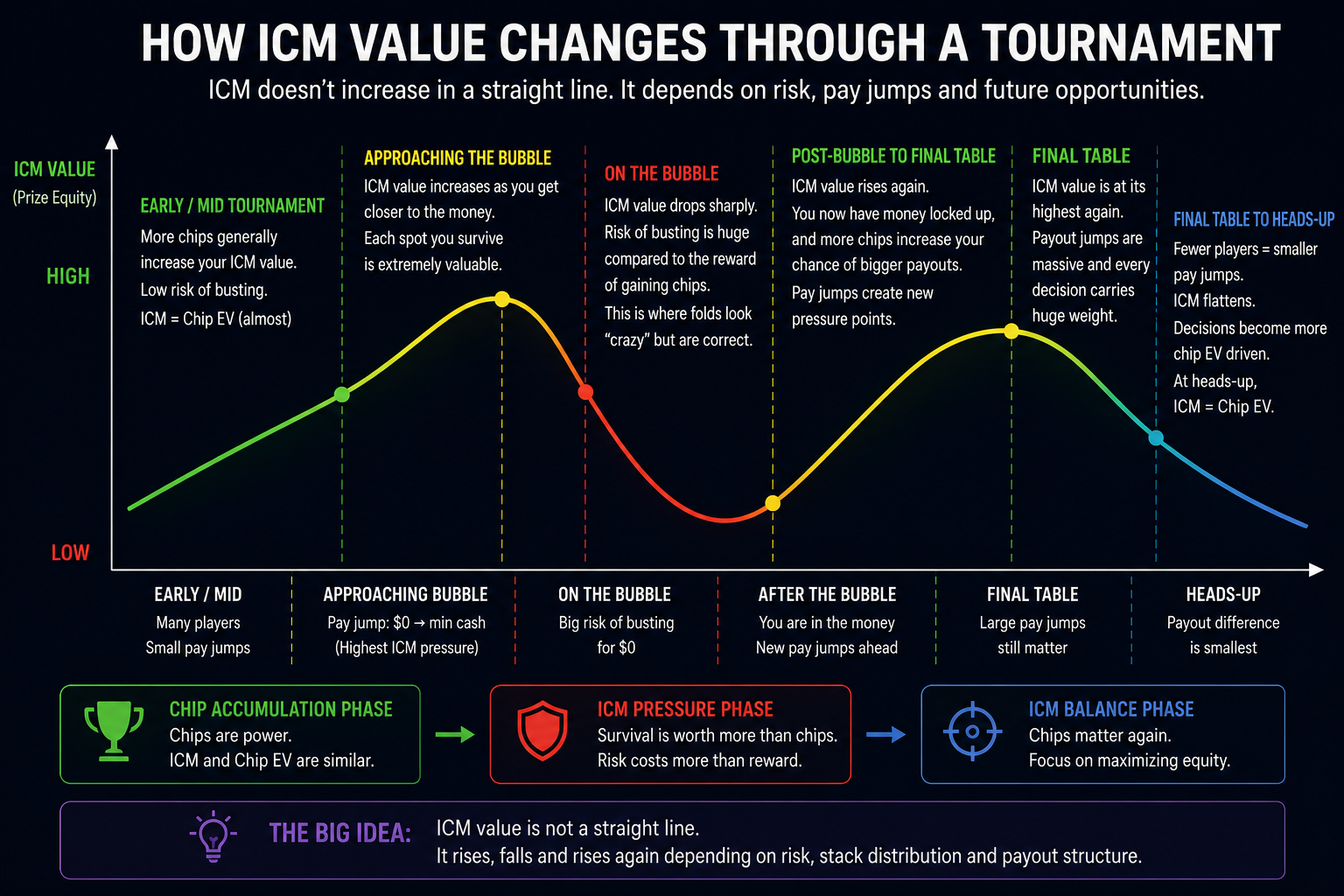
The chart below illustrates how the strategic impact of ICM changes throughout a tournament. Notice that it peaks twice: first on the money bubble, and again at the final table, before gradually fading as the tournament reaches heads-up, where decisions become almost pure Chip EV again.
Great tournament players do not try to win the most chips. They try to win the most money.
That sentence sounds small, but it changes everything.
In tournament poker, chips are not cash. They are a path to cash. Sometimes that path is smooth. Sometimes it becomes steep and dangerous, especially near bubbles, pay jumps, and final tables. That is where Poker ICM changes the way real experts think.
I have seen many players understand hand strength, stack depth, and position, yet still make costly mistakes because they judge decisions only by chip gain. Their logic is often clean, but their goal is wrong. They think, “This call wins chips.” The better question is, “Does this call increase my share of the prize pool?”
This is why elite tournament players often make decisions that look weak to everyone else at the table. They are not playing a different game mechanically—they are optimizing a different objective.
Once I began seeing tournament poker through that lens, many strange folds stopped looking weak. They started looking precise. In this article, I want to explain that mental model clearly, without hiding behind formulas. If you already know the term ICM but still feel unsure when it truly matters, this is for you.
Cash games and tournaments are built on different math
In a cash game, chip value is linear. If I win 1,000 chips, I gain the exact same amount someone else loses. If one chip equals one dollar in value, then 100 extra chips always mean the same thing. The math is clean.
Cash game chips keep the same value no matter how many you have.
Tournaments do not work like that. A tournament chip has changing value because the payout structure sits above the chips. I do not cash out my stack at face value when I bust or when I double. My stack only affects my chance to reach each prize level.
That creates a strange but very real asymmetry:
- Doubling my stack does not double my expected payout.
- Losing half my stack hurts more than gaining the same amount helps.
- Busting ends every future chance to move up the ladder.
This is where many low and mid stakes players go wrong. They carry over cash game logic into tournament spots. They say, “I am ahead of villain’s range, so I call.” That can be fine in chip terms and still be a poor tournament decision.
I think this is one of the hardest adjustments in poker strategy because chips feel real. We count them. We stack them. We watch our graph in our head. But in tournaments, stack size is only part of the story. Payout pressure changes the whole board.
If you want a shorter companion read on this same theme, I think this discussion of ICM versus chip-count thinking in tournament play connects well with what I am describing here.
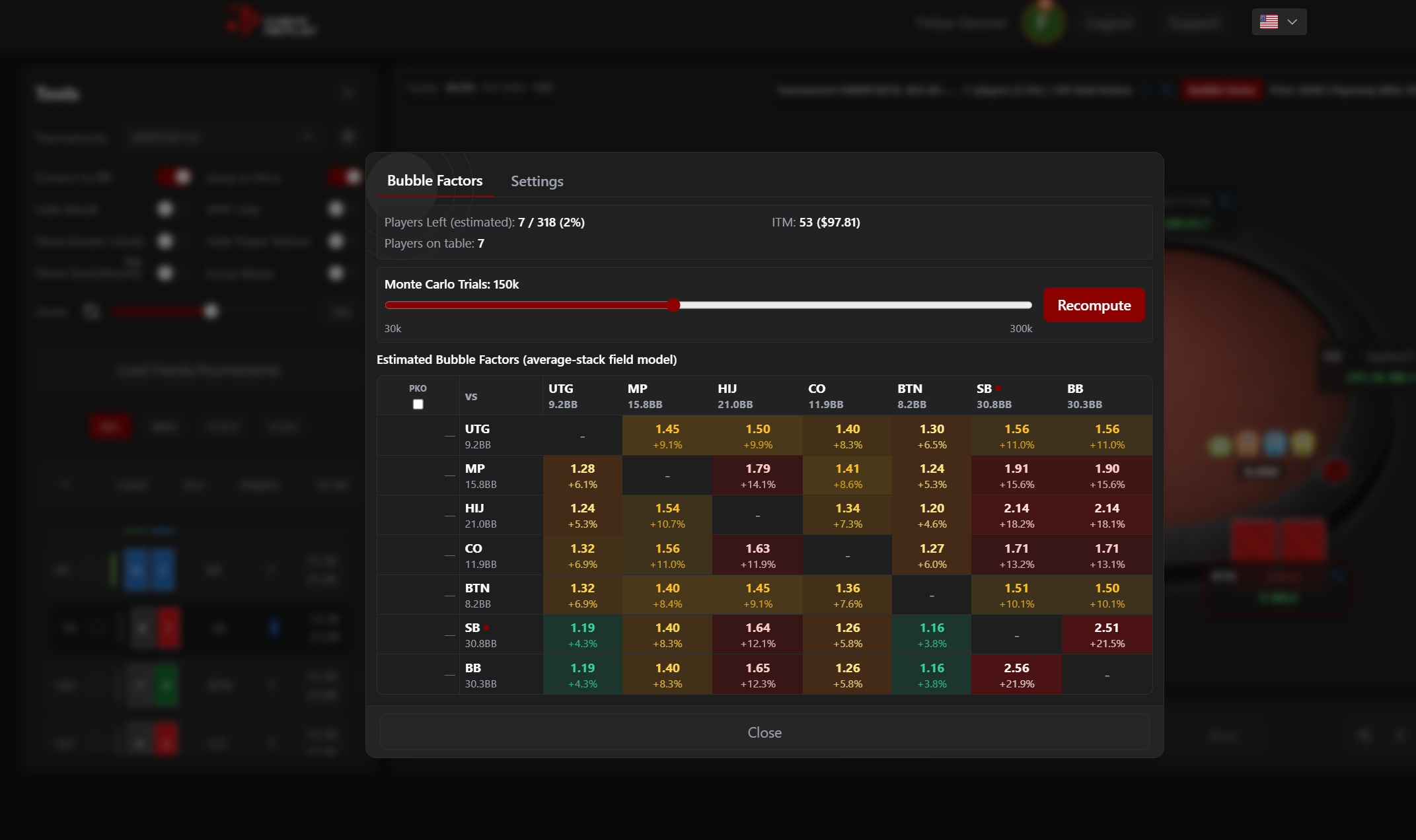
Understanding Bubble Factors at the Final Table
The table above shows the Bubble Factor between every pair of players remaining at the final table.
Each value answers a simple question:
“How much more expensive is losing chips than winning the same amount against this specific opponent?”
A Bubble Factor of 1.00 means there is no ICM pressure. This is essentially cash game poker, where gaining and losing chips have equal value.
As the Bubble Factor increases, survival becomes more valuable than chip accumulation.
For example:
- SB vs BB = 2.51
- BB vs SB = 2.56
These are extremely high values.
They mean that losing an all-in against the other big stack is more than two and a half times as costly as winning the same pot is rewarding.
This is why two large stacks often avoid marginal confrontations at final tables, even with hands that would be easy calls in Chip EV.
On the other hand:
- SB vs BTN = 1.16
- BB vs BTN = 1.16
These Bubble Factors are much lower.
The short stack has much less leverage over the big stacks because busting them has a relatively small impact on the big stack’s tournament equity. As a result, chip leaders can apply far more pressure to shorter stacks, who are forced to defend much tighter.
The most important takeaway is that Bubble Factor is not a single number for the entire table.
It depends on:
- the two players involved,
- their relative stack sizes,
- the remaining stacks,
- and the payout structure.
That is why Bubble Factor changes from one confrontation to another.
In this example, the highest values occur between the two chip leaders (SB and BB), where both players have the most to lose by colliding. Meanwhile, confrontations involving the shorter stacks produce much lower Bubble Factors, allowing the larger stacks to play far more aggressively.
This interaction is one of the defining strategic features of final-table poker and explains why optimal ranges can differ dramatically depending on who you are playing against—not just what cards you hold.
What ICM really means
ICM stands for Independent Chip Model. That sounds technical, but the idea is not hard.
ICM is a way to estimate how much of the prize pool your stack is worth right now.
It does that by looking at three things:
- The size of every stack still in the tournament
- The payout structure
- Your chance of finishing in each remaining position
It does not assume that chips turn into cash one for one. Instead, it asks a more honest question: given the stacks and payouts, what is my current expected share of the prize pool?
That is why stacks matter. If I have 20 big blinds with eight players left, my value depends not only on those 20 blinds, but also on whether everyone else has 18, 40, or 3. The same stack can be worth very different amounts in different lineups.
Payouts matter too. Near a flat payout stage, risk may be easier to take. Near a huge ladder, one all-in can swing a large amount of real value.
I do not think of ICM as a calculator first. I think of it as a translator. It translates chips into tournament equity. That is why two hands with the same chip expectation can have very different money expectation.
ICM does not ask, “How many chips can I win?” It asks, “What happens to my prize equity if I win or lose?”
The mental shift that separates strong tournament players
The biggest shift is simple to say and hard to live by at the table.
I am no longer trying to maximize chips. I am trying to maximize expected prize money.
That sounds like the same thing until you hit pressure points. Then the gap becomes huge.
Suppose I can take a thin coin flip that is slightly profitable in chips. Early in a tournament, I may gladly take it. Near a bubble or a big pay jump, the same spot may become a fold because the cost of busting is too high compared with the reward of adding chips.
In tournaments, a good chip gamble can still be a bad money gamble.
I think this is the sentence that many players need to sit with for a minute.
Here is another way I explain it to myself:
- Chip EV asks whether a play grows my stack on average.
- ICM asks whether a play grows my tournament payout on average.
- Those goals often match early, but they split later.
When elite players make folds that look strange on stream or in hand histories, they are often not being scared. They are being loyal to the real scoring system of the event.
I have reviewed many tournament hands where the emotional reaction was, “I cannot believe I folded that.” Then after calm review, the answer became obvious. The hand was strong in isolation, but the situation made the risk too expensive.
Why chips are not worth the same
Let me make this concrete.
If I go from 100 chips to 200 chips, I have doubled my stack.
If I go from 200 to 400, I double again.
But my tournament value does not double both times in the same way. The more chips I already have, the less each extra chip changes my share of the prize pool.
Tournament chips have diminishing returns.
Think of it like this. Your first chips keep you alive. They buy fold equity, orbit survival, and chances to ladder. Extra chips after that still help, but they do not scale in a straight line.
That is why the jump from very short to playable can mean a lot. The jump from chip leader to bigger chip leader may matter less than people think.
I often picture tournament value as a curve, not a staircase. Early gains are powerful. Later gains flatten. This is one reason all-ins for massive stacks need extra caution when money pressure is high.
If four players remain and payouts are top heavy, being second in chips may already hold a strong share of the remaining value. Risking that position for a thin edge can be poor, even with a premium hand, because the added chips do not buy a proportional increase in payout expectation.
Players who think only in stack size see growth. Players who think in ICM see conversion rate.
Why losing chips hurts more than winning them
This is the emotional center of tournament poker.
When I lose chips, I lose options. I may lose fold equity. I may lose my seat at the pay ladder. I may lose the event entirely. When I win chips, I gain opportunity, but not certainty. I still have to survive future hands, future coolers, future blinds, future pressure.
Losing tournament chips is usually more expensive than gaining the same amount is rewarding.
That idea leads into two concepts many players hear but do not really feel: risk premium and bubble factor.
Risk premium is the extra equity I need before risking elimination or serious damage in an ICM-heavy spot. In cash, near breakeven may be enough. In a tournament, I often need more than that because survival itself has value.
Bubble factor describes how much more costly losing is than winning in a given spot. The stronger the payout pressure, the higher that factor becomes.
I like to define them simply:
- Risk premium means I need more reason to put my tournament life at risk.
- Bubble factor means loss and gain are no longer balanced.
- Both concepts tighten calls far more than they tighten shoves.
That last point matters. Many players understand that they should call tighter near bubbles, but they do not fully see why. The reason is not fear. The reason is that calling and busting can destroy much more prize equity than winning the pot can create.
I once reviewed a final table hand where a player called off with a hand that was ahead of the shover’s range. On chip logic, the call looked fine. On payout logic, it was a clear mistake. Busting there cost too much compared with the reward of becoming a bigger stack.
Survival has value.
Where ICM changes everything
ICM does not hit every phase with the same force. Some moments are much sharper than others.
The bubble
Near the money bubble, short stacks want to survive, medium stacks feel trapped, and big stacks can apply pressure. This is not random. It happens because each group faces a different cost of losing.
Medium stacks often suffer the most on the bubble because they can bust before the shortest stacks do.
If I cover many players, I can open more and force folds. If I am covered by active stacks, my calling range must often shrink.
Pay jumps
As ladder jumps grow, survival gains real money value. A hand that was a clear continue one orbit earlier may become a fold because one or two bustouts change the reward map.
I think many players underestimate how much a large jump affects medium stacks. They say, “I cannot fold ace-queen here.” But that hand does not live alone. It lives inside a payout structure.
Final tables
Final tables are where Poker ICM stops being theory and starts changing almost every close decision. Stack interaction matters. Seat order matters. Who covers whom matters.
Final table poker is not just short-handed poker with bigger payouts. It is a different scoring system.
Satellites
Satellites push the logic even further. If several players win the same seat, extra chips can become nearly worthless once survival is locked. In those spots, folding hands that look absurd can be fully right.
Covered versus covering
If I am covered, busting hurts more. If I cover someone, I can pressure them because they have more to lose. This changes all-in dynamics in a major way.
Short stacks and medium stacks
Short stacks sometimes gain freedom because they have less to lose relative to their position. Medium stacks often feel the most tension because they can still ladder, but they are vulnerable.
For a focused breakdown of why these tournament spots matter, I also like pointing readers to this article on why ICM matters in tournament poker, since it frames the pressure points very clearly.
Why strong players fold hands that look too strong
Let me return to the paradox from the start.
How can folds with AQ, AK, QQ, or even KK be right?
The answer is not that these hands became weak. The answer is that the price of being wrong became too high.
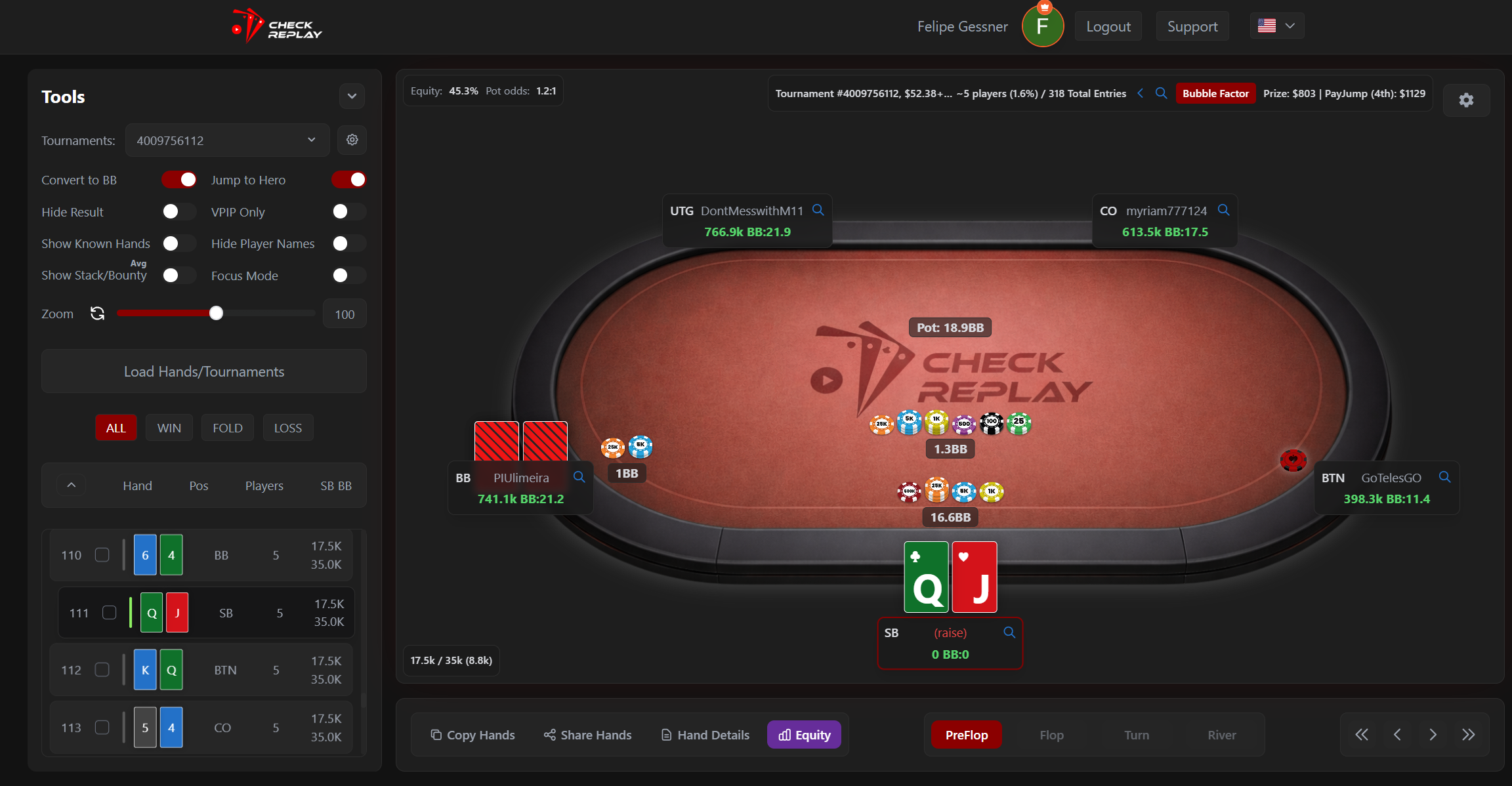
Suppose I hold ace-king with two shorter stacks close to busting and a bigger stack jams into me. In chip terms, I may be doing fine against the range. In prize terms, calling and losing may cost me far more than calling and winning gains me.
A premium hand can be a fold when the downside damages your tournament equity more than the upside helps it.
Queens work the same way. If a tight player shoves and I know I am often racing or crushed, chip logic may still support a call at some stack depths. But if several payouts are near and I am already in strong position, folding can protect more money than calling can create.
Kings and aces are rare examples, but they belong in the conversation because they show how far this logic can go in extreme formats or extreme payout pressure. Once people hear that aces can theoretically fold, they often react as if ICM has become nonsense. I think the opposite. It proves how serious the model is. It forces me to stop worshipping hand strength and start respecting context.
Strong players are not folding because they hate variance. They are folding because they understand what they are being paid to protect.
The most common ICM mistakes I see
Most ICM mistakes are not math mistakes first. They are goal mistakes.
Players pick the line that wins the most chips, then assume that must be best. That habit creates repeated leaks.
These are the errors I see most often:
- Playing bubble spots as if they were early-stage chip EV spots
- Calling all-ins too loose because the hand looks pretty
- Ignoring the payout structure and only counting blinds
- Forgetting who covers whom before making a close decision
- Using the same final table style they use in the middle stages
- Asking “Am I ahead?” instead of “What happens to my equity if I lose?”
The best ICM question is not “Do I have the best hand?” but “Does this choice increase my expected payout?”
I think one hidden mistake deserves extra attention. Many players overcorrect and become passive in every spot where money pressure exists. That is also wrong. ICM is not a command to hide. It is a command to understand who is allowed to fight hard and who is not.
ICM is not just about folding
This part is often missed.
When people first learn tournament ICM, they think it means tighter calls, tighter stacks, scared poker. That is only half the picture.
ICM creates aggression for the players who can apply pressure safely.
If I cover players who are trapped by pay jumps, I can open wider, three-bet more selectively, and force folds from hands that would continue in chip EV settings. Their problem is not that my cards are always strong. Their problem is that their tournament life carries more value than the pot in front of them.
This is why some final table chip leaders seem unstoppable. They are not just running hot. They are using the hidden tax that ICM places on everyone else.
Pressure becomes a weapon when:
- I cover stacks that cannot call off light
- Large pay jumps make survival more valuable
- Short stacks are waiting to bust
At the same time, aggression is not automatic. If another big stack can hurt me, I lose some freedom. If payouts are flatter, pressure drops. Good tournament poker is about reading the pressure map correctly.
I have often found that reviewing these spots after a session is where the light turns on. Hands that felt random in real time start to show a pattern. The chip leader’s opens were not wild. The medium stack’s folds were not timid. The whole table was reacting to payout gravity.
How I build ICM intuition without memorizing charts
I do not think the best path is to memorize isolated answers and hope the table gives me the same question. I want pattern recognition, not flashcards.
ICM intuition grows through repeated review of similar spots, not through blind memorization.
Here is the process I trust most:
- Review hands from bubbles, pay jumps, and final tables.
- Compare what is good in chips with what is good in prize equity.
- Pay close attention to stack coverage.
- Notice how calling ranges tighten faster than shoving ranges.
- Group hands by situation, not just by hand class.
Over time, the same ideas appear again and again. Medium stack under pressure. Big stack attacking two players who cannot bust. Short stack taking a spot because waiting is worse. Once I saw those patterns enough times, my instincts changed.
This is also where a practical hand review workflow helps a lot. Reviewing tournament hands under ICM assumptions is one of the fastest ways I know to build real intuition because repeated exposure teaches more than memorizing a few charts. Tools like Check Replay fit naturally into that process since I can revisit hands quickly, share spots with a coach or friend, and focus on the decision itself instead of wrestling with messy hand history formats.
I like that kind of review because it keeps the learning close to real hands. A strange fold stops being a trivia answer and becomes part of a broader pattern I can recognize next time.
Conclusion
Tournament poker becomes much clearer when I stop treating chips as money.
Great tournament players do not see stacks the way cash game players do. They see future payout chances.
They see that doubling up helps, but not in a straight line. They see that busting destroys far more than a chip count suggests. They see that a call is not good because a hand is strong. A call is good only if the full result, including survival risk, improves expected prize money.
That is why some folds look shocking. That is why some chip leaders attack so often. That is why medium stacks can feel trapped. That is why tournament poker without ICM thinking is incomplete poker strategy.
I think the best summary is this: the elite do not chase chips for their own sake. They judge chips by what those chips can still become.
Recreational players count chips.
Professionals count equity.
Great tournament players count future prize money.
Once you understand the difference, tournament poker never looks the same again.
If you want that way of thinking to become natural, start reviewing your own tournament hands with that question in mind: was I maximizing chips, or was I maximizing money? And if you want a clean way to revisit and share those spots, get to know Check Replay and use it to study the hands that matter most.
Frequently asked questions
What is ICM in poker tournaments?
ICM, or Independent Chip Model, is a way to estimate the money value of your tournament stack based on stack sizes and payout structure. It translates chips into expected prize equity instead of treating chips like cash. That is why the same stack can have different value depending on who is left and how the prizes are distributed.
How does ICM affect poker strategy?
ICM changes which risks are worth taking. It often makes calling all-ins tighter, especially near bubbles, pay jumps, and final tables. It also gives covering stacks more room to attack. ICM changes strategy by making survival and payout pressure part of every close decision.
Why should I use ICM over chips?
You should think in ICM because tournaments do not pay out by chip count alone. They pay by finishing position. A play that wins chips can still lose money if the risk of busting is too costly. Using ICM helps you aim at the real goal, which is expected prize money, not raw stack growth.
When should I start thinking in ICM?
You should start early by understanding the concept, but it matters most when payout pressure grows. That includes the money bubble, large pay jumps, final tables, and satellites. As stacks get shorter and prizes get closer, ICM has more force on your choices.
Does ICM really improve tournament results?
Yes, because it helps you avoid expensive mistakes in the spots where money pressure is highest. It also helps you spot strong aggression opportunities when others are handcuffed by payouts. Players who understand ICM make better folds, better calls, and better attacks when the stakes are highest.