If there’s one lesson I wish every poker player could learn sooner, it’s this: how you play matters far more than whether you win a hand in the moment. This mindset has been the dividing line between those who grow as winning players and those who just chase short-term luck.
Stop judging yourself by what happened. Start judging by what was right.
Over the years, both sitting at felt tables and reviewing hands with tools like Check Replay, I have seen this mindset make all the difference. So let me share why, in poker, math always comes before results, and how embracing this idea can truly change how you play and improve.
Why Results-Oriented Thinking Holds Players Back
Imagine someone offers you a bet where you win $100 60% of the time and lose $100 40% of the time.
Most people would take that bet because it is clearly profitable.
Now imagine you lose the first three times.
Has the bet suddenly become bad?
Of course not.
The quality of the decision did not change simply because a short-term outcome went against you. If you could take the same bet a thousand times, you would happily keep doing it.
Poker works exactly the same way. Good decisions can lose. Bad decisions can win. What matters is whether the decision makes money over a large enough sample.
The math mindset: What really matters
To improve in poker, you must become familiar with concepts such as pot odds, range equity, and combo counting. The more you practice these skills, the less you’ll rely on intuition and short-term results. Instead of thinking, “I have a feeling he’s bluffing,” start thinking, “I’m getting 33% pot odds on this river call, so my opponent needs to be bluffing at least 33% of the time for this call to be profitable.”
From there, think about your opponent’s range. How many value combinations can they have? How many bluffs? Does your hand have enough equity against that range to justify a call? This is how strong players approach poker decisions. They don’t call because they “feel” like it and then label themselves a hero if they win or a terrible player if they lose. They judge the quality of the decision based on the information available at the time, not on the outcome of a single hand.
Expected Value (EV): The average amount you stand to win or lose from a play, repeated across many similar situations.
Ranges: The likely hands your opponent could have, not just the one hand you see at showdown.
Equity: Your chance of winning.
Long-term profitability: Whether repeating this decision will make money over hundreds or thousands of hands.
Results-Oriented Thinking vs Solid Logic
You see a river spot where you only need to be right 25% of the time for a call to be profitable. Instead of relying on intuition, you think about your opponent’s range. You count value hands, count potential bluffs, and conclude that calling is mathematically correct.
You make the call.
Your opponent shows up with one of the value hands you included in their range, and you lose the pot.
Immediately, your brain wants to tell you that it was a bad call. That’s how most people naturally think. We are wired to judge decisions by outcomes.
But once you inject logic into the process, it becomes clear why this is a mistake. The question was never whether your opponent had a value hand this time. The question was whether your decision would make money over hundreds or thousands of similar situations.
If your analysis was correct and your opponent is bluffing often enough for the call to be profitable, then the call remains good regardless of what happened in this particular hand. In the long run, this thought process generates EV, and nothing in poker will make you more money than consistently making +EV decisions.
The earlier you stop caring about the outcome of a single showdown and start focusing on the quality of your decisions, the sooner you unlock real growth in your game. Winning players don’t judge themselves by individual results. They judge themselves by whether they made the best decision with the information available at the time.
The goal is not to win this hand. The goal is to make the decision that wins the most money over the next 10,000 hands.
Why Your Brain Keeps Lying to You
Poker creates a psychological trap that doesn’t exist in most other activities. In school, correct answers get rewarded. In sports, good execution usually produces good results. But poker is different. You can make a terrible decision and win a huge pot, or make a perfect decision and watch the chips slide the other way.
This disconnect confuses the brain. We naturally look at outcomes and assume they validate the decision that came before them. When a bluff gets through, we feel clever. When pocket aces get cracked, we start questioning our strategy. The problem is that neither result tells us whether the decision was good.
Winning players learn to separate outcomes from decision quality. They understand that poker is not a game of being right today. It is a game of being right often enough over thousands of hands.
The moment you stop asking “Did I win?” and start asking “Would I make the same decision again?” your improvement accelerates dramatically.
Good Decisions Don’t Always Win
Variance is the reason so many players struggle to trust the math.
Most people expect a good decision to produce a good result. When that doesn’t happen, they assume something went wrong. But poker doesn’t work that way.
Imagine making a river call that only needs to be correct 25% of the time to be profitable. You analyze the range correctly, identify enough bluffs, and make the call. This time, your opponent happens to show up with a value hand.
You lose.
The result feels bad, but the decision remains profitable.
Variance is simply the gap between what should happen in the long run and what happens in a single hand, session, or tournament.
This is why poker can be so frustrating. The game constantly mixes good decisions with bad outcomes and bad decisions with good outcomes. A reckless bluff may get through. Pocket aces may get cracked. A perfect hero call may run into the top of a range.
None of these outcomes change the quality of the decision.
Winning players understand that variance is not an obstacle to overcome. It is the price of having an edge.
If the best decision always won immediately, poker would be a very different game. It would look much more like chess, where skill dominates almost every result and weaker players rarely have a realistic chance against elite competition.
Variance is what makes poker unique. It allows less experienced players to win sometimes, even when they are making worse decisions overall. A recreational player can sit down in a tournament, make several mistakes, and still walk away with a big score. Pocket aces can get cracked. A bluff can get through. A dominated hand can improve.
That uncertainty is not a flaw in the game—it is one of its greatest strengths.
Because weaker players can occasionally win, they continue to enjoy the game and keep coming back. Imagine asking a beginner to put $25,000 on the table against Magnus Carlsen in a chess match. Almost nobody would do it because the outcome is overwhelmingly predictable. In poker, however, a recreational player can sit across from a world-class professional and still believe they have a chance. Sometimes, they actually do.
This is why variance is so important to the poker ecosystem. It keeps the game competitive, entertaining, and accessible. Without it, poker would be far less attractive to recreational players, and the opportunities for skilled players to profit would shrink dramatically.
The best players don’t complain about variance. They understand that while it creates short-term pain, it is also the reason the game remains profitable in the long run.
The goal is not to eliminate variance. The goal is to make so many mathematically sound decisions that variance becomes irrelevant over time.
Once you truly understand this, bad beats become easier to handle, downswings become easier to survive, and your confidence stops depending on what happened in your last session.
How strong players review hands: Objectivity and growth
When I coach (or get coached myself), we almost never ask, “Did you win the hand?” We care about:
- “Was this decision +EV against this player’s range?”
- “Did I have the right odds to call or raise?”
- “What did my opponent show me about their tendencies?”
- “Did I control what I could control?”
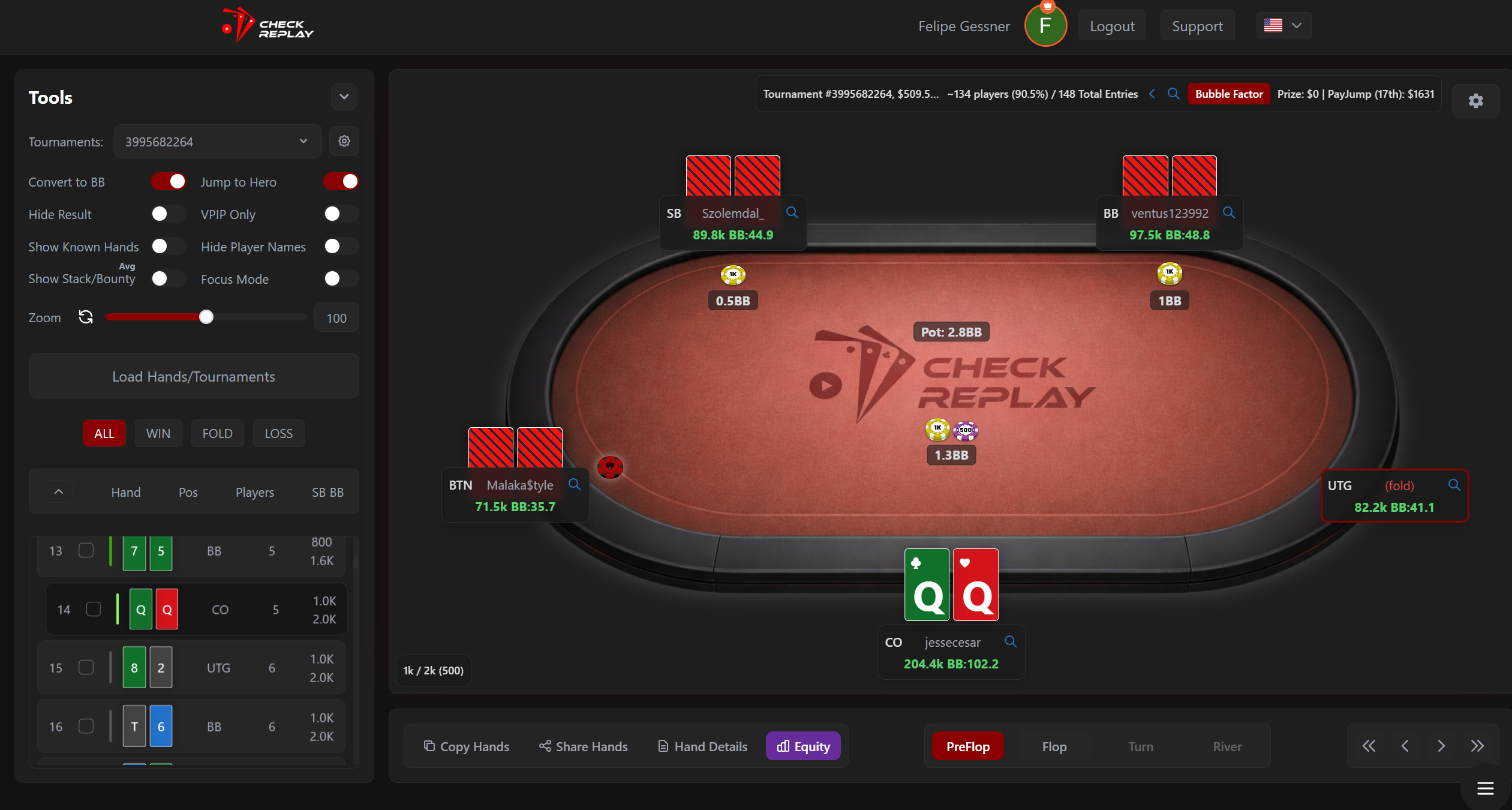
Check Replay shines here. With fast history uploads and clear hand visualization, it lets me share tricky spots with friends or coaches without bias from the end result. We break down each action by logic and math, not by whether it paid off just this once.
Want to know more about how math drives poker decision-making? The post on how math powers smart poker strategy is a simple but deep introduction you might find useful.
Practical steps to build a math-first mindset
Building this approach isn’t about turning into a robot, but about making better long-term choices. Here’s what I found works for most willing learners:
- When reviewing a hand, write down your actual logic in the moment. Don’t judge only after you see the cards.
- Study expected value and pot odds, not to memorize, but to train your gut to spot good situations.
- Focus on hand ranges (“What could my opponent have here?”) instead of results or emotions.
- Use tools like Check Replay so you can replay hands, ignoring the final river card at first, focusing only on information available at each street.
- When you lose, ask: “Did I make a good decision?” not “Why me?”
- When you win, don’t pat yourself on the back for every pot. Instead, analyze if your line was the best, or just the luckiest.
This builds both skill and mental toughness. You’ll find yourself less tilted by bad beats and more proud of making good folds, even when the table mocks you for it.
Conclusion: Judge yourself by decisions, not results
My best moments in poker didn’t come from hitting a lucky card, but from looking back and seeing that I made the right play, win or lose. The math-over-results mindset is what separates players who last from those who stay lost in swings.
If you want to improve, start today by tracking your decisions and sharing them with others who will judge your logic, not just the outcome. Tools like Check Replay can give you the edge by letting you focus on process, not luck.
The easiest way to develop this mindset is by reviewing hands objectively. Whether you’re studying alone or discussing spots with friends and coaches, the goal is always the same: evaluate the quality of the decision, not the result.
Tools like Check Replay make that process easier by allowing you to revisit hands street by street, focusing only on the information that was available at the time.
Frequently asked questions
What is the math over results mindset?
The math over results mindset means you judge your poker decisions based on their expected value, logic, and long-term profitability, not on whether you won a particular hand. This way, you focus on improving your play, not chasing luck.
How does mindset impact poker success?
Mindset affects how you handle variance, recover from bad beats, and learn from mistakes. Players with a math-focused mindset improve faster because they analyze decisions rationally instead of becoming emotional about outcomes.
Why should I focus on math in poker?
You should focus on math in poker because it’s the foundation of making good decisions that win money over time, no matter what happened in any one hand. Math helps you avoid common traps like overvaluing luck and repeating bad plays.
Can beginners use the math mindset?
Absolutely. Beginners can learn to estimate odds, think in ranges, and judge decisions by logic instead of results, even with little experience. Starting with a math mindset saves time and builds good habits.
Is it worth it to ignore short-term results?
Yes. Ignoring short-term results keeps you focused on what you can control: your decisions, your study, and your steady improvement. The good outcomes add up over time if your logic is sound.