I have seen this mistake many times. A player faces a river bet, looks at his hand for two seconds, and says something like, “I block the nut flush, so I guess I have to call.” That sounds smart. It sounds advanced. It also skips the question that should come first.
A good poker decision starts with the right question, not the most advanced concept.
Before I care about blockers, I want to know whether my opponent even bluffs in that spot. Before I think about fancy combo logic, I want to know how often I need to be right. Before I talk about theory terms, I want a clean process.
This is where many intermediate players get stuck. They know the language of modern poker study. They know pot odds, minimum defense frequency, blockers, risk premium, and range advantage. Yet when the hand gets difficult, their thinking becomes scattered. They jump to the last step first. Then they use a smart concept to support a bad starting point.
Order matters.
In my experience, strong poker decision making is less about knowing more ideas and more about applying simple ideas in the correct sequence. That is what separates players who “know stuff” from players who make money.
This article is about that sequence. I am not going to ask you to memorize charts. I am not going to turn this into a theory lecture. I want to show how experienced players think through a hard spot in real time, especially on later streets where mistakes cost the most.
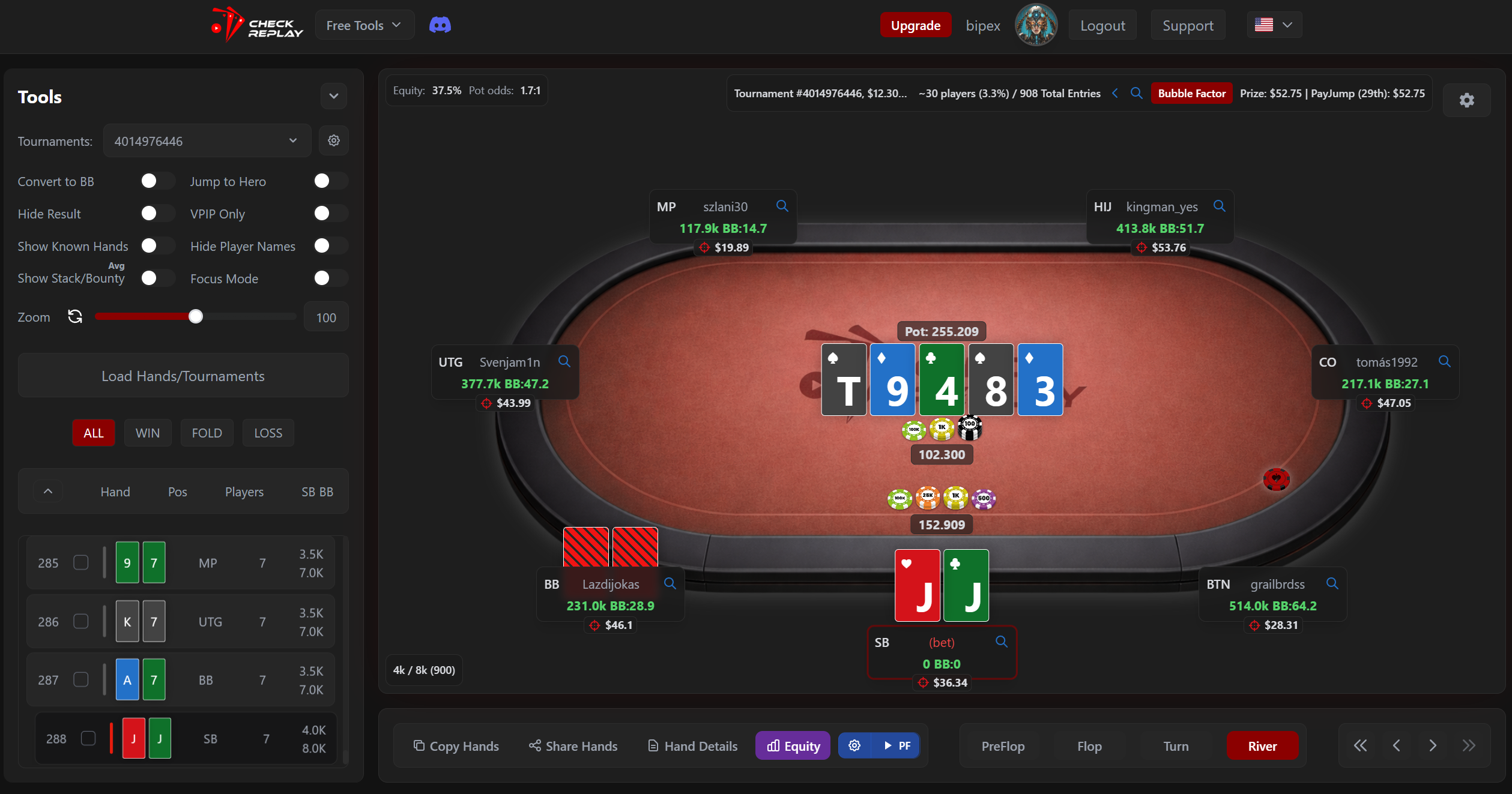
If you study hands with a tool like Check Replay, this structure becomes much easier to build. Instead of just replaying the action and saying “nice hand” or “bad call,” you can pause at the river and ask each question in order. That is where real improvement starts.
Start with pot odds
Everything begins here. Not with blockers. Not with reads. Not with a story you tell yourself about how the hand “feels.”
Pot odds tell me how often I need to win for a call to make money.
That number becomes my target. The rest of the hand is just my attempt to estimate whether I reach it.
Let me keep it simple. If the pot is 100 and my opponent bets 50, the total pot after I call will be 200. I am calling 50 to win 150. That means I need to win 25 percent of the time.
If the pot is 100 and my opponent jams 100, I call 100 to win 200. I need 33 percent.
If the pot is 100 and the bet is 200, I call 200 to win 300. I need 40 percent.
These numbers change everything. A hand that is a clear fold against one sizing can become a clear call against another.
- Small bet, low required equity
- Medium bet, moderate required equity
- Big bet, high required equity
This is why I always begin with price. If I skip this, I have no target. I am just guessing in the dark.
I think many players lose value because they treat every river spot as if it asks the same question. It does not. Facing one-third pot is not the same as facing a shove. The first asks, “Can I win enough at a low threshold?” The second asks, “Can I really beat this range often enough?”
Pot odds anchor the whole hand-reading process.
If you want to sharpen this habit, review a few sessions and write the required equity beside every river decision. I have done this with students, and the effect is immediate. Their thinking becomes calmer because they stop chasing certainty. They start chasing a number.
That is a very different form of poker strategy. It is grounded, practical, and easier to apply under pressure.
Build the value range first
Once I know my price, I move to the opponent’s value range. This is the first range question I ask, and I keep it clean.
Before I count bluffs, I list the hands my opponent is betting for value.
This step clears out a lot of confusion. Many players try to build the whole range at once. That gets messy fast. I prefer to split it in two parts. Value first. Bluffs second.
Suppose the board is K♠ 9♠ 4♦ 4♣ 2♠ and I face a river bet after calling flop and turn. What value hands can Villain have?
- Flushes
- Trips with a strong kicker
- Full houses if the line allows them
- Sometimes strong kings if the player value bets thinly
At this stage, I do not worry yet about whether all those hands would actually choose this line. I just identify the natural value candidates.
This matters because a lot of players do the reverse. They look at their bluff-catcher and ask, “What bluffs did he miss?” before asking, “What is he value betting?” That usually leads to hopeful calling.
I have done that too. Most of us have. We want to find reasons to continue. But if the value range is already huge, I know the bluff side will need to work hard to catch up.
When I review hands in Check Replay, I like to pause at the river and write two short columns. One for value. One for bluffs. Just separating them often makes the spot feel much simpler.
Build the real value range
Now the hand gets interesting. This is where better players gain a big edge.
Theoretical value is not the same as realistic value.
Just because a hand could bet for value on the river does not mean it got there this way. I now ask a better set of questions:
- Would this hand always bet flop?
- Would it always bet turn?
- Would it choose this river sizing?
- Would this player slow down earlier?
- Would this stake pool play the hand that way?
This part of poker decision making is where population reads start to matter. Not every player arrives at the river with all possible value combos. Some check back marginal made hands. Some fast-play monsters on earlier streets. Some never overbet thinly. Some only use large river bets with very strong hands.
That last point is huge. A hand may belong in the “value hands that exist” bucket, but not in the “value hands that bet this size” bucket.
Let me give a common example. Say a tight player opens preflop, c-bets flop, checks turn, and then overbets river when the front-door draw completes. In theory, he can have many flushes. In practice, he may not have all of them. Some suited hands may not open preflop from that position. Some weaker flushes may bet turn. Some medium flushes may choose a smaller river size from fear of losing action.
So I trim. Not wildly, but honestly.
I ask myself what would really show up here, not what could show up in a perfect abstract model.
Strong players do not count every possible combo. They filter for likely combos.
This is where many calls and folds get fixed. I have seen players talk themselves into hero calls because they left every value hand in the range and every bluff hand in the range too. Real hands are not that wide by the river. Real players make narrower choices.
If you want to get better at this, review rivers from your own database and look backward street by street. Ask what hands survive each action. That backward method is one of the best ways I know to sharpen practical hand reading.
Build the bluff range
Only after I have shaped value do I move to bluffs. And at first, I stay broad.
The first bluff range is a candidate list, not a final answer.
I am simply asking what hands could reach the river without showdown value and choose to bet.
That may include:
- Missed flush draws
- Missed straight draws
- Backdoor draws that failed
- Weak made hands turned into bluffs
- Random air from aggressive lines
This stage is not for removing hands. It is for seeing what exists. If I skip this and go straight to “he never bluffs,” I can become too lazy. If I go straight to “there are tons of missed draws,” I become too hopeful. I want the list first.
Suppose the river completes a flush. A player may bluff missed straight draws that lack showdown value. On another board, the busted flush draws are the main bluff source. On paired boards, some players turn weak trips or one pair into a bluff less often than theory might suggest. Context matters.
Board texture matters too. Dry runouts produce fewer natural bluffs. Wet boards produce more candidates. That does not mean more actual bluffs, but it changes what I am allowed to consider.
This is why I dislike shortcuts like “all missed draws bluff” or “people never bluff paired rivers.” Those lines are too rough to trust. Better questions create better choices.
Build the real bluff range
This is one of the hardest skills in practical poker strategy, and one of the most profitable.
Many hands can bluff in theory, but far fewer hands bluff in real games.
Now I ask the question that should have come long before blockers:
Would this player actually pull the trigger?
That depends on several things.
First, player type. Some players hate risking chips without value. Some love applying pressure. Some bluff early streets but give up on the river. Others reach the river underbluffed but still use big sizes with confidence, which can fool less experienced opponents.
Second, pool tendencies. In many games, players do not bluff enough in large river pots. They especially do not bluff enough when the board becomes scary and they expect to get looked up. On the other hand, some pools overbluff small river probes, missed draws after passive lines, or blind-versus-blind spots where ranges stay wide.
Third, fear. This does not get discussed enough. A player may know he should bluff some missed draw, but still fail to do it because the river bet feels expensive, the board is paired, the stack sizes are awkward, or he simply does not want to be called.
Fourth, pressure. Tournament life changes behavior. Final table jumps change behavior. Deep cash stacks change behavior. A player who bluffs freely for 50 big blinds may not bluff at all for 150.
Fifth, the hand itself. Does the bluff candidate block folds? Does it have weak showdown value that makes checking attractive? Did the turn improve it just enough that the river check makes sense? Not every busted draw wants to bluff.
I think this is where many intermediate players give away money. They identify bluff candidates correctly, then assume those candidates all fire at healthy frequencies. Real pools are rarely that balanced.
Here is a simple way I frame it in session reviews:
- Can this hand bluff?
- Does this player bluff it?
- Does this size fit a bluff?
- Does this stake pool bluff enough here?
If too many of those answers are no, the bluff range shrinks fast.
I once reviewed a hand where a student called river because “all the missed hearts bluff.” When we replayed the hand slowly, the spot changed. The player was passive for two hours. The river was a large overbet into two people. The missed hearts included several hands that would not even take the turn line. The final bluff count was tiny. The call looked clever at first. It was just built in the wrong order.
Population reads should adjust your ranges before blockers ever enter the picture.
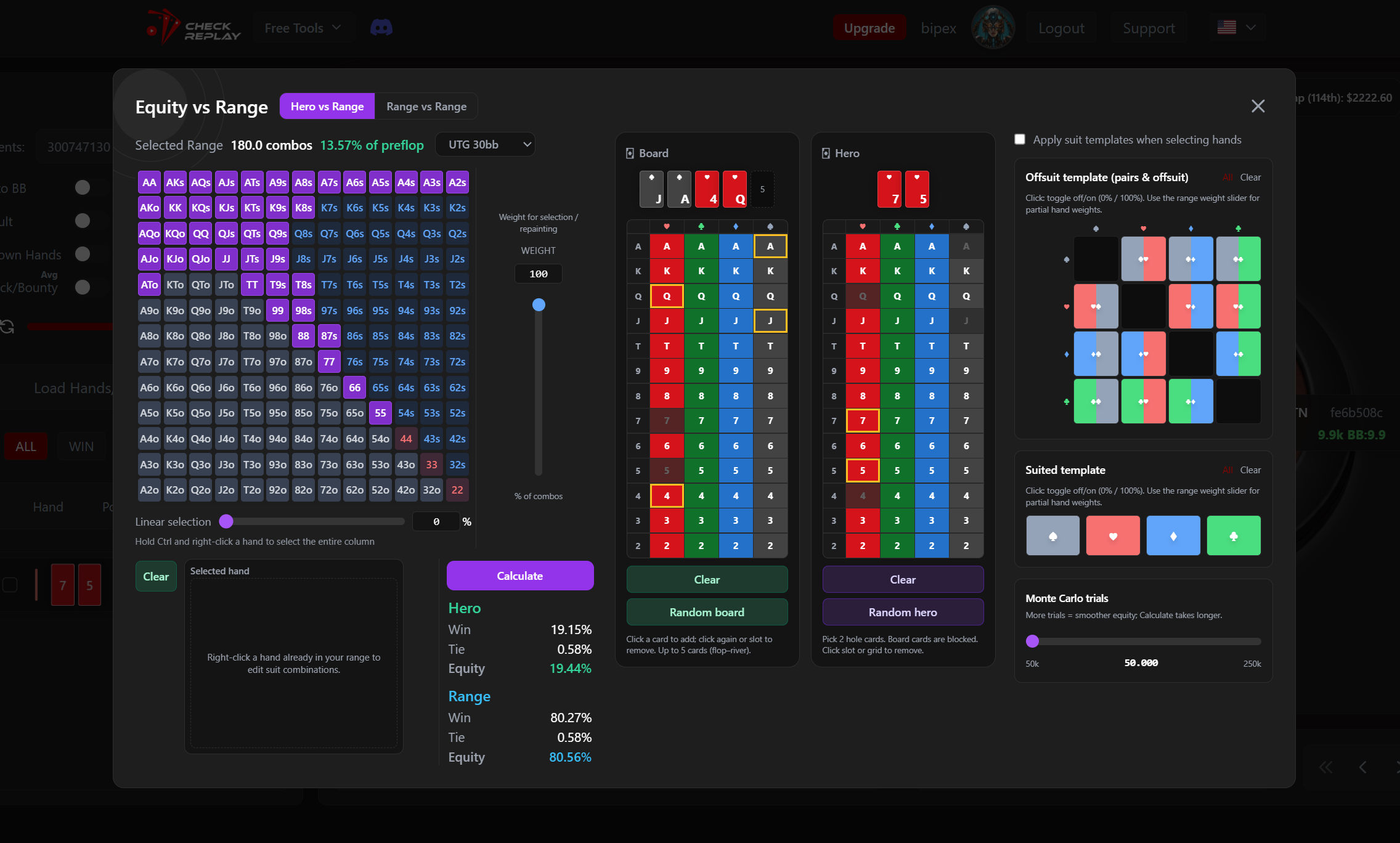
This is also a good place to use study tools well. In Check Replay, I like how easy it is to revisit the exact line, stack depth, and sizing sequence, because real bluff ranges depend on those details. Fast hand review helps, but only if the questions are good.
Use blockers only after the ranges are real
Now, and only now, I bring in blockers.
Blockers refine a close spot. They do not rescue a bad range assumption.
This is one of the most misunderstood parts of poker decision making. Blockers are powerful. But players often use them as a shortcut instead of a filter.
Let us say I hold the A♠ on a flush-completing board. That can matter. I may block some nut value hands. But I may also block missed hands that would have bluffed earlier or arrived differently. The blocker is not “good” by default. It changes the composition. I still need the range framework first.
Another example. If I hold a card that blocks top pair with a strong kicker, I may remove some value bets. Good. But if the opponent almost never bluffs this line anyway, removing a few value combos may still not make the call good.
This is why I tell students not to start with “I block X.” That sentence is often true and still useless.
Here are common blocker effects I care about:
- Blocking the strongest value hands
- Blocking missed draws that would bluff
- Blocking natural folds when I am considering a bluff of my own
- Unblocking weak missed hands that may give up or bluff too much
The point is not to worship blockers. The point is to place them correctly in the process. If I already think Villain has too little bluffing, a nice blocker can make the call less bad, but not good. If I think the spot is very close, blockers can swing the result.
When bluff frequency is near zero, blockers barely matter.
That line alone has saved many players from expensive hero calls.
Add risk premium and ICM at the end
This step exists for tournaments, not cash games. And it comes late for a reason.
ICM changes your calling threshold, not your opponent’s past actions.
I first estimate the hand in chip EV terms. Then, if tournament pressure exists, I adjust my threshold. Busting hurts more than gaining the same number of chips helps. That is risk premium.
On a bubble, for example, I may need more than raw pot odds suggest before I call an all-in. If pot odds say I need 33 percent, I might really need quite a bit more once payout pressure is included.
This does not mean Villain suddenly has a different river range because ICM exists. It means my standard for calling becomes tighter.
Here is the practical order I use in tournaments:
- Find the pot odds.
- Build value and bluff ranges.
- Estimate whether the call wins enough in chip EV.
- Adjust the threshold upward if payout pressure is high.
I have seen players misuse ICM by bringing it in too early and too vaguely. They say, “It is a final table, so I guess I fold.” That is not thinking. That is hiding from the hand.
If you are in cash, you can skip this whole step. That alone simplifies many close decisions.
Put it all together
So what does the full process look like in real time?
I use something close to this:
- What price am I getting?
- What value hands bet here?
- Which of those value hands really take this line?
- What bluff hands could exist?
- Which of those bluff hands really bet this player, this size, this pool?
- Do blockers change a close result?
- If this is a tournament, does ICM raise my threshold?
Good players are not faster because they guess better. They are faster because their question order is cleaner.
This order matters because each answer shapes the next one. Pot odds create the target. Value sets the base. Realistic filtering removes fantasy combos. Bluff construction fills in the missing side. Blockers fine-tune. ICM adjusts the final standard.
That is a complete thought process. Not a memorized rule. Not a magic read. A sequence.
Common mistakes I keep seeing
When I watch players move from recreational habits into serious study, the same leaks appear again and again. They are not usually caused by lack of knowledge. They come from applying knowledge out of order.
Most bad river decisions begin with a good concept used at the wrong time.
These are the mistakes I see most often:
- Starting with blockers instead of pot odds
- Ignoring the bet size and treating all river bets the same
- Counting every theoretical bluff combo as if players always fire
- Using balanced frequencies against opponents who are not balanced
- Confusing possible hands with likely hands
- Forgetting that sizing changes ranges
- Applying ICM before building the hand correctly
I think the “possible versus likely” mistake is the biggest one. A hand can exist. That does not mean it belongs in the final range with real weight. Strong hand reading is not about imagination. It is about discipline.
If you want another way to practice this, I recommend reviewing your biggest river pots and writing one sentence for each street: “What got added?” and “What got removed?” That keeps the hand honest.
I also like pairing this process with structured study notes. If you want a related breakdown of clean thought process, I suggest reading this guide on how to make poker decisions and this discussion on poker strategy without GTO. Both ideas fit the same theme: better questions beat random concepts.
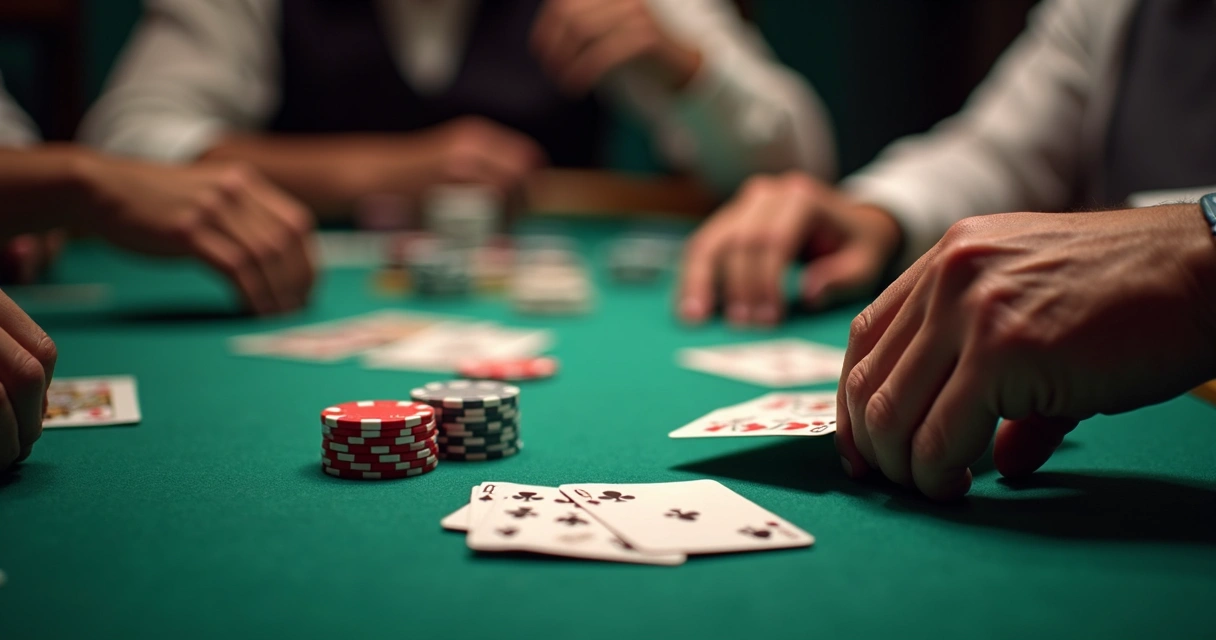 How I practice this thought process
Knowing the order is good. Training it is better.
I do not think most players need more concepts right away. I think they need better repetition. They need to rehearse the same sequence until it becomes natural under time pressure.
Here is a simple practice routine I like:
- Review ten river spots from recent sessions
- Write the pot odds for each one
- List value before bluffs every time
- Trim both ranges street by street
- Add blockers only at the end
- For tournaments, add risk premium last
This works because it trains discipline. It stops the mind from jumping ahead.
Sometimes I even cover my own hole cards at first during review. I only look at the line and ask what the bettor represents. Then I uncover my hand and see whether my blockers or bluff-catcher strength change anything. That little trick helped me separate hand reading from self-justification.
You improve poker thinking by repeating a clean process, not by chasing new buzzwords.
If you are serious about improvement, replaying hands one by one is worth your time. That is another area where Check Replay fits naturally. The easier it is to revisit a hand, share it with a coach, and walk through each street in order, the easier it becomes to train real decision quality instead of vague opinions.
 Conclusion
A hard poker spot rarely gets solved by one brilliant thought. In my experience, it gets solved by a chain of plain questions asked in the right order.
The best decision is usually the result of a clean sequence, not a clever shortcut.
Start with pot odds. Build value first. Then cut that value range down to the hands that really arrive. Build bluff candidates. Then cut those down even harder based on player type, pool habits, pressure, and sizing. Only after that should you look at blockers. Only after that, in tournaments, should you raise your threshold with ICM.
That is how experienced players think. Not perfectly. Not magically. Just in order.
I think this is good news for many players. You do not need to memorize everything. You do not need to force every hand into a theory phrase. You need a reliable structure for poker decision making, and you need enough honest review to trust that structure when the chips are in the middle.
If you want to train that process with real hands, review your spots with Check Replay and walk through them one question at a time. That is the kind of study that turns knowledge into better decisions.
Frequently asked questions
What is a good poker decision process?
A good process starts with pot odds, because they tell you how often you need to be right. After that, I build the opponent’s value range, then narrow it to the hands that really take that line. Next, I list possible bluffs and trim those based on player and pool tendencies. Only then do I look at blockers. In tournaments, I add ICM at the end. A good process moves from price, to ranges, to refinements.
How do I improve my poker thinking?
I improve my poker thinking by reviewing hands in a fixed order instead of relying on instinct alone. The best practice I know is to replay difficult hands, write down pot odds, separate value from bluffs, and filter both street by street. Doing this often builds discipline. Over time, your in-game choices become calmer and more accurate.
Is GTO necessary for winning at poker?
No. You do not need to memorize game theory outputs to become a winning player. Theory can help, but many profitable decisions come from reading ranges in the right sequence, understanding bet size, and adjusting to real player habits. You can win a lot by thinking clearly before thinking theoretically.
How can I avoid common poker mistakes?
I avoid common mistakes by not skipping steps. Do not start with blockers. Do not ignore pot odds. Do not assume every missed draw bluffs. Do not count every possible combo as likely. Build the hand carefully, and give more weight to what players really do in your games than to what they could do in theory.
What are basic poker strategy tips?
Some of the best basic tips are simple. Know your pot odds. Respect bet sizing. Separate value from bluffs when hand reading. Pay attention to player tendencies. In tournaments, account for risk premium. Study your hands after each session. If you want a practical way to do that, using a hand review tool like Check Replay can help you turn single hands into long-term progress.