Poker, to me, is not a card game. It’s a game of frequencies, combinations, and calculated guesses built on numbers. I’ve seen players obsess over “reading” faces or following their gut, but the real story happens with the math underneath. Strong players always talk about ranges, hand combinations, and how often something is likely to happen. That’s why, over time, understanding a few key concepts in poker math has changed not only how I play, but how I see every hand I review on modern tools like Check Replay. Suddenly, the fog of luck starts to clear, and the numbers begin to make sense.
Why poker is really a game of combinations
When I first learned Texas Hold’em, I obsessed over what exact hand my opponent might hold. Later, I realized this is not how good players think. Every decision we make should consider the full range of possible hands our opponent might play, not just one.
Let’s break down the language of ranges and how poker hand combinations work. Every two card holding is called a combo. When we talk about ranges, we really mean collections of these possible combos.
- Pocket pairs: Any pair like 7-7 or A-A. There are 6 possible ways to make a pocket pair (ex: A♠A♥, A♠A♦, etc.).
- Suited hands: Both cards the same suit, like A♠K♠. There are 4 combos of every suited non-pair hand (1 for each suit).
- Offsuit hands: Cards of different suits, like A♠K♦. There are 12 possible combos for every offsuit non-pair hand.
Why the difference? Out of 4 suits, there’s only one way to make, say, A♠K♠, while for AKo, you can mix every ace with every king that’s not that same suit, so there are many more.
Here’s why it matters. Hands like AKo (12 combos) appear three times as often as suited hands like AKs (4 combos). That means some hands just show up way more in practical play, and ranges built around offsuit hands are naturally wider.
Ranges are collections of hand combinations, not just “one hand.”
Once I started thinking in combos, I could better estimate how strong my opponent’s hand range actually was. For more on breaking down combos in play, I found this guide on poker combos and probabilities helpful when I was learning.
The probability of hitting the flop
I often hear, “Why do I never hit my sets?” The answer, always, is in the numbers. Say you have a pocket pair. The chance of flopping a set is about 11.8 percent. That’s not often! For flush draws with two suited cards, you’ll hit a flush on the flop just 0.8% of the time, but you’ll make a flush draw just over 10% of the time.
Other common draws:
- Open-ended straight draw: With hands like 6-7 on 5-8-9, you’ll see an OESD roughly 10.5% of the time.
- Two pair with unpaired hole cards: This happens about 2% of the time.
People often overestimate these chances because draws stick in our memory. That feeling you always miss is just variance. But there’s more: implied odds matter a lot, especially in tournaments. When set mining, for example, I want my implied payout to be big enough that it’s worth calling a raise even knowing I’ll miss eight times out of nine.
I’ve found set mining with small pairs has more value when stacks are deep and my opponents will pay off my sets. In tournaments, hundreds of spots are decisions like this. For beginners, a more detailed treatment can be found at Hold’em math basics, which covers these practical set mining odds.
Implied odds can turn a weak chance into a profitable play.
How boards interact with ranges
This is the real heart of No-Limit Hold’em. Ranges and the board texture are always in conversation. Some flop textures “hit” the preflop raiser’s range, while others fit the big blind defends.
Here’s what that means with a few simple examples:
- Low connected boards: A flop like 8-7-6 with two spades smashes a big blind defending range, because hands like 9-8, 7-5, suited connectors, and two pairs are all in there. The button will often be weaker.
- High, dry boards: Boards like A-7-2 rainbow favor the preflop raiser, who has more top pairs, strong aces, etc. in their range.
- Paired boards: Trip boards like K-K-4 reduce the number of “value” combos that can be made, since fewer kings are available to either player.
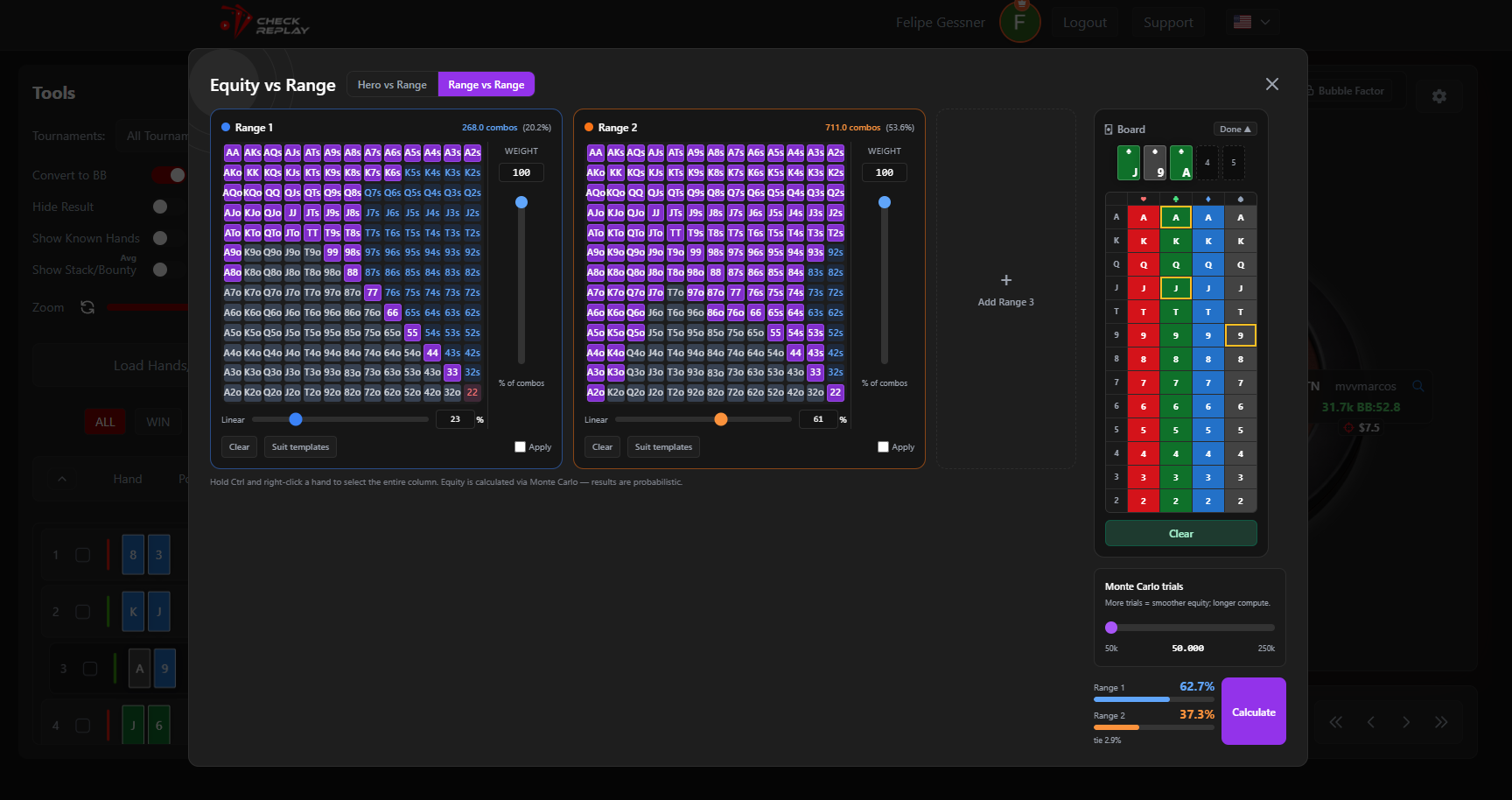
Understanding this is key to reading the story of a hand. Board coverage, nut advantage, and range advantage drive betting decisions. When I replay hands on Check Replay, seeing range distributions over different flops shows me why a bluff works in one case, but would fail badly in another. Equity visualization tools, like those I use in Check Replay, make these patterns much more clear for me.
The board doesn’t hit everyone equally—it’s about range overlap with the flop.
Blockers and card removal effects
I think blockers are where new players truly start to “see” the invisible math of poker. A blocker is a card you hold that reduces the number of strong combinations the opponent can have. Here’s a clear way I explain it to friends:
- If you hold the A♠, there is one less flush possible when the flush hits. Fewer combos for your opponent.
- When considering an all-in, having an ace in your hand blocks the nut flush value combos and makes your own bluff more credible.
- The same applies if you’re considering running a large bluff. Holding K♥ means there are fewer king-high flushes out there for your opponent, making your bluff more effective.
In tournament play, late-stage bluffs using blockers can be the difference between bubbling and building a stack. When I analyze spots on Check Replay, the blocker effects are simple to visualize, making it easier to spot winning bluffs or thin value bets.
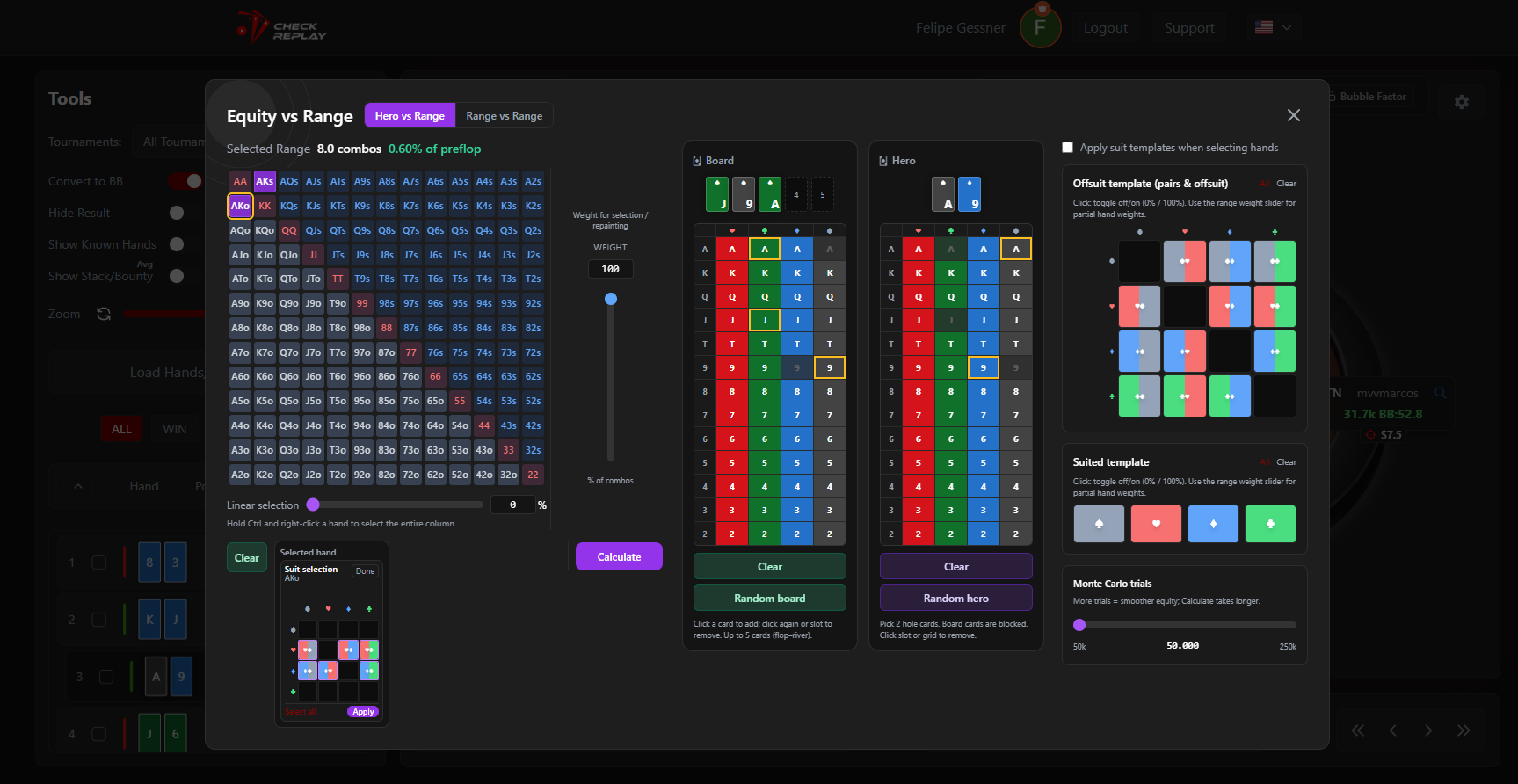
Look at this example:
You hold one Ace in your hand, and another Ace is already on the board. Now you want to know how many combinations of AK your opponent can still have.
The math becomes simple:
- Originally, there are 16 total AK combinations.
- But since two Aces are already visible, only 2 Aces remain in the deck.
- All 4 Kings are still available.
That leaves:
2 × 4 = 8 possible AK combinations.
This is called card removal, and it dramatically changes how ranges interact with boards and blockers.
You can easily validate these combo reductions in Check Replay, since the software automatically applies card removal effects during range analysis.
Blockers can turn an average hand into the perfect bluff candidate.
Why tournament poker changes everything
If you only play cash games, the expected value of each chip is simple. In tournaments, though, chips become more precious as you get closer to prizes. Because of ICM (Independent Chip Model), bubble factor, and risk premium, calling an all-in just before the bubble is a totally different calculation than it would be in a cash game.
- ICM: Each chip lost hurts more when prizes are near, so calling ranges get tighter.
- Bubble Factor: Outlasting one player means you cash; this affects who should risk chips and who shouldn’t.
- Risk Premium: The chip leader can put pressure on medium stacks, further warping standard calling frequencies.
While this isn’t a full ICM article, understanding these shifts is key. I make a lot of my late tournament decisions not just on equity, but on fold equity, pressure, and blockers—a mix that Check Replay visualizes clearly for different tournament spots, including pressure near the bubble.
In tournaments, not all chips are equal. The math changes as the payout ladder looms.
The biggest mistake most players make
If you take one lesson from this entire article, let it be this. Most players, myself included when starting out, think way too much about “what do I have?” and not enough about “what does my range look like?” or “how does my hand interact with the board and my opponent’s range?”. The best players see the whole map of possibilities.
They reason in distributions. Hands vs. ranges. Combo density. Board interaction. Likelihoods and probabilities, not just their own two cards.
Great poker is about understanding all the hands in play—not just yours.
Conclusion
If you’re intimidated by “poker math,” remember you’re not trying to become an engineer. You’re learning to see the hands, boards, and actions with new clarity—based on numbers, not superstition.
- Better choices come from knowing how combos, probabilities, and board textures shape what’s possible.
- Understanding ranges uncovers hidden profit spots and shows where to avoid trouble.
- Equity, blockers, and tournament pressure all flow directly from these basic principles.
I encourage you to start reviewing your own hands, noticing how these concepts come alive when you see full ranges, equity changes, and blockers on real hand histories. Check Replay is built specifically to make this kind of study visual, fast, and easy. Poker isn’t just about the cards you hold—it’s about the numbers that shape every showdown. Try reviewing your next big hand with this mindset, and see how quickly your understanding grows.
Frequently asked questions
What is a combo in poker math?
A combo refers to one specific two-card hand combination from the 1,326 possible in Hold’em. For example, A♠K♥ and A♣K♦ are two different combos, even though they are both Ace-King. Counting combos helps you estimate how often an opponent can have a certain holding in their range.
How do probabilities affect poker decisions?
Probabilities help you weigh risk and reward in every poker spot. If you know the chance you’ll improve your hand or the chance your opponent has a strong hand, you can make better choices about calling, betting, or folding. Math helps cut through “gut reads” to focus on real likelihoods.
What are range interactions in Hold’em?
Range interaction means how a player’s set of possible hands connects with the board texture. Some boards “hit” certain ranges more than others. Recognizing these patterns lets you spot profitable bet and bluff spots by understanding whose range the runout favors.
How can I use math to improve poker?
You can use math by routinely thinking about hand combinations, estimated probabilities, and betting frequencies during hands. Reviewing with visual tools, like Check Replay, can help you spot leaks in range construction and see hidden angles, especially in tournament settings.
Is studying poker math worth the effort?
Absolutely—grasping the basics of combinations, ranges, and simple probabilities will raise your poker results far faster than memorizing tells or wild bluffs. Math puts you on the right side of long-term profit and helps you understand what’s really happening at the table.