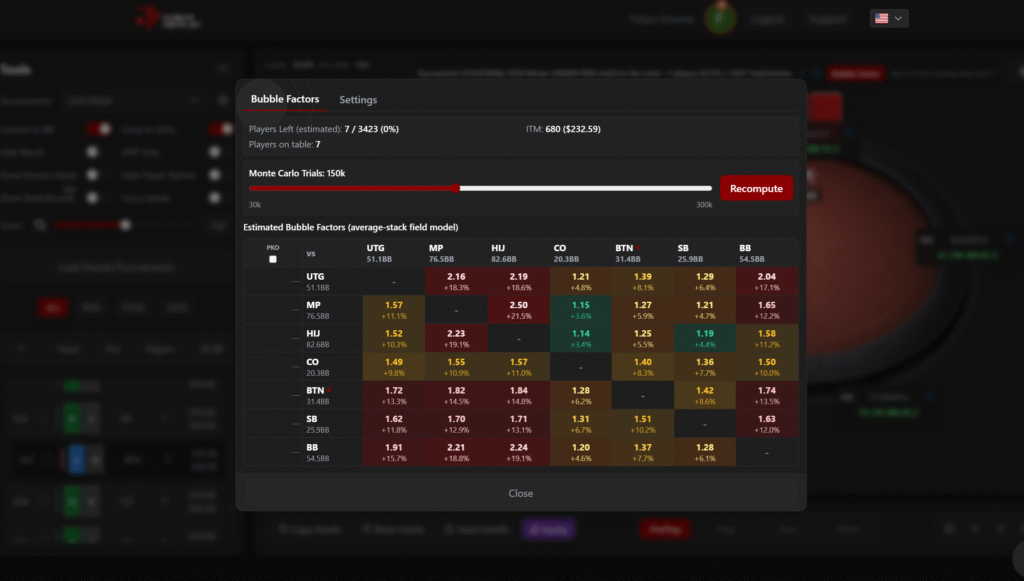
If you play poker tournaments, sooner or later, you face those moments loaded with tension: blinds are big, the average stack shrinks, and the next elimination means the field hits the money. This period is called the “bubble.” Over time, I noticed that surviving here requires more than knowing only hand strength or stack sizes. There’s a unique strategic concept that dramatically shapes play decisions: the bubble factor.
The bubble factor shines a spotlight on the high-pressure transitional zone in tournaments. If you want to make smarter moves and survive the bubble with confidence, I believe understanding this concept is not optional—it’s the core of tournament survival.
Understanding bubble dynamics in poker tournaments
The bubble is where most players know the pressure is highest. You see short stacks stall, big stacks push, and nearly everyone making decisions they’d never make in the early stages. Why does behavior change so much? It all comes down to pay jumps and risk calculation.
From my experience and study, the “bubble” is that point when just one or a handful of players remain to bust before everyone still in receives a payout. In Sit & Gos with nine players and three paid spots, for example, the bubble is when there are four left. But it isn’t just about getting paid—it changes how everyone values their chips, and how much risk hurts compared with reward.
The basics: What is bubble factor in poker?
Bubble factor is a mathematical measure describing how much more negative it is to lose chips than it is to gain chips during the bubble stages of a tournament. It is a way to quantify the risk premium—the amount of extra strength your hand must have to call an all-in compared to shoving yourself in the same spot.
The closer you are to the bubble, the more you want to avoid busting, even at the cost of folding hands you’d easily play in a cash game.
Bubble factor explains why sometimes rational players fold big hands on the bubble that they would enthusiastically play elsewhere.
How does bubble factor actually work?
In technical terms, bubble factor is the ratio of the negative value of busting or losing chips to the positive value of gaining chips. It ties directly into how prizes are distributed in tournaments—the math behind Independent Chip Model (ICM). ICM is a mathematical model that gives us a way to convert chip stacks to real-world money values, reflecting how each decision impacts your payout potential.
ICM shapes bubble factor because, under tournament payouts, doubling your chips doesn’t double your expected winnings, but busting always drops your share to zero, so “risk premium” exists.
Bubble factor, risk premium, and hand decisions
Let me break it down with a basic explanation:
- Risk premium is the extra hand strength you need to call an all-in because losing means more than just losing chips—it can mean missing the money.
- Bubble factor increases as you get closer to the bubble, making it tougher to justify risking your tournament life.
- Aggressors (the one who shoves) force their opponents to risk elimination, so they can shove looser than they can call.
At the beginning of a tournament, decisions are primarily based on chip EV, with only a small (but still present) risk premium.
As the tournament progresses, the risk premium gradually increases, reaching its peak around the bubble. After the bubble bursts, it drops significantly and stays relatively low until the final few tables (in large-field tournaments), where it begins to rise sharply again as players approach the final table.
Becoming a profitable player in tournaments depends on understanding when to push and when to fold, based on bubble factor and risk premium.
Real examples: Seeing the bubble factor in action
Let’s use GRAND PRIX $150 from Kelvin Kerber as example. This Hand history is available, for free here: https://lp.checkreplay.com/hh-kelvin-kerber , so feel free to download it and check the bubble factor in different spots by yourself, easily done on checkreplay.com; On this tournament, there were 3423 total entries, 533 hands played getting kelvin +$31k ont third place.

How Check Replay helps you study bubble factor
In Check Replay, once you configure the total entries and initial stack, you can automatically track the percentage of the field remaining for each hand.
Let’s use this Pocket Tens example to explore the bubble factor in more detail. In the next section, we’ll walk through what happens when you configure the tournament and click the red “Bubble Factor” button.
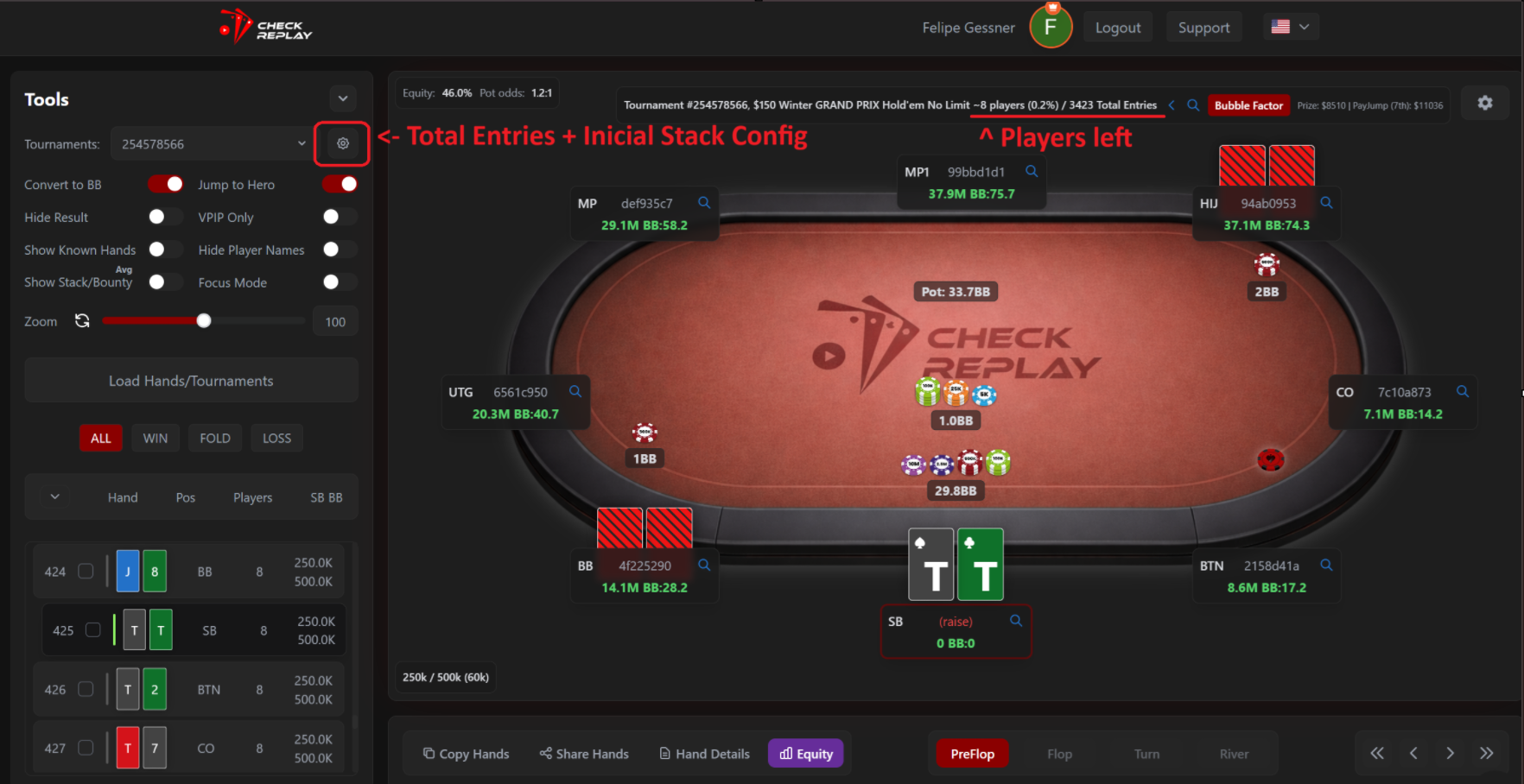
You will also need to add the payouts, but it is quite simple. For most poker sites, simply click the blue search button to the left of the red “Bubble Factor” button, and the tournament will be searched on SharkScope.
From there, click “Download as JSON” and then upload the JSON file under “Payout Structure” on Check Replay.
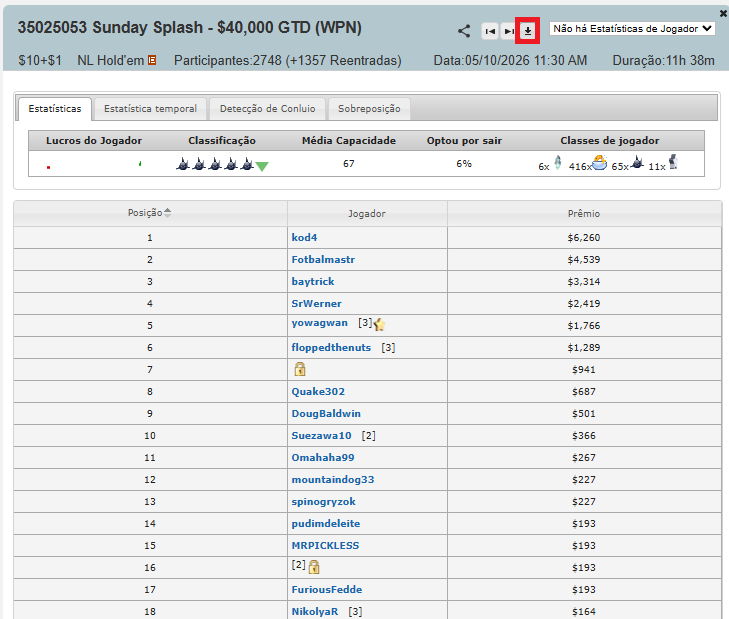
If the tournament you are reviewing is from GG Poker, use our structure-extractor instead, as GG blocked Sharkscope search. Go to https://web.checkreplay.com/structure-extractor and extract the payout as JSON; There are other tutorials on our blog, it is simple as well!
A deeper look: Risk premium math in bubble situations
After configuring the stacks and payout structure and clicking the red “Bubble Factor” button, this is what you will see: the Bubble Factor chart.
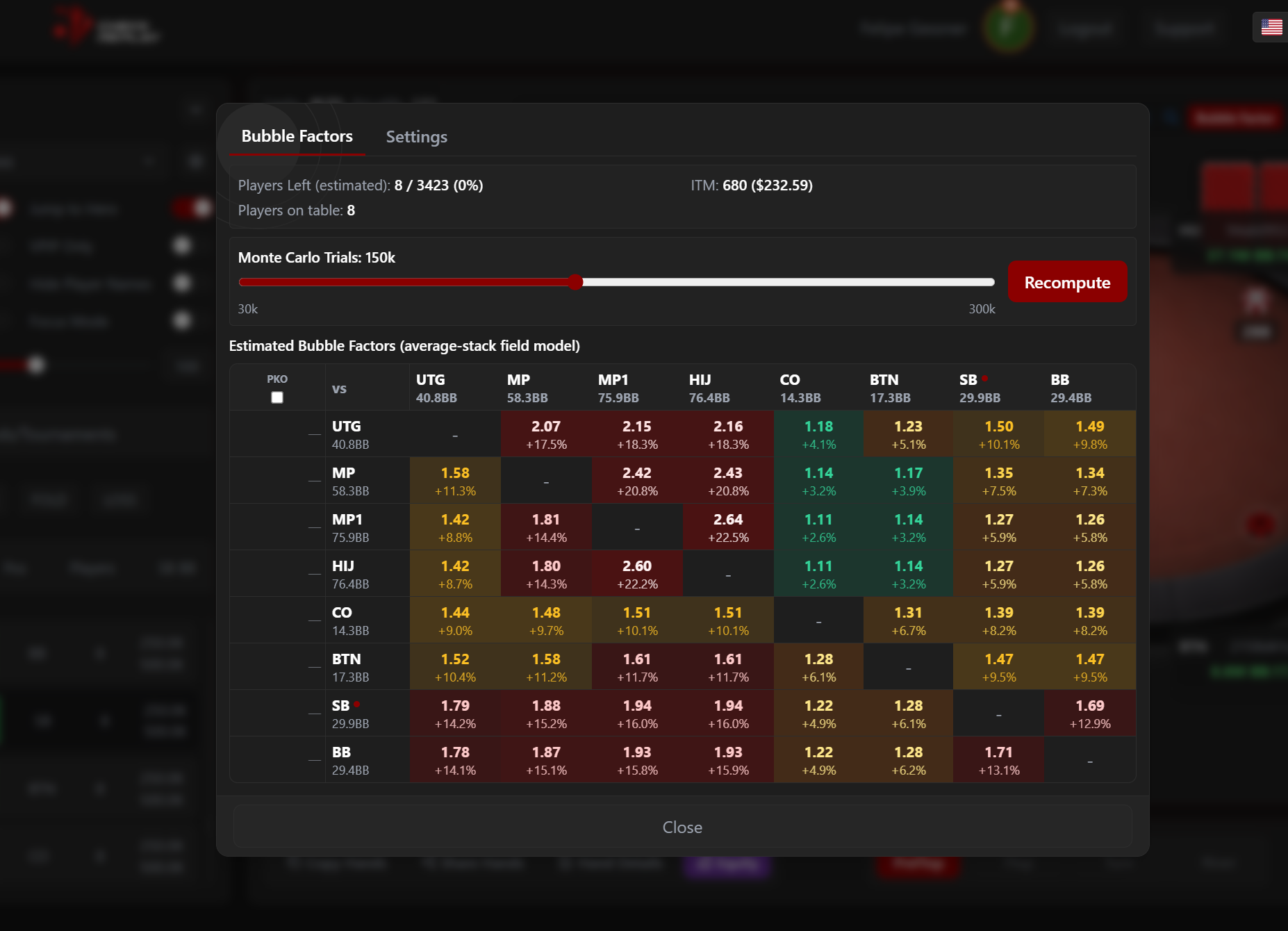
You can see the players’ positions and their stacks. Notice the red dot on the SB? That means that’s the hero.
If you look at the spot from the previous section, you’ll see that the stacks and positions match.
Looking at the stacks, you can see that Kelvin was under significant pressure with his mid stack. There were two players with smaller stacks and one player with a similar stack. This means that if he busts in this TT hand, he would lose two pay jumps (to the shorter stacks) and also miss the opportunity to compete for another pay jump against the player with a similar stack (the big blind).
Looking at the bubble chart for the first time might be confusing, but it’s actually very simple. Let’s start with the vertical columns: UTG, MP, MP1, HJ, CO, BTN, SB, and BB. The horizontal axis shows the same positions.
UTG vs UTG has no value because a player never plays against themselves. The same applies to MP vs MP, and so on.
Now let’s look at UTG vs MP. These are two big stacks: UTG with 40.8BB and MP with 58.3BB. The chart shows a 2.07 risk premium (+17.5%) for UTG vs MP, and 1.58 (+11.3%) for MP vs UTG.
What does this mean? It means that UTG (the smaller stack) needs an extra 17.5% equity to play against MP, while MP needs an extra 11.3% equity to play against UTG.
Why aren’t these values the same? Because if UTG loses all their chips to MP, they bust in 9th place. However, if MP loses an all-in to UTG, they would still have around 18BB and could continue competing for pay jumps.
To see Kelvin’s risk premium in this spot, look at the SB column (vertical axis). In the previous spot, he went all-in against the hijack, who was the chip leader. Kelvin needed an extra 16% equity to play against him, while the hijack only needed an extra 5.9% to call.
This equity requirement also applies postflop when the hand doesn’t end preflop. The hijack would have position and a strong ICM advantage over Kelvin, putting even more pressure on him.
That’s why TT is a clear all-in here. Well played, Kelvin.
What really changes with bubble factor poker strategy?
Through trial and error, and studying my hands with detailed tools, I learned to:
- Shove wider when big stack or everyone folds to me (because opponents can’t risk busting easily)
- Call narrower when facing all-ins from larger or similar stacks
- Wait for micro-stacks to bust whenever that improves fold equity
- Understand that sometimes, folding strong hands is actually optimal—when the risk premium is high enough
If you want to consistently reach the money, survive deeper, and make better final table appearances, mastering the bubble factor will give you a real edge compared to those stuck thinking only in chip values.
Conclusion: Turning bubble pressure into opportunity
From my viewpoint, learning how bubble factor works unlocked a new gear in my tournament game. The concept is much more than an interesting math trick. It’s the compass that points out when to be bold and when to fold, when to gun for chips, and when to step back. With tools like Check Replay showing you the math behind each move, understanding and using bubble factor to your advantage becomes much easier. If you want to step up your tournament game, start by reviewing your hands with bubble factor in mind. Find out where you’re pushing too hard or holding back needlessly. The better you get at navigating the bubble, the deeper you’ll run.
Ready to see your own hands through the lens of bubble factor? Try the Check Replay platform now and see your play with a new clarity only math—and experience—can bring.
Frequently asked questions
What does bubble factor mean in poker?
Bubble factor in poker refers to the increased penalty of busting out during the payout bubble, compared to the potential value of accumulating more chips. It’s a way to describe how calling all-ins gets riskier as the money approaches, especially compared with being the one pushing all-in.
How does bubble factor affect strategy?
Bubble factor changes how tight or aggressive you play on the bubble, mostly forcing players to call less often and shove more when they are the aggressor. Players adjust their range to avoid busting needlessly while putting pressure on others who fear elimination.
When should I consider bubble factor?
You should use bubble factor thinking any time you are close to the money in a multi-table tournament or approaching a big pay jump, especially when one more bust pushes everyone else into the next payout tier.
Is bubble factor important in tournaments?
Bubble factor is extremely relevant in tournaments and almost irrelevant in cash games. Tournament structure, payouts, and ICM all give bubble factor its power, shaping major decisions around the bubble phase.
Can bubble factor help me win more?
Yes, using bubble factor to inform your push, fold, and call decisions can lead to more regular cashes and bigger paydays by protecting your stack when risk is highest and picking smarter spots to accumulate chips.
Is ICM for poor people?
Absolutely not. ICM is one of the most important concepts in tournament poker. If you want to become a true crusher, you must understand it deeply and apply it consistently. Good luck!