Poker equity calculators answer a simple question that becomes increasingly important as you improve:
How much equity does my hand or range have against my opponent’s range?
But the tools used to answer that question can be very different.
Flopzilla has been one of the most popular poker range-analysis tools for years. It combines equity calculations with a detailed breakdown of how a range interacts with a board.
Power-Equilab takes the concept further, offering a more complete set of advanced range and equity analysis features.
And Check Replay takes a different approach: provide the most important equity and range calculations for free, directly inside the same environment where you are already reviewing your poker hands.
All three can be useful.
The best choice depends on whether you want a quick equity calculation, detailed range analysis, or a more complete standalone study tool.
Flopzilla vs Power-Equilab vs Check Replay: Quick Comparison
| Feature | Check Replay | Flopzilla | Power-Equilab |
|---|---|---|---|
| Price | Free | Low-cost, one-time payment | More expensive, recurring license |
| Current pricing | Free | $25 lifetime license | Annual subscription available |
| Hero vs Range | Yes | Yes | Yes |
| Range vs Range | Yes | Yes | Yes |
| Multiple ranges | Up to 3 ranges in Check Replay Range vs Range | Multiway calculations supported | Up to 6 ranges |
| Weighted ranges | Yes | Yes | Yes |
| Specific suits | Yes | Yes | Yes |
| Board selection | Yes | Yes | Yes |
| Hand-strength breakdown | Basic equity focus | Very detailed | Very detailed |
| Range-analysis depth | Good for everyday analysis | Advanced | Most complete of the three |
| Integrated with a hand replayer | Yes | No | No |
| Best for | Fast hand review and equity analysis | Detailed range-vs-board study | Advanced dedicated equity study |
Flopzilla’s official website currently lists its license at $25 as a one-time payment, with future upgrades included. Flopzilla Power-Equilab is sold through time-based licenses; a current listing offers a 12-month license for $42. Gipsy Team Shop
The important difference, however, is not just price.
It is how each tool fits into your poker study process.
What Is Flopzilla?
Flopzilla is primarily a range and board analysis tool for Texas Hold’em.
You select a range, enter a board, and Flopzilla shows how that range interacts with it.
Instead of simply telling you:
Range A has 58% equity.
Flopzilla can break down what is actually inside that range.
For example, it can show how often the range contains:
- top pair;
- middle pair;
- overpairs;
- sets;
- flush draws;
- straight draws;
- gutshots;
- and other hand categories.
This is one of Flopzilla’s biggest strengths.
Its official description emphasizes exactly this use case: understanding how frequently a range connects with a board, alongside heads-up and multiway equity calculations, filters, equity graphs and detailed range statistics. Flopzilla
That makes Flopzilla particularly useful when your question is not simply:
“Who has more equity?”
but:
“Why does this range have this equity, and what kinds of hands actually make up that range?”
Flopzilla’s biggest advantage: understanding range composition
Imagine BTN opens and BB calls.
The flop is:
9♥ 8♦ 7♥
You can calculate BTN versus BB equity relatively easily.
But that number alone does not tell you how the ranges interact.
You may want to know:
- Who has more straights?
- Who has more two pair?
- How much of each range is one pair?
- How many draws does each player have?
- Which range improves more often on different turns?
This is where Flopzilla becomes much more powerful than a simple equity calculator.
It does not only calculate the result.
It helps you dissect the range.
How Much Does Flopzilla Cost?
One reason Flopzilla remains attractive is its pricing.
At the time of writing, the official Flopzilla website lists the software for $25, paid once. The license is lifetime and includes future upgrades. Flopzilla
That makes it relatively inexpensive compared with many poker study tools.
If you frequently perform detailed postflop range analysis, it is difficult to argue that Flopzilla is expensive.
The real question is whether you actually need that additional depth.
What Is Power-Equilab?
Power-Equilab is another advanced poker equity calculator, developed as a more powerful version of the original Equilab concept.
Like Flopzilla, it goes significantly beyond simply calculating one hand against one range.
Power-Equilab includes tools for weighted ranges, sub-ranges, equity graphs, heatmaps, hand-strength distributions, scenario analysis, hand-history imports and other forms of detailed range analysis. Current product listings also describe an Equity Trainer and EV calculations using decision trees. Gipsy Team Shop
Of the three tools compared here, Power-Equilab is the most complete dedicated equity-analysis environment.
That depth also makes it the option most likely to appeal to players who spend substantial amounts of time doing dedicated off-table range research.
Power-Equilab and Multi-Range Analysis
One advantage of Power-Equilab is the ability to work with more ranges simultaneously.
Check Replay currently allows you to compare up to three ranges inside Range vs Range.
Power-Equilab can go further, allowing more complex multi-range scenarios with as many as six ranges.
For most standard poker study questions, two ranges are enough.
For example:
BTN opening range vs BB defending range
or:
Hero calling range vs Villain shoving range
But multiway analysis can become useful when studying pots involving several players.
This is where a dedicated tool such as Power-Equilab offers more flexibility.
What Does Check Replay’s Equity Calculator Do?
Check Replay approaches the problem from a different direction.
Instead of trying to replace every specialized range-analysis feature available in software such as Flopzilla or Power-Equilab, the goal is to make the equity tools players use most frequently available directly alongside their hand review.
There are two main modes:
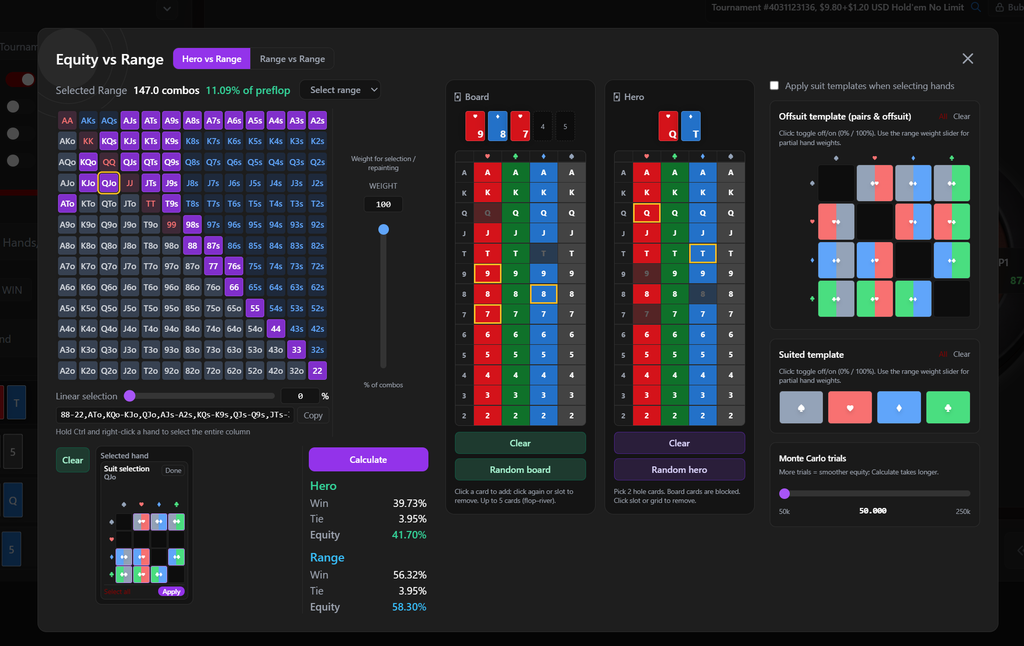
Hero vs Range
Select Hero’s exact cards and compare them against an opponent’s range.
You can define:
- Hero’s cards;
- the board;
- Villain’s range;
- individual combinations;
- hand weights;
- specific suits;
- and the number of Monte Carlo simulations.
Check Replay then calculates Hero’s win percentage, tie percentage and total equity against the selected range.
[Insert Hero vs Range screenshot here]
This is especially useful during hand review.
Instead of replaying a hand, opening another program, recreating the board and entering the ranges again, you can calculate the equity from the same environment where you are already studying the hand.
Range vs Range in Check Replay
The second mode is Range vs Range.
Instead of giving Hero two exact cards, you can compare complete ranges against each other.
Check Replay currently allows you to add up to three ranges.
[Insert Range vs Range screenshot here]
This is useful for questions such as:
- How does BTN’s opening range perform against BB’s calling range?
- How does a value range perform against a bluff-catching range?
- What happens to the equities when we tighten one player’s range?
- How do three ranges interact in a multiway pot?
You can also select specific boards and individual suits, which becomes important when card removal affects the result.
Check Replay vs Flopzilla: Are the Equity Results Similar?
For normal hand-versus-range and range-versus-range calculations, the resulting equities should be very similar when the tools are given the same inputs.
The important condition is same inputs.
That means:
- same range;
- same weights;
- same suits;
- same board;
- same dead cards or blockers;
- and equivalent calculation settings.
Check Replay uses Monte Carlo simulation for its equity calculations, so increasing the number of trials produces a smoother estimate.
This means tiny differences between calculations are not necessarily strategically meaningful.
If one tool reports approximately 41.7% equity and another produces a value very close to it, the important conclusion from the hand is usually unchanged.
The bigger difference between Check Replay and Flopzilla is therefore not the basic equity result.
It is what happens after the result is calculated.
Where Flopzilla Goes Further
Flopzilla gives you considerably more information about how a range is constructed postflop.
Suppose two ranges have:
Range A: 52% equity
Range B: 48% equity
Check Replay gives you the equity comparison you need to continue analyzing the decision.
Flopzilla can go much further and help explain that 52%.
It can show how frequently the range contains different hand strengths and draws, allowing you to investigate the structure behind the equity number. Its current feature set includes detailed range distributions in percentages and combos, configurable postflop statistics, equity graphs and range-versus-board breakdowns. Flopzilla
For dedicated range research, this is a major advantage.
So if the goal of the study session is:
“I want to deeply understand how this entire range hits this board.”
Flopzilla is the stronger tool.
If the question is:
“I am reviewing this hand and need to know my equity against this range.”
Check Replay may already give you everything you need without leaving the hand.
Where Power-Equilab Goes Further
Power-Equilab takes dedicated analysis another step further.
Its feature set includes tools such as:
- range and sub-range calculations;
- hand weighting;
- equity heatmaps;
- equity graphs across streets;
- hand-strength distribution;
- scenario analysis;
- multiple-flop calculations;
- range reduction;
- an equity trainer;
- and EV calculations with decision trees. Gipsy Team Shop
If your objective is advanced range research and you regularly use these features, Power-Equilab is the most complete option in this comparison.
But completeness has a cost.
You are paying for a dedicated analysis package rather than simply accessing an equity calculator while reviewing a hand.
For many players, that distinction matters more than which software technically has the largest feature list.
The Biggest Check Replay Advantage: The Equity Calculator Is Inside the Replayer
This is where the comparison changes.
Flopzilla and Power-Equilab are primarily dedicated study tools.
Check Replay’s equity calculator is part of a broader hand-review workflow.
You can import your actual poker hand, replay the action, identify the difficult decision, open the equity tool, build the opponent’s range and calculate the spot without reconstructing the entire hand in another program.
Then you can continue studying the same hand.
That means your workflow can be:
Import → Replay → Identify the decision → Build a range → Calculate equity → Adjust the range → Return to the hand
rather than:
Replay hand → open separate software → recreate situation → calculate → return to replayer
That convenience becomes increasingly valuable when reviewing many hands from a session or tournament.
Free vs $25 Lifetime vs Subscription
Pricing makes the use cases even clearer.
Check Replay
Equity calculator: Free
For someone who wants to calculate Hero vs Range or Range vs Range while reviewing poker hands, there is no additional software purchase required.
Flopzilla
$25 one-time payment
Flopzilla is extremely inexpensive for the amount of dedicated range-analysis functionality it provides, and its current license includes future upgrades. Flopzilla
For players who want detailed hand-strength and range-vs-board analysis, it offers a lot for a small one-time payment.
Power-Equilab
Paid subscription
Power-Equilab is the more feature-heavy option, but unlike Flopzilla, access is sold through time-based licenses. A current listing offers one-, two-, six- and twelve-month options, with the annual license listed at $42. Gipsy Team Shop
For serious users of its advanced functionality, that may be worthwhile.
For someone who only needs occasional equity calculations, it may be more than necessary.
Which Poker Equity Calculator Is Best?
There is no reason to pretend that one tool is objectively better in every situation.
They serve somewhat different users.
Choose Check Replay if…
You primarily want to:
- review your own poker hands;
- calculate equity without leaving the replayer;
- compare Hero against a range;
- compare up to three ranges;
- use weighted hands and specific suits;
- analyze spots quickly;
- and use the calculator for free.
For the majority of routine hand-review questions, this may be enough.
Choose Flopzilla if…
You want to:
- deeply study how ranges hit specific boards;
- break ranges down by hand strength;
- analyze draws and made hands;
- use detailed postflop filters;
- investigate board textures;
- and pay once rather than maintain a subscription.
Flopzilla remains particularly strong for range-vs-board analysis.
Choose Power-Equilab if…
You want:
- a more complete dedicated equity-analysis package;
- more complex multi-range analysis;
- advanced range and sub-range tools;
- equity graphs and heatmaps;
- scenario analysis;
- trainers;
- and additional analytical features beyond basic equity calculation.
Power-Equilab makes the most sense when these advanced functions are part of your regular study routine.
Flopzilla Alternative: Is Check Replay Enough?
If you are searching for a free Flopzilla alternative, the answer depends entirely on what you use Flopzilla for.
If you need Flopzilla’s detailed breakdown of how often a range makes top pair, middle pair, draws, sets and other hand classes, Check Replay is not a direct replacement.
Flopzilla is more specialized in that area.
But if what you usually need is:
Hero vs Range
or:
Range vs Range
then Check Replay can cover that part of the workflow for free.
And because the equity calculator lives inside the hand replayer, it may actually be more convenient when the calculation begins with a real hand you just played.
That is the important distinction.
Check Replay is not trying to be Flopzilla with a different interface.
It is trying to make equity analysis part of hand review instead of a separate step.
Power-Equilab Alternative: Do You Need All the Advanced Features?
The same logic applies to players searching for a Power-Equilab alternative.
Power-Equilab offers more analytical functionality than Check Replay’s equity calculator.
That is not really disputed.
The question is whether you use it.
If you regularly use advanced heatmaps, multi-range scenarios, range reduction, trainers and detailed equity analysis, a dedicated tool makes sense.
But many poker players open an equity calculator for much simpler questions:
What is my equity against this range?
What happens if Villain calls tighter?
How does one range perform against another?
How much does removing these combinations change the result?
For those questions, a simpler calculator integrated into the actual hand-review process can be more practical.
Flopzilla, Power-Equilab and Check Replay Solve Different Problems
It is tempting to compare poker tools by counting features.
But the tool with the most features is not automatically the best tool for every player.
Power-Equilab is the most complete dedicated analysis package of these three.
Flopzilla offers excellent range and board analysis at a very low one-time price.
Check Replay offers the core equity calculations for free and places them directly inside the workflow where many players actually need them: reviewing the hands they played.
The right choice depends on the question you are trying to answer.
If you want to dissect exactly how a range interacts with a board, use a specialized tool such as Flopzilla.
If you need a deeper dedicated equity-analysis environment, Power-Equilab provides more advanced options.
If you are replaying a hand and simply want to build ranges, compare equities and continue your analysis without changing tools, Check Replay provides a much simpler path.
Final Thoughts
Flopzilla and Power-Equilab are established poker study tools for good reason.
There is no need for Check Replay to pretend they do not offer functionality that goes beyond a basic equity calculation.
Flopzilla provides a much deeper breakdown of hand strength and range interaction.
Power-Equilab goes further still with an extensive set of dedicated analysis features and support for more complex range comparisons.
But not every poker decision requires the most complex tool available.
Sometimes you simply want to replay a hand, assign your opponent a realistic range and answer:
How much equity did I actually have?
For that workflow, Check Replay’s free Equity vs Range tools may be all you need.
And because they are already inside the replayer, the calculation stays where it belongs:
next to the hand you are trying to understand.
Try the Check Replay equity calculator for free and compare your own hands, ranges and boards directly inside the replayer.