Imagine two players with identical skill. Same knowledge, same discipline, same understanding of ranges and bet sizing. One of them consistently makes twice as much money as the other. How? They did not study harder or memorize more charts. They simply chose better games. One sat down at soft tables full of weak players, while the other grinded tough tables full of tough regulars. That difference alone, repeated over thousands of hours, is enormous.
This is the power of table selection, and it might be the most underrated skill in all of poker. Players obsess over solver output, three-bet ranges, and blocker theory, while quietly ignoring the single decision that shapes their win rate more than almost anything else: which game to play in the first place. Because in poker, your profit does not come from playing well in a vacuum. It comes from playing better than your opponents, and choosing weak opponents is the fastest way to guarantee that edge.
This guide explains why table selection matters so much, how to identify the games worth playing, and the practical habits that turn game selection into a genuine, repeatable edge. By the end, you will understand why the pros treat table selection as seriously as they treat strategy itself.
Why Table Selection Is So Valuable
Let me start with the uncomfortable truth that reframes how you should think about poker. Your win rate is relative, not absolute.
You do not win money by playing well. You win money by playing better than the people at your table. A world-class player sitting with other world-class players might barely break even after the rake, while a merely decent player sitting with beginners crushes the game. The skill gap between you and your opponents, not your raw skill level, determines your profit. This is why table selection is not a minor optimization. It is a fundamental driver of results.
Consider the math. If you sit at a table with three weak players and five strong ones, your edge is thin, and the rake might eat most of it. If you sit at a table with five weak players and three strong ones, your edge balloons, and you print money from the same amount of skill. The cards are the same. Your strategy is the same. The only difference is who you chose to play against, and that difference is worth more than almost any strategy adjustment you could make.
Furthermore, table selection compounds with every other skill you have. The better you play, the more you extract from weak opponents, so choosing soft games multiplies the value of everything else you have learned. This is why serious players treat game selection as a core competency rather than an afterthought. It is the lever that amplifies all their other edges.
What Makes a Table Worth Playing
So how do you identify a good table? A few clear signals separate a profitable game from a grind, and learning to read them quickly is the heart of table selection.
The single most important signal is the presence of weak players. A good table has at least one or two obvious fish, recreational players who call too much, play too many hands, and make clear mistakes. These players are the source of the money at the table, and your job is to sit where they are. Whenever you scan a lobby or a room, you are really scanning for weak players to sit near.
Several statistics and observations reveal a soft table:
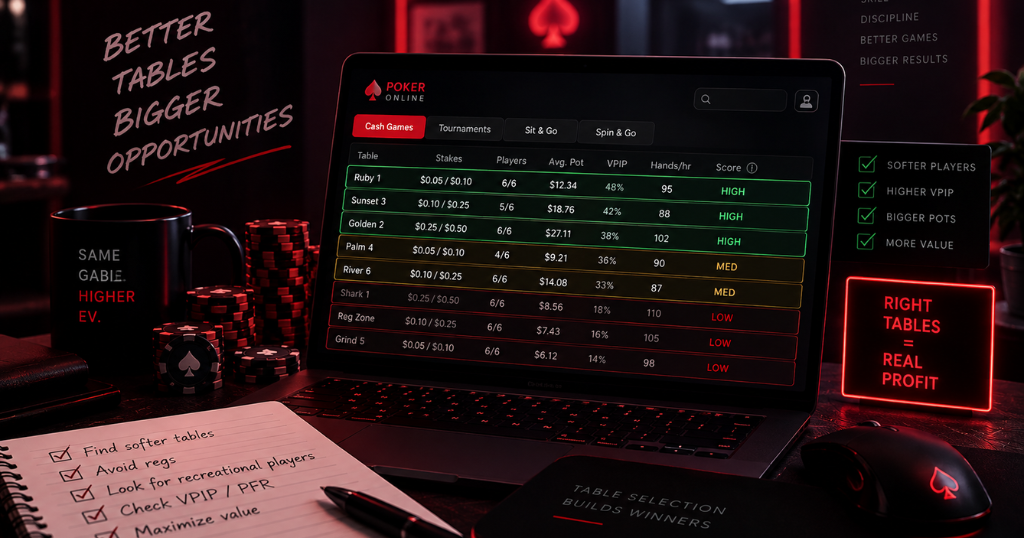
- High average pot size relative to the stakes: Big pots often mean loose, action-heavy play, which usually means weak players splashing around.
- A high percentage of players seeing the flop: When many players see flops, the game is loose and passive, which favors a disciplined player.
- Short stacks and recreational buy-ins: Players who buy in for less than the maximum are often recreational and less experienced.
- Obvious mistakes in the hands you observe: Limping, calling down light, and passive play all signal weak opponents worth targeting.
Conversely, a bad table is full of regulars playing solid, aggressive poker, with small pots, tight play, and few obvious mistakes. Whenever you find yourself at a table of tough, thinking players, the correct move is usually to leave, because your edge there is thin or nonexistent.
Position at the Table Matters Too
Table selection is not only about which table to join. It is also about where you sit within that table, a detail most players completely ignore.
In games where you can choose your seat, you want the weak players on your right and the strong players on your left. Why? Because you act after the players to your right, which means you have position on them throughout the hand. Having the fish on your right lets you see their action before you decide, giving you maximum information and control against the very players you most want to exploit.
The strong players on your left are less of a problem when they act after you, because you can simply avoid marginal spots against them. This connects directly to table position in poker, the principle that acting last is a massive advantage. Seat selection extends that principle beyond individual hands to your entire session, positioning you to have the informational edge against the players you profit from most.
So whenever you sit down, do not just take the first open seat. Look at who is sitting where, identify the weak players, and choose the seat that puts them on your right whenever possible. This small adjustment, applied over thousands of hands, meaningfully increases your win rate against the exact opponents you came to beat.
Knowing When to Leave a Table
Table selection is a continuous process, not a one-time decision. So knowing when to quit a table is just as important as knowing which to join.
Games change. The fish you sat down to exploit busts and leaves, replaced by a tough regular. The soft table you found at midnight tightens up as the recreational players go to bed. Whenever the conditions that made a table profitable disappear, your reason for sitting there disappears too. The disciplined move is to leave, even if you are winning, because your future expected value depends on the current lineup, not on how the session has gone so far.
Many players struggle with this because leaving a table feels like quitting, or they want to stay and win back losses from a specific opponent. But poker is not about proving anything or chasing individual players. It is about maximizing your long-term expected value, and that means constantly evaluating whether your current table is still worth playing. As the 5 biggest mistakes that hold back players makes clear, being honest about table selection and moving to softer games is professionalism, not cowardice.
So build the habit of periodically reassessing every table you play. Ask whether the weak players are still there, whether the game is still loose, and whether your edge is still meaningful. If the answer is no, leave and find a better game. The willingness to quit a table that has gone bad separates disciplined winners from stubborn players who bleed their profits back.
Table Selection in Online vs Live Poker
The mechanics of table selection differ between online and live poker, and understanding both helps you apply the skill wherever you play.
Online, table selection is fast, data-rich, and constant. You can scan lobbies, read statistics on average pot size and players per flop, use tracking software to identify known weak players, and switch tables instantly. This makes online table selection incredibly powerful, because you have information and flexibility that live players can only dream of. Serious online players often use software specifically to find the softest games and the weakest opponents, treating game selection as a systematic process rather than a guess.
Live, table selection is slower and more social but just as important. You cannot read statistics, so you rely on observation. Watch a table before you sit, note which players are drinking and gambling versus which look focused and disciplined, and request table changes when your game gets tough. Live players who master this quietly outperform equally skilled players who just take whatever seat they are given.
In both formats, the principle is identical. Find the weak players, sit where you have position on them, and leave when the game goes bad. Only the tools differ. Whether you are scanning an online lobby or reading a live room, the goal is always to maximize the skill gap between you and your opponents.
Common Table Selection Mistakes
Even players who understand table selection make consistent errors. So let me highlight the ones that quietly cost the most money.
First, playing out of boredom or ego. Many players sit at tough tables because they want action or because they want to prove they can beat strong opponents. Both are expensive habits. Whenever you catch yourself playing a tough game for reasons other than profit, remember that your ego does not pay your bills, and your win rate does.
Second, staying too long at a table that has gone bad. As discussed, games change, and the fish leave. Players who fail to reassess keep grinding tables that were profitable an hour ago but are now full of regulars. Build the habit of constant reassessment.
Third, ignoring seat selection. Even at a soft table, taking a bad seat with the fish on your left throws away part of your edge. Whenever you can choose your seat, choose deliberately.
Fourth, playing too many tables to find action. Online players sometimes load up so many tables that they cannot possibly table-select well, ending up in mediocre games just to fill screens. Fewer, softer tables almost always beat more, tougher ones, because your win rate per table matters more than your raw volume.
Fifth, forgetting the rake. A game can look soft but still be barely beatable if the rake is high. Whenever you evaluate a table, factor in the rake, because a heavily raked soft game can be less profitable than a lightly raked medium one.
Discover the most efficient way to play poker with Check Replay. Subscribe to the plan that best fits your needs!
Final Thoughts
Table selection is the highest-EV skill that almost nobody talks about, and that neglect is exactly why it remains such a powerful edge. While everyone else pours their energy into solver study and advanced theory, the players who quietly print money are the ones who show up, find the softest game in the room, sit in the best seat, and leave the moment the conditions turn. Their strategy matters, of course, but their game selection multiplies it.
So before you obsess over your next three-bet range, ask yourself a simpler and more valuable question. Are you even playing in the right game? Because no amount of strategic brilliance rescues a player who insists on battling tough regulars, and no amount of mediocrity fully squanders the edge of a player who consistently sits with weak opponents. Choose your games well, and you win before the cards are even dealt.
Frequently Asked Questions
What is table selection in poker?
Table selection is the practice of choosing which games and tables to play based on the strength of the opponents. Since your profit comes from playing better than your opponents, selecting soft tables full of weak players dramatically increases your win rate compared to playing tough tables full of strong regulars.
Why is table selection so important?
Table selection is important because your win rate is relative, not absolute. You make money by playing better than your opponents, so sitting at soft tables with weak players maximizes your edge. The same skill produces vastly different results depending on who you play against, which makes game selection one of the highest-EV decisions in poker.
How do I identify a good poker table?
Look for signals of weak play: a high average pot size relative to the stakes, a high percentage of players seeing the flop, recreational short buy-ins, and obvious mistakes in the hands you observe. A good table has at least one or two clear fish, while a bad table is full of tight, aggressive regulars making few mistakes.
Where should I sit at a poker table?
When you can choose your seat, put the weak players on your right and the strong players on your left. This gives you position on the fish, letting you act after them and gain maximum information against the players you most want to exploit. Seat selection extends positional advantage across your entire session.
When should I leave a poker table?
Leave a table whenever the conditions that made it profitable disappear. If the weak players bust or leave, if the game tightens up, or if tough regulars replace the fish, your edge shrinks and you should find a better game. Leaving a table that has gone bad is disciplined, not quitting, even if you are currently winning.