
I have seen this question asked for years, and I think many players ask it the wrong way. They want one simple answer. One room. One final ranking. One place where the games are always easy. In my experience, that answer does not exist.
There is no universally softest poker site, because softness comes from the makeup of the player pool, not from the logo on the client.
That idea changes everything. A room can have many very strong regulars and still offer highly beatable games if enough casual players keep entering the ecosystem. On the other hand, a smaller room can look soft from the outside, yet feel hard in practice if the available tables are mostly shared by the same studied regulars.
When I review hands, I try to avoid lazy labels. The same is true when I think about poker fields online. I prefer asking better questions. Who is entering the games? Who is leaving? What formats attract new money? What regions are feeding the pool? How mature is that market?
What makes a poker site soft?
Before I compare major rooms, I want to define the word properly. Many players say a game is soft when they simply mean that weak players are present. That is only part of the story.
A soft poker game is a game where meaningful mistakes are being made often enough relative to the skill level of the rest of the pool.
That matters because a table full of average players may be softer for one person than a table with two terrible players and four strong pros. Softness is relative. Your edge depends on what kinds of mistakes appear, how often they happen, and whether the structure lets you capture that value after rake.
When I judge online poker fields, I usually think about several forces at once:
- Recreational-to-regular ratio
- How many new players enter the ecosystem
- How long the market has existed in a mature form
- Overall liquidity and game volume
- Average skill exposure to modern strategy
- Geography and player culture
- Local regulation and market segregation
- Marketing, ambassadors, and sponsorships
- Cash games versus tournaments
- Micro, low, mid, or high stakes
- Time of day and day of week
- Series schedules, satellites, and qualifiers
- Rake and rewards structure
These factors interact. A room with lower average skill can still be unattractive if there is little traffic. A room with excellent traffic can still be great if promotions keep fresh recreational money coming in. This is why I never trust blanket statements about the softest poker sites.
The pool creates the softness.
One of the best ways I can say it is this: The softest poker ecosystem may be the one bringing new recreational players into poker faster than experienced players can extract them.
That sentence explains why giant networks can stay profitable for strong players even when the regulars are very good. The room does not need weak grinders. It needs enough fresh, casual, or temporary traffic.
Why liquidity changes everything
Liquidity is one of the most misunderstood ideas in online poker. People often think more traffic means tougher games because more strong players show up. That is partly true. But big traffic also means more diversity. More formats. More qualifiers. More one-time entrants. More players taking a shot above their comfort zone.
Large traffic does not only attract professionals, it also creates more ways for recreational players to enter the pool.
I have always felt this most clearly in tournament poker. Big guarantees attract all kinds of entrants. Some are elite players. Some are part-time grinders. Some won a satellite. Some are trying one session after seeing a promotion or live event stream. The resulting field is mixed, not uniform.
This is also why field quality can change fast. A quiet weekday cash pool at one stake may feel structured and hard. That same room during a major series, especially around qualifiers and late registration periods, may feel very different. If I am serious about game selection, I cannot judge a site from one session.
GGPoker and the effect of huge traffic
When I think about giant global poker ecosystems, GGPoker stands out because the traffic is massive. That simple fact shapes everything. There are many strong regulars there. There are many studied players. There are also many casual players, new players, qualifiers, and people pulled in by large promotions and tournament guarantees.
A site does not need weak regulars to have soft games, it needs enough recreational liquidity.
This is the key point with GGPoker. Huge traffic creates huge variety. In large tournament fields, I can expect to find several types of opponents in the same event:
- Elite professionals with very polished ranges
- Full-time regular grinders
- Mid-stakes players taking occasional shots
- Satellite winners
- Casual players attracted by branding and guarantees
- Players trying a big event for the first time
That mix matters more than the top-end skill. Many players get scared when they hear that a room has a lot of top pros. I understand that reaction, but it misses the real question. If the ecosystem is broad enough, those pros are sharing the pool with many players who are making large mistakes.
I think GGPoker often illustrates a strange truth in online poker. The presence of excellent players does not kill softness by itself. If anything, very large ecosystems can remain profitable because they keep replenishing the pool. Tournaments are the clearest example, but this can also appear in cash when traffic is wide enough across time zones and stakes.
Of course, that does not mean every table is great. Dense traffic gives more table selection, yet strong regulars also know where to sit. So the room offers opportunity, not automatic profit. If I were choosing where to play, I would still pay close attention to format, buy-in, start time, and whether a major series is running.
PokerStars and a more mature ecosystem
PokerStars feels different for a reason. In my view, it represents one of the most mature online poker ecosystems ever built. That kind of maturity shapes player behavior. A larger share of the population has had years of contact with online strategy, study routines, poker media, and hand review culture.
Mature poker ecosystems tend to contain more players who have already been exposed to modern strategy.
That does not mean everyone is good. I do not think that is true at all. Recreational players still exist, and there are still profitable spots. But the baseline often feels more structured. Ranges can be tighter. Standard lines are more familiar. Players are less likely to be seeing online poker fundamentals for the first time.
Another layer is geography and regulation. Over time, changes in access from major markets such as Russia and China have affected the composition of global traffic. Whenever large regions are restricted, segmented, or otherwise reduced in a shared player pool, the ecosystem shifts. Field softness is never fixed. It moves when the map moves.
I have often felt that mature rooms produce a cleaner strategic environment. Players bluff in more recognizable ways. Preflop choices make more sense. Postflop sizing patterns fit common study methods. This can make some PokerStars fields feel tougher than newer or less mature markets, even when the room still has many recreational players.
That word, mature, matters. It does not mean solved. It does not mean impossible. It means a higher proportion of the field has already passed through the early learning stage. For players who rely on opponents making very basic errors, that can make the games feel harder. For players with stronger technical edges in structured pools, it may still be a fine place to play.
WPT Global and the effect of newer markets
WPT Global is one of the more interesting cases because of where some of its growth has come from. Its exposure to large Asian markets creates a different type of pool. I want to be careful here. This is not about saying players from one region are weak. I do not think that is a good or accurate way to talk about poker. What I do think is that market maturity changes behavior.
New poker markets often produce wild poker before they produce optimized poker.
That line explains a lot. When large numbers of players are entering serious online poker for the first time, the games can look less standardized. I have seen pools like this create spots that feel unusual if you are used to older Western online environments. The patterns can include:
- Very loose preflop calling ranges
- Odd raise sizes before the flop
- Big multiway pots
- Aggressive gambling with weak hand classes
- Unusual river decisions
- Lines that do not match standard study charts
For some players, that is uncomfortable. They prefer structured games where ranges look clean and actions are familiar. For others, this is exactly where strong adaptation skills shine. If the pool is less standardized, then reading population tendencies matters more than memorizing textbook assumptions.
I think WPT Global becomes very attractive from a game-selection angle because this transition stage can create mistakes that are both large and repeated. A newer market is often still learning what disciplined online poker looks like. That learning process can take time. During that period, the games may feel far less mechanical and much more volatile.
Wild does not mean random. It means less standardized.
That said, wild games are not always easy games. Loose players can create high variance. Large multiway pots reduce the value of thin edges and raise the need for emotional control. If I play in that kind of pool, I need to be ready for odd sizings and strange lines without losing discipline. Reviewing these hands later is useful because they can feel chaotic in real time.
Partypoker and the value of a smaller pool
Partypoker has been around for a long time. It is one of the oldest known names in online poker, even if it no longer shapes the market the way it once did. Its software and overall ecosystem have not moved at the same speed as some newer rooms, but that does not make it irrelevant.
Lower traffic does not automatically mean tougher games.
I think this is one of the easiest mistakes to make when comparing poker sites. Players see lower liquidity and assume only regulars are left. Sometimes that happens. Sometimes it does not. A smaller ecosystem can still have attractive games if the recreational-to-regular ratio is healthy.
With partypoker, the trade-off is usually clearer. You may not get the same table selection or round-the-clock volume that giant rooms offer. There may be fewer active tables at some stakes. Tournament choices can be thinner outside peak windows. But if the available games include enough casual traffic, that lower volume does not make them bad.
I have always thought that smaller or older ecosystems reward patience. You cannot just open the lobby at any time and expect endless options. You have to pay attention to when the recreational traffic appears, which formats stay active, and how the room’s promotions feed the pool. A player who is selective may still find very playable fields there.
That is the larger lesson. Size matters, but composition matters more. I would rather face a smaller pool with a healthy mix than a medium pool where the active tables are mostly strong regulars waiting for action.
CoinPoker and a different type of audience
CoinPoker has another advantage when it comes to attracting new players: crypto makes deposits and withdrawals extremely accessible for an audience that already holds digital assets. Combined with the platform’s recent investment in marketing, this creates a direct path from crypto and gambling audiences into online poker.
For some of these players, CoinPoker may be their first serious contact with online poker. That matters. New players have not yet spent years studying preflop charts, solver outputs, population tendencies, or modern poker theory. When a platform successfully brings this kind of new audience into the ecosystem, it can create softer games alongside its established regulars.
Winamax and the strength of localized ecosystems
Winamax shows another side of the question. Regional strength can create a rich poker economy of its own. A room does not need to dominate globally to have strong internal liquidity and a living ecosystem. Local brand identity, trusted payment methods, language comfort, and cultural familiarity can all keep recreational traffic active.
Regional poker pools can stay attractive when a room has strong local recognition and steady casual participation.
At the same time, localized ecosystems often become very studied over time. When a room is deeply rooted in one market, many regulars grow up inside that same structure. They know the formats, understand the schedule, and adapt closely to local pool habits. So again, softness becomes situational.
What I often like about regional rooms is that they can feel more stable. Players know the brand. They return regularly. Tournaments have a familiar audience. The downside is that market segregation can raise the regular concentration in some formats, especially when traffic is not shared broadly across many countries. The upside is that strong local marketing can keep fresh casual players arriving.
That balance is always the real issue. If a regional room keeps pulling in new recreational entries through trusted branding and visible promotion, the games may stay quite playable. If the same familiar regulars dominate most hours, they may feel tighter.
European and regional pools in general
When I look at European and other regional poker fields as a group, I see one major theme. Regulation changes composition. Shared liquidity rules, country-specific pools, licensing models, payment friction, and local advertising all shape who sits in the games.
Regulation does not just affect access, it changes who remains in the pool and how the pool grows.
Some regional pools feel softer because they are fed by strong local recreational traffic and less by outside professionals. Others feel tougher because the market is closed enough that the same committed regulars keep meeting each other. There is no single pattern.
In practical terms, I think players should stop asking which market sounds easiest and start asking which market is still growing. Growth can come from live event tie-ins, sports sponsorship, mainstream ads, easy deposits, or cultural acceptance. If a room has good local traction, that may matter more than whether outsiders think the player base is famous for being soft.
I also think time of day matters more in regional pools than many players admit. A market can feel very different during local evening leisure hours than during off-peak grinder hours. This sounds simple, but many win rates depend less on the room itself and more on whether the player chooses the right window.
Format, stakes, and timing matter more than most people think
One mistake I made early on was speaking about a site as if all its games were the same. They never are. Tournament fields can be soft while cash pools at the same buy-in level feel much tighter. Micro stakes may contain many casual players while mid stakes are crowded with regulars. Late-night sessions can be rougher than prime-time weekends.
The softest games are often found in the right format and time slot, not simply on the right site.
If I were looking for softer online poker fields, I would pay close attention to:
- Large guaranteed tournaments that attract shot-takers
- Satellite-fed events with many qualifiers
- Weekend schedules with leisure traffic
- Local evening peak hours in recreational markets
- Formats heavily promoted to casual players
- Stake levels where ambition rises faster than study discipline
Rake and rewards also matter. A field full of mistakes is not enough if the cost structure eats too much of the edge. Some games look soft on the surface but are less attractive after fees. I try to think in net terms, not just in emotional terms. A pool can feel easy and still be a poor choice if the economics are bad.
For players who want a sharper process, I suggest combining observation with review. Study your own sessions. Tag odd lines. Compare spots by room and by time of day. If you already enjoy reading about strategy, I think this guide on poker strategy tips pairs well with field selection because both depend on noticing where people stray from sound decisions.
The Softest Poker Site Isn’t Necessarily the Most Profitable
Finding softer opponents is only part of game selection. A softer player pool does not automatically make a poker site more profitable.
Rake matters. Rewards matter. Liquidity matters. Tournament structures matter. And most importantly, your own edge matters.
A site with weaker opponents can still be a poor choice if the rake absorbs too much of your advantage or if there is not enough volume in the games you play. Meanwhile, a slightly tougher site may produce more profit if it offers better structures, more tables, stronger rewards, or formats where your personal edge is larger.
Softness is only one component of expected value.
The goal is not to find the weakest opponents possible. The goal is to find the highest expected value available to you.
Frequently asked questions
What makes a poker site “soft”?
A soft poker site is one where players make enough significant mistakes for a skilled player to have a real edge after rake. I do not define softness by the absence of professionals. I define it by the mix of players, the number of recreational users, market maturity, and whether fresh casual traffic keeps entering the games.
How can I find soft poker games?
I look at timing, format, and field composition more than brand name. Large guaranteed tournaments, qualifier-heavy events, local evening hours, and leisure-heavy weekends often produce softer spots. I also review my own hands and notes to see where repeated mistakes appear, instead of trusting one-session impressions.
Where are the easiest poker fields online?
There is no fixed answer for all players. In my experience, the easiest online poker fields usually appear in ecosystems that are still attracting many new or casual players, especially in lower and mid buy-in tournaments. Newer or growing markets can feel less standardized, while mature markets may feel more studied.
Which sites have the weakest poker players?
I would not frame the question that way, because player strength changes by stake, format, and time. A site may contain many strong regulars and still be profitable if enough recreational players are present. I think it is more useful to ask which ecosystems keep generating mistakes at a high enough rate for your own skill set.
Is it worth joining soft poker sites?
Yes, if the games are truly beatable for you after rake and if the traffic fits your schedule and format. I would not join a room only because someone calls it soft. I would study the actual player pool, test small samples, review my sessions, and choose the games where my edge is clearest. If you want to make that process more practical, trying Check Replay can help you review hands faster and spot where those edges really are.
So which poker site has the softest games?
I think the honest answer is less dramatic than most people want.
No poker site is permanently the softest, because softness changes with player inflow, market maturity, liquidity, and format.
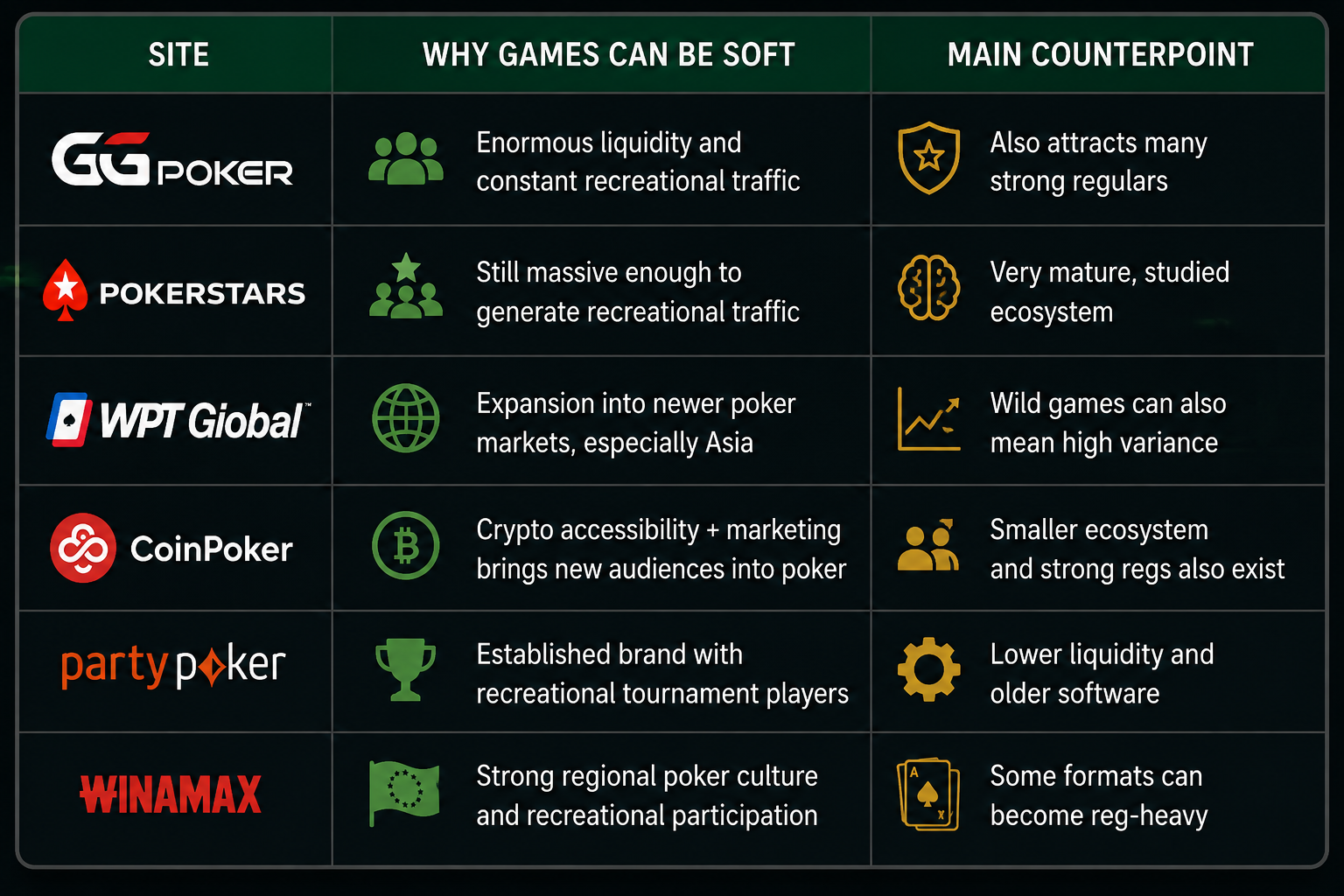
GGPoker can be highly profitable because huge liquidity brings many recreational players, even while strong pros are present. PokerStars can feel tougher because it is a more mature and filtered ecosystem, though that does not mean all games are hard. WPT Global can offer wild and profitable spots because newer markets often create less standardized play. partypoker can still be playable because smaller traffic does not automatically mean bad games. CoinPoker can draw a different audience into poker, which changes behavior but also depends on liquidity. Winamax and other regional pools can be attractive when local recreational traffic is healthy, but they can also become regular-heavy in certain windows.
That is why I do not like simple rankings. A room can be soft on Sunday evening and hard on Tuesday morning. It can be soft in low-buy-in tournaments and tough in mid-stakes cash. It can be soft during a live festival crossover and tighter a month later. The answer moves.
If I had to reduce all of this to one working rule, I would say this: look for ecosystems that keep attracting new and casual players, then narrow that search to the formats and time windows where those players actually show up.
The best poker players don’t just ask where the softest games are. They understand why games become soft.
Player pools change. Markets mature. New players arrive. Professionals migrate. Promotions bring recreational traffic. Regulations reshape entire ecosystems.
So instead of searching for one permanently soft poker site, learn to recognize the conditions that create soft games.
The softest poker ecosystem is often the one bringing new recreational players into the game faster than experienced players can extract them.