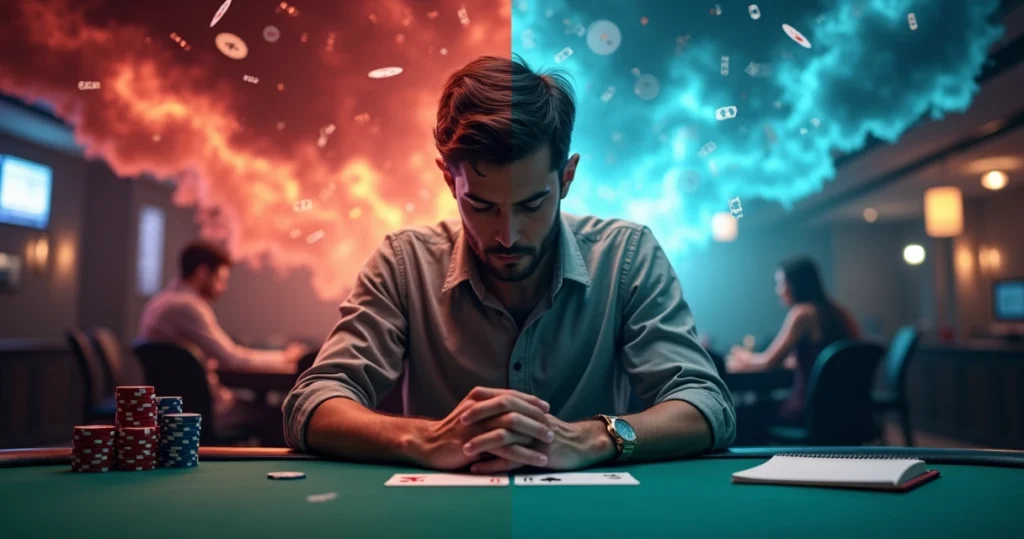
I have seen many poker players make the same mistake. They believe that one day, if they study enough and get good enough, they will stop tilting. They picture the great players as calm machines who no longer get angry, rushed, scared, or offended by bad beats. I do not think that picture is real.
The biggest myth about Poker Tilt is not that it exists, but that strong players eventually become immune to it.
They do not. They just get better at catching it early.
That difference changes everything. If I expect myself never to lose emotional control, I will judge every bad reaction as failure. But if I see tilt as part of poker, I can start working on the real skill, which is shortening the distance between emotional trigger and mental recovery.
Tilt is a process.
In my experience, that process rarely starts with the obvious explosion. It starts a few hands earlier. A call feels a bit faster. A fold feels more annoying than usual. I begin to think about fairness. I stop asking what the best play is and start asking why this keeps happening to me. That is the shift.
Why immunity is the wrong goal
One of the best ways I have found to think about this comes from Jared Tendler’s A-Game, B-Game, and C-Game model. It is simple, and because of that, it stays useful.
My A-Game is when I am clear, patient, and accurate. My reads are sharp. My decisions follow logic. My B-Game is still solid, but not as clean. I may miss small spots, rush a close river choice, or feel a little friction after losing a pot. My C-Game is when emotion starts driving the session. I force thin bluffs, chase losses, and react instead of think.
No player performs at their A-Game all the time, and no player fully removes emotional disruption from poker.
That is why the dream of becoming immune to tilt is so harmful. It sets a false standard. Poker is too uncertain, too public, and too punishing for that. You can make the right move and lose. You can get all the money in good and still feel sick when the river falls. You can play well for three hours and then one hand changes your whole state.
What separates long-term winners is not perfect emotional control. It is the speed of recognition. They notice when they are slipping from A-Game to B-Game. They notice when B-Game is becoming C-Game. Then they interrupt the slide.
What tilt does to the mind
I think Daniel Kahneman’s ideas from Thinking, Fast and Slow explain this better than most poker advice does. He describes two modes of thought. System 1 is fast, automatic, emotional, and reactive. System 2 is slower, more effortful, and more logical.
At the table, both systems matter. Routine spots often need quick pattern recognition. But when I tilt, System 1 starts taking over in the worst way. It becomes less about useful instinct and more about emotional autopilot. I stop processing the hand in full. I jump to action.
Tilt pushes players toward automatic decisions, and recovery begins when logic gets invited back into the hand.
This is why a tilted player often says, “I do not know what I was thinking.” In many cases, he was barely thinking in the reflective sense. He was reacting. The mind narrowed. The need to win the pot, punish an opponent, or erase a loss became stronger than the process of good decision-making.
I have felt this in very ordinary spots. Nothing dramatic. Just a turn decision where I suddenly wanted the hand to be over. That urge alone told me something was wrong. I was no longer choosing from strategy. I was choosing from discomfort.
Great players build habits that bring System 2 back faster. Not forever. Not perfectly. Just faster.
How the slide usually begins
I rarely see tilt arrive as one event. Most of the time it unfolds in stages. The trigger can be a cooler, a bluff that gets snapped off, a misread, a long losing stretch, or even fatigue. But the event itself is only the start. The real danger is the chain reaction that follows.
These are common early shifts I watch for in myself:
- I start thinking about recent results during a hand.
- I feel a need to win chips back soon.
- I stop enjoying close decisions and start resenting them.
- I click faster preflop and justify it after.
- I pay more attention to one opponent than to the full table.
- I want to prove a point.
Early warning signs matter because by the time full tilt is visible, several bad decisions have often already happened.
That is why I do not like advice that focuses only on the final explosion. By then, the mind is already deep in reaction mode. The better question is this: what did I feel ten minutes before I punted?
When I review my sessions, that is often where the answer lives.
 Recovery is a skill
I think the most useful mental shift is this one. Instead of asking, “How do I never tilt?” I ask, “How do I recover one step sooner?” That question is practical. It can be trained.
There are several methods that help me interrupt emotional momentum before it becomes expensive:
- I use the time bank on spots where I feel heat, even if the decision looks simple.
- I slow down every action for a few hands after a painful pot.
- I take a short break when my body feels restless or rushed.
- I reset my attention to ranges, stack sizes, and position instead of results.
- I mark emotionally charged hands to review later, not to relive them.
None of these methods are dramatic. That is why they work. They create a bridge back to clearer thinking.
The goal is not to suppress emotion on command, but to stop emotion from making the next decision for you.
The time bank is a good example. Many players think of it as a technical feature. I think of it as a mental tool. A few extra seconds can create enough space to notice what is happening inside my head. Am I counting combos, or am I trying to win this pot because the last one hurt? That pause can save a session.
Short breaks help for the same reason. I do not mean long dramatic exits every time I lose a flip. I mean a real reset. Stand up. Breathe. Let the adrenaline drop. The break is not to avoid poker. It is to return with choice.
If you want more practical ideas, I think this piece on recognizing and reducing poker tilting patterns fits well with this mental approach.
Why post-session review matters more than in-session emotion
I used to judge my emotional hands only by the result. If the bluff worked, I called myself brave. If it failed, I called myself tilted. That is a terrible method.
You cannot measure mental quality by whether the pot came your way.
The better way is to review the hand after the session and ask cleaner questions:
- What was I feeling before the action?
- Did I follow my normal process?
- What options did I ignore?
- Was I responding to the hand, or to the pain of the previous hand?
- Would I make the same play in a calm state?
This is where a tool like Check Replay becomes very useful. I like that I can revisit emotionally charged hands in a clean format, share them with a coach or study partner, and separate process from outcome. When I can replay a hand without the noise of the moment, patterns become easier to spot. I see that my river jams after bad beats are not random. I see that my too-fast calls come after frustration, not logic.
That kind of review has real value because it turns vague emotion into visible habit. Then I can work on the habit.
I also think many players miss the link between tilt and memory. During a rough session, I may tell myself a story like, “I always do this after a cooler.” But when I check the actual hands, the pattern is often narrower. Maybe it only happens when I am tired. Maybe it only appears after I lose a big bluff. Check Replay helps make that difference visible, and that matters when I am trying to improve instead of just blame myself.
 From awareness to shorter episodes
I once played a session where I lost a standard all-in, then another, then misplayed a turn in a hand I usually handle well. Years ago, I would have kept going and called it “fighting through it.” This time I noticed something smaller. I had stopped asking one simple question before acting: what is my opponent representing?
That was enough. I sat out, took a short break, and came back calmer. I still felt annoyed. I did not become peaceful in two minutes. But the episode ended sooner. That is progress.
Too many players think recovery only counts if the bad feeling fully disappears. I do not agree. If I can feel irritated and still rebuild a sound process, that is a win. Emotion may linger. Decision quality can still improve.
This is why long-term winners are not the players who never lose control for a moment. They are the players who cut short the damage. They return to their decision framework faster. They move from reaction back to thought with less waste.
If this topic speaks to where your game is right now, I think this article on how to handle tilt in poker with a clearer process is a good next step.
Conclusion
You will tilt playing poker. I will too. That is not a sign that we are weak, unprepared, or not serious enough. It is part of a game that mixes uncertainty, skill, money, ego, and time pressure. The mistake is not feeling that reaction. The mistake is expecting to outgrow it forever.
The real edge is not avoiding every emotional spike, but recognizing it earlier and shortening how long it controls your decisions.
When I think in terms of A-Game, B-Game, and C-Game, I stop chasing perfection and start tracking recovery. When I think in terms of System 1 and System 2, I understand why bad states feel so fast and why deliberate pauses matter so much. And when I review difficult hands instead of judging them by the river card, I give myself a fair chance to improve.
If you want to study your own emotionally charged spots with more clarity, get to know Check Replay and use it to review the hands that pull you away from your best decisions.
Frequently asked questions
What is tilt in poker?
Tilt in poker is an emotional state that harms decision-making. It often starts after frustration, anger, fear, or stress, and it pushes a player away from sound strategy and toward reactive choices.
How can I avoid going on tilt?
I do not think anyone can avoid it every time. What helps is catching it early. Use your time bank, slow down your decisions, take short breaks, and watch for signs like rushed clicks, revenge thoughts, or a strong need to win losses back fast.
Why do poker players experience tilt?
Poker creates emotional pressure because good decisions can still lose. Variance, fatigue, ego, time pressure, and unfair-feeling outcomes can all trigger frustration. That frustration can move a player from logical thinking into automatic emotional reactions.
What are signs of tilt in poker?
Common signs include playing faster than normal, forcing action, thinking about recent losses during hands, trying to punish opponents, ignoring standard logic, and feeling unable to let a bad pot go mentally.
How do professionals deal with tilt?
Professionals do not become immune to tilt. They build recovery habits. They notice early warning signs, pause with the time bank, step away when needed, and review hands after sessions to find patterns. Tools like Check Replay can help with that review by making emotional hands easier to revisit with a clearer mind.