When I first started studying postflop poker, I remember how often I would second-guess my decisions. Was my call profitable? Did my bluff make sense? Over time, I found that understanding equity versus range changed the way I approached almost every spot. In this article, I’ll guide you through what “equity vs. range” means, why it matters, and how tools like Check Replay can help you use this concept for better postflop choices.
What does equity vs. range actually mean?
If I could explain this to my past self, I’d say: your equity is your probability of winning the pot, given all possible future community cards, against the hands your opponent might have. But the catch is, you rarely know exactly what your opponent holds. Instead, you put them on a “range”—the set of hands they could logically have based on the betting so far.
The key insight is that your decisions should weigh your hand against your opponent’s possible range, not just against one hand or the board alone. In practice, I’m always comparing my hand’s equity to the likely range of my opponent when deciding whether to bet, check, call, or fold.
Equity isn’t a fixed number—it changes with every action and every new card dealt.
Why it’s smarter to think in ranges, not hands
When I used to play “by feel,” I’d put my opponent on a specific hand—something like Ace-King, or maybe a missed flush draw. But this is limiting. Experienced coaches and tools like Check Replay show that players make more informed choices when they shift to range-based thinking.
- Range analysis forces you to consider all reasonable hands your opponent can have, not just the obvious ones.
- This perspective helps you avoid costly mistakes, like folding when you’re actually ahead of most of their possible holdings.
- It helps you spot profitable bluffs, because you see when your opponent’s range is weak.
- It becomes much easier to review hands, either alone or with a coach, when you think in terms of ranges.
I noticed the biggest jump in my results not from learning more fancy plays, but from building better range estimates and comparing my equity to them.
How to put your opponent on a range
Assigning a range is part art, part science. I usually start the process well before the flop, watching for patterns and betting sequences. Here’s a checklist I follow on most hands:
- What hands make sense given preflop actions? If they raised from early position, their range is likely tighter than from the button.
- What does their bet size tell you? Small bets sometimes cap a range, while big bets can be polarizing.
- Has their betting been consistent with strong or weak hands so far?
- What have you seen them show down in the past? Any recognition of patterns is valuable.
The more you review hands, say with a hand history review tool or replayer like Check Replay, the faster your range-assigning skills improve. I try to practice this actively by pausing and asking, “What are all the hands that could make sense here?”
Equity: turning percentages into decisions
Equity tells you your share of the pot if all cards were dealt and all bets went in. In practical terms:
- If your hand has 70% equity versus a range, you’re ahead far more often than not. This would often call for a value bet.
- If your hand only has 20% equity versus their range, it’s time to think about bluffing or folding—unless you have the right odds to continue.
- When at a decision point, compare your equity to the pot odds. If your equity is higher, calling or raising is profitable in the long run.
- For a river bet to be profitable, you need at least 50% equity against the portion of your opponent’s range that will call your bet.
Sometimes, a spot that feels “close” becomes clear when you run the numbers and see that your flush draw, for example, only has 32% equity against their made hands range—and you’re getting 2-to-1 on a call.
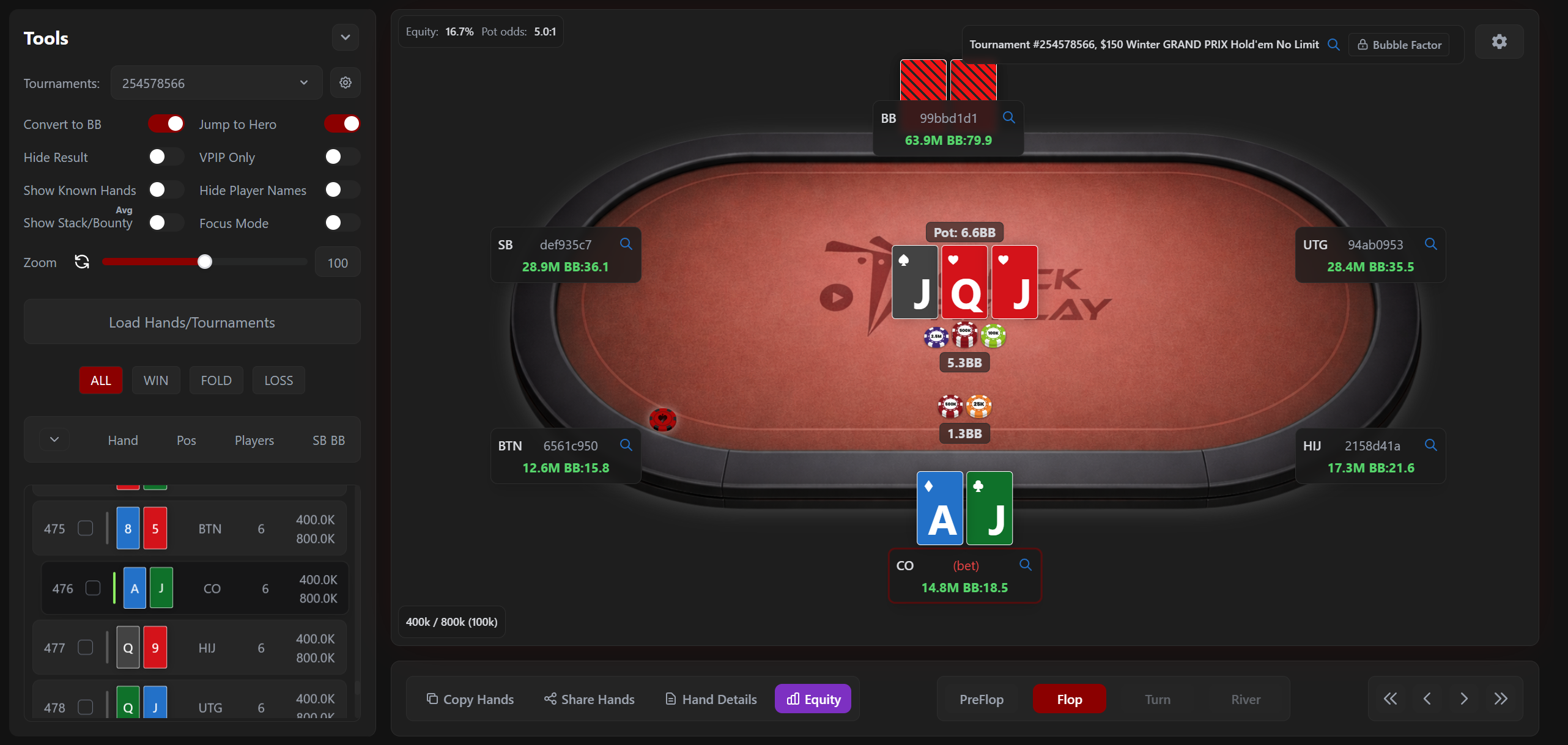
Putting equity vs. range into practice in postflop spots
Let’s break down how I use equity versus range in a real hand review.
Suppose I have Ace-Ten of hearts on a board of Ten-Seven-Two rainbow, facing a bet. I put my opponent on a range of overpairs, some top pairs like Ace-Jack, some bluff hands, and perhaps slow-played sets.
Using a range calculator or a replayer’s built-in tools (I like how Check Replay provides fast hand history uploads and visualizations), I quickly see my hand has about 68% equity against this range. That tells me calling or raising may often be winning plays here.
But what if the turn was a King? Now my equity may drop, as some of their overcards hit top pair, and their range shifts. By recalculating at each street, I can choose the best path—whether to check-call, bet for value, or even fold.
Reviewing hands with equity in mind after the session is a habit that helped me plug leaks faster than almost anything else. Sometimes, I’d look back and see I misjudged an opponent’s range, and with tools like Check Replay, I could even share the hand for instant feedback from friends or coaches via the instant hand link feature.
Common mistakes when learning equity vs. range
In my experience, most players trying to apply this concept early on fall into a few traps:
- They use too narrow or too wide a range as a baseline, missing key hands in their opponents’ holdings.
- They forget to adjust the range after new actions or board cards.
- They rely on gut feeling instead of checking the numbers, even when the math is clear.
One post I found helpful on this topic is in the strategy section of Check Replay’s blog. Taking time to read and apply these ideas made a real difference in my decision quality.
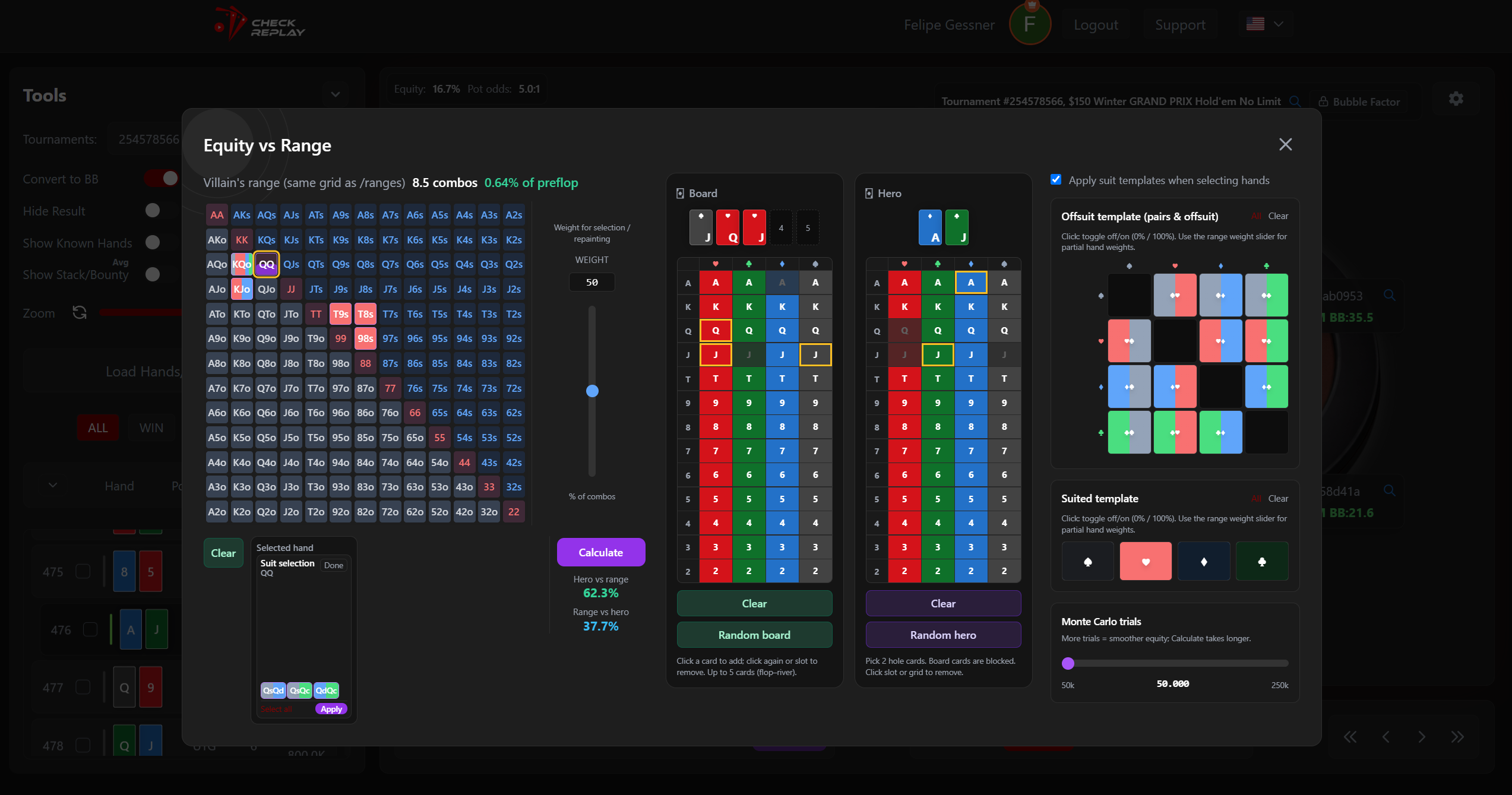
How to use Equity vs Range on Check Replay
When you select the “Equity” button on Check Replay, you can define a range for your opponent. The board and your hand are automatically populated, allowing you to instantly evaluate your equity against your opponent’s range.
Putting it all together with regular review
I found it most helpful to set aside time after each session to review hands—not just the biggest wins and losses, but any spot where I felt uncertain. Platforms like Check Replay let me move quickly from uploading a hand, to seeing player stats, to sharing an analysis link with a mentor, coach, or study group.
There’s an entire section on poker fundamentals in the Check Replay blog. Skimming through there gave me fresh perspectives. When reviewing, I ask:
- Did I accurately estimate ranges, or was I influenced by emotion?
- How did my actual hand equity change after each bet?
- Could I have played the spot more profitably knowing the numbers?
For even more practical examples, see their article on using equity in hand reviews, which includes case studies and example breakdowns that I found easy to follow.
Conclusion: Turn knowledge into results
Every winning player I’ve met thinks about equity versus range, rather than “what does he have right now?” I learned that the more often I practice this skill, the more second nature it becomes, and poker feels less stressful and more logical. If you’re ready to start using these ideas, check out the tools and learning resources at Check Replay—it’s where I refined my process, and it could be the spark for your next jump in results. Review, estimate, and learn, and see your postflop decisions get sharper with every session.
Frequently asked questions
What is the difference between equity and range?
Equity measures your percentage chance to win the pot in a hand, while range refers to the full set of possible hands an opponent could hold based on their actions so far. We use equity versus range analysis to compare our hand’s winning chance against this group of possible holdings, rather than against a single specific hand.
How do I calculate my hand equity?
To calculate equity, you start by identifying your hand and estimating your opponent’s range. Then, using a tool (like the calculators in Check Replay), you enter both and get a percentage—this is your hand’s share of the pot if all cards were dealt out. You can do this step-by-step after each community card is revealed.
When should I use range analysis?
I use range analysis on almost every decision after the flop, especially when facing a bet or considering a big value bet or bluff. Whenever you find yourself asking, “Am I ahead here?” or “Can they call with worse?” it’s a perfect spot to think in terms of ranges, not just single hands. Slow down in major pots and put extra effort into this process.
Is it worth it to study poker ranges?
Absolutely. Studying ranges is one of the fastest ways to improve your long-term results at the poker table. It helps you make better calls, folds, and bluffs, and it also makes your game more balanced and tougher for others to read. I found that consistent range practice paid back almost immediately.
What are the best tools for range analysis?
My go-to for reviewing and comparing ranges is Check Replay. It allows easy uploading, visualization, and sharing of hands, and includes built-in range, equity, and odds tools. With instant sharing features and deep integration with major poker sites, it works well whether you’re a new player, a pro, or a coach. For practical tips, the example hand breakdowns in their blog can help bring the numbers to life.
Ready to analyze your own hands?
Upload a hand on Check Replay and calculate your equity vs range in seconds.